
Tomatoes in Australia: when to plant, varieties and fixes
Tomatoes are killed by frost and stall in cold soil, so the right month depends on where you live. Most Melbourne gardeners plant out from Cup Day in early November. Sydney and Perth plant seedlings out in September and October. South East Queensland and the Northern Rivers get two windows a year, and in Darwin and North Queensland tomatoes are a dry season crop. This page gives the months for all ten regions, the varieties that suit each climate, the basics in short, a finder for what has gone wrong, and what to do with the glut.
Updated 19 October 2026. Planting months: Planting Season's regional planting data for the ten Australian climate regions.
On this page: When to plant Frost, soil and heat Varieties by climate The basics What is wrong with my tomato? Saving seed Preserving the crop All tomato guides Questions
When to plant tomatoes in each region
The sow months in this table are taken straight from our regional planting data. Plant out means putting seedlings into the garden once frost has passed and the soil is warm, and the wording comes from the regional notes in the same data. First fruit is our own calculation: our plant data gives about six weeks in the tray and then about 10 to 12 weeks from planting out to the first pick, so we have added those to each region's plant out dates. In South East Queensland, the Northern Rivers and North Queensland the data gives sow months only, so plant out is taken as about six weeks after sowing.
| Region | Sow (calendar data) | Plant out | First fruit (calculated) |
|---|---|---|---|
| South East QueenslandSubtropical. SEQ guide, Brisbane guide | February to April, and August to September | About six weeks after sowing | Autumn sowings: late May to early September. Spring sowings: late November to early February. |
| Northern Rivers NSWSubtropical. Northern Rivers guide | February to April, and September. Hinterland frost pockets wait until mid September. | About six weeks after sowing | Autumn sowings: late May to early September. September sowings: late December to early February. |
| Sydney and coastal NSWWarm temperate. Sydney guide | July to September, with seed started indoors in July and August | September and October, once frost risk has passed | Mid November to late January |
| Melbourne and VictoriaCool temperate. Melbourne guide | October to December, with seed started indoors in August and September | From mid October (inner city and bayside), from Cup Day for most suburbs, late November in the Hills, once soil passes 16°C | Late December to late February |
| Adelaide and SAMediterranean. Adelaide guide | August to November, with seed started undercover in August and September | From mid October, once frost has passed and the soil reaches 16°C | Late December to late February |
| Perth and WAMediterranean. Perth guide | July to September, with seed started indoors | From mid September on the plain, in October in the Hills | Late November to late January |
| TasmaniaCool temperate. Tasmania guide | September and October, with seed started indoors in September | After the last frost in early October | Mid December to early February |
| Canberra and ACTCool highlands. Canberra guide | October and November, with seed started indoors or under cover in October | After the last frost in early November, once Melbourne Cup Day has passed | January to early March |
| North QueenslandTropical wet and dry. North Queensland guide | April to September, the dry season (April and May are the bridge months) | About six weeks after sowing | From late July for April sowings. Late sowings ripen as the wet season builds, so heat tolerant varieties are essential. |
| Darwin and Top EndTropical wet and dry. Darwin guide | April to July, the dry season only | Seedlings go out in June and July | August to October |
Those are regional midpoints. A frost pocket, a slope or a sheltered wall can shift your own dates by weeks. Put your postcode into the frost dates lookup or find your growing region if you are between two regions.
How the regions group
The cool south: Melbourne, Tasmania and Canberra. The warm season is short, so the job is to raise sturdy seedlings indoors and then wait. Our Melbourne data describes a warm season from October to April, with the last spring frost in mid to late September in the outer suburbs. Canberra's last frost is around 1 November and its first autumn frost from about 10 April, which leaves a warm window of only about five months. Tasmania's warm months run from November to March. Hobart city is often frost free from late August, with postcode records giving a median last frost of 28 August and a safe planting date from 19 September in nine years out of ten, but the regional calendar says early October because inland and higher country can frost later.
The temperate middle: Sydney, Adelaide and Perth. Sydney's cooler spring soil holds warm crops back by two to four weeks compared with South East Queensland. Adelaide and Perth have the opposite problem, with December to February heat of 30 to 40°C, so tomatoes there have to be established and setting fruit before summer arrives. That is why both calendars start in July or August and plant out in September or October. In Perth, advanced seedlings planted in late February sit outside the calendar and only succeed on the frost free plain, most reliably on the Coastal Strip.
The subtropical east: South East Queensland and the Northern Rivers. There are two windows. Our data note says the autumn sowing (February to April) dodges peak fruit fly and humidity, and the spring sowing (August to September) gives a summer crop. Fruit fly exclusion bags or netting are essential from December to March. On the Northern Rivers the coast matches South East Queensland, but the hinterland and the Lismore basin get cooler nights and light frost, so wait until mid September for the spring sowing.
The tropical north: North Queensland and Darwin. Tomatoes are a dry season crop. In Darwin the data is blunt: wet season sowings fail. Plant so that fruit sets before the build up. The Northern Territory Government says the same, recommending late April to July, with fruiting between May and October.
The logic behind the months: frost, soil and heat
- Frost. Tomatoes are frost tender in our plant data, and the Queensland Government's tomato information kit says they are susceptible to frost damage at every stage of growth. Plant out after your last frost, not before.
- Soil temperature. Plant out once the soil is consistently above 16°C. Our Melbourne and Adelaide data both use that figure, and cold soil stalls tomatoes for weeks. Seed germinates best warm: our plant data gives 18 to 30°C and the Queensland kit gives 20 to 30°C, slowing sharply below 15°C. A heat mat or a warm spot is worth the effort.
- Heat. Flowers drop without setting fruit when days pass about 30°C, nights stay above about 21°C or nights fall below about 13°C. The Queensland kit puts the best fruit set at 18 to 24°C and says set falls off below 10°C or above 27°C. The two sources differ by a few degrees, so treat 27 to 30°C as the zone where flowering starts to fail. Fruit sets again when the weather eases.
- Time. Raise seed in warmth about six weeks before planting out, and expect the first pick about 10 to 12 weeks after planting out. The Queensland kit breaks the same stretch into three to four weeks from planting to first flower and six to eight weeks from flower to harvest.
- Why two windows in the subtropics. Midsummer heat and wet bring flower drop, splitting and disease. Planting in late summer to autumn and again in late winter to spring keeps the fruit away from the worst of it.
Choosing varieties by climate
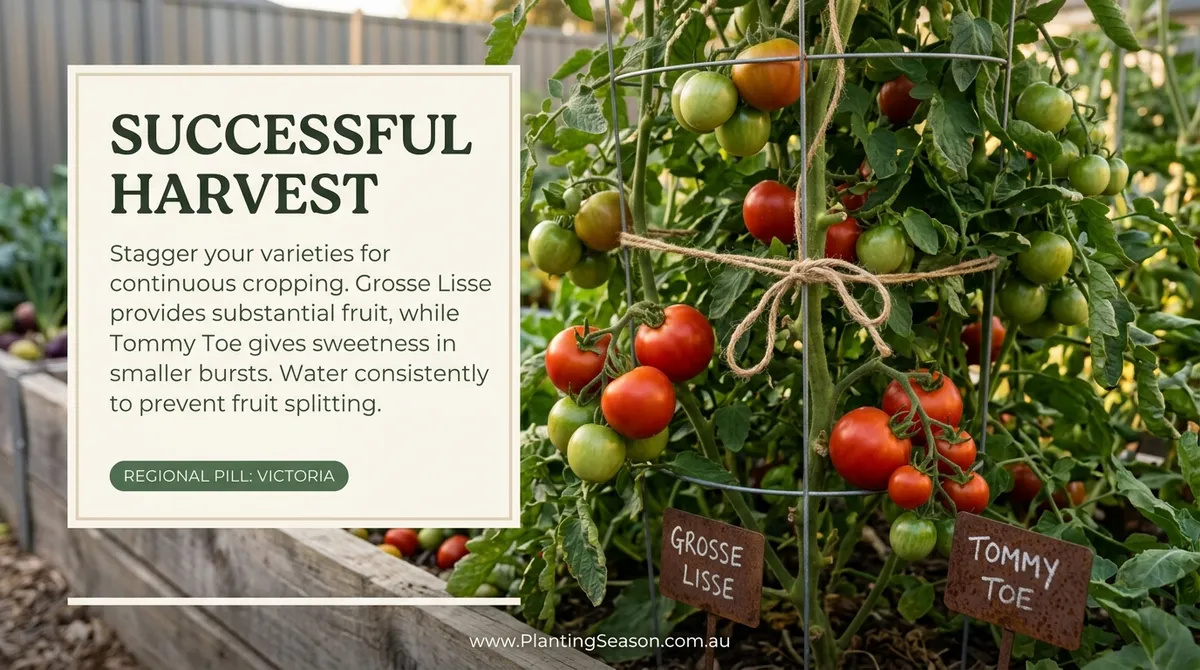
There is no single best tomato. What matters is how many days the variety needs against the length of your warm season, and whether it is a tall type or a bush type. Tall (indeterminate) types such as Grosse Lisse and Black Russian keep growing and fruiting all season and need tall stakes. Bush (determinate) types such as Roma grow to a set size and fruit in one main flush. Our complete growing guide has a picker with more than 20 varieties and their days to maturity. Where we quote days below, they come from that table.
Cool south: Melbourne, Tasmania, Canberra
Short season gardeners should lean on early types of 65 to 75 days: Tommy Toe (70 days), Sungold (65), Mighty Red (70) and Money Maker (75). Our Tasmania data names Stupice and Tommy Toe, and notes that a greenhouse lifts yields. Melbourne has more room. Grosse Lisse (80 days) is the reliable classic, Rouge de Marmande suits cool temperate gardens and ripens into late autumn, and Black Krim (80) and Brandywine (90) do well if they go in early in the warmest spot you have. Canberra and Tasmania are marginal for Brandywine, so treat it as a bonus beside an early cherry. Our take: in Hobart and Canberra, plant the early cherry first, because it is the one that is certain to ripen. Read the cherry tomato guide for the sweet ones.
Temperate: Sydney, Adelaide, Perth
Grosse Lisse is reliable in every region over a long season, and Tommy Toe keeps cropping when the weather swings. Add a Roma or other paste type if you want sauce, because the whole crop ripens in a concentrated flush. In Adelaide and Perth the aim is fruit set before the January heat, so favour varieties in the 65 to 80 day range and plant on the early side of the window. The Roma guide and the paste tomato guide cover the sauce types. In Perth, also read the psyllid entry in the problem finder below.
Subtropical: South East Queensland and the Northern Rivers
Our plant data lists five that suit the region: Tommy Toe (an Australian heirloom cherry, so fast that fruit fly often cannot keep up), Grosse Lisse, Roma, Black Russian (best from the autumn sowing) and Apollo Improved, a modern disease resistant slicer that handles humidity better than most and makes a good first tomato. Cherry types are less affected by fruit fly than large fruit. Our take: if you only plant one window, make it autumn. It dodges the peak of fruit fly and humidity, and that matters more than the extra weeks of summer warmth.
Tropical: North Queensland and Darwin
Heat tolerance is essential. The Northern Territory Government lists Summer Taste, Scorpio, Tracer, Grosse Lisse, Futura and cherry types as varieties that grow well there, and notes that tomatoes can be grown outdoors in winter and in shadehouses in summer. Several of those are commercial hybrids that nurseries may not stock, so ask what your local nursery has been selling through the dry season. Cherry types are the easiest buy. The Queensland kit adds that fruit can ripen orange or yellow above about 22°C when it is exposed to direct sun, so keep the leaf cover on and prune lightly.
Pots, balconies and small gardens
Choose compact types. Tumbling Tom is bred for hanging baskets, Patio is a full-flavour slicer on a tidy plant, Mighty Red and Roma stay compact, and Tommy Toe is a productive cherry for a large tub. A full-size tomato needs a pot at least 40 cm wide and deep (about 40 litres), while dwarf and bush types can go in 30 cm. Skip tall beefsteaks unless you have a very big container and a strong stake. Potted tomatoes need watering daily in hot weather. The tomatoes in pots guide has the full method.
Heirlooms, bush tomato and tomatillo
The Cherokee Purple guide covers the dusky heirloom beefsteak. Two plants are tomato lookalikes rather than tomatoes. Bush tomato (desert raisin, Solanum centrale) is a desert native that dries on the bush, and our bush tomato guide and bush tomato plant page cover it. Tomatillo is a warm season relative that needs at least two plants to set fruit: see the tomatillo guide and plant page.
Planting, staking, feeding and watering in short
- Sun and soil. Full sun, 6 to 8 hours a day, in rich, free draining soil with a pH of 6.0 to 6.8. Dig in compost and well rotted manure a week or two before planting.
- Spacing and rotation. Plants 60 to 70 cm apart. Do not plant tomatoes where tomatoes, potatoes, capsicums or eggplants grew in the last three years, because they share soil borne diseases.
- Stake first. Push in a 1.8 to 2 m stake or cage at planting, so you never damage roots later. Tie the stem loosely as it grows. The trellis and support guide compares the options.
- Plant deep. Remove the lowest leaves and bury part of the stem. Roots grow along it. Water in, then mulch with straw or lucerne, keeping the mulch a little away from the stem.
- Prune tall types. Pinch out the side shoots between the main stem and a leaf, keeping one or two main stems. Bush types need no pruning. See how to prune tomatoes.
- Water deep and even. Water at the base so the soil is wet 20 to 30 cm down. In mild weather that is once or twice a week, in hot weather two or three times a week, and every day for pots. Irregular watering is the main cause of blossom end rot and split fruit. The watering guide and mulching guide have the detail.
- Feed lightly. Too much nitrogen gives big leafy plants with little fruit. Once flowers appear, feed every three to four weeks with a liquid fertiliser higher in potassium, such as a tomato food, or fish emulsion with added potash. See the fertilising guide.
- Help the bees. Tomatoes pollinate themselves with wind, but buzz pollination by bees, especially native blue-banded bees, noticeably lifts fruit set and size. Flowers nearby help, and our bee friendly vegetable garden guide has ideas.
- Companions and clashes. Basil, marigold, borage, parsley, carrot and chives all sit well beside tomatoes. Keep potatoes well away (they share late blight), and give fennel and brassicas their own beds. Read more in the companion planting guide.
Starting from seed instead of buying punnets gives you far more varieties for the price. The growing tomatoes from seed guide has a sowing calculator, and the seed raising guide covers mix, warmth and light. Leggy seedlings can be planted deep, and the leggy seedlings fix explains how.
Plant tomatoes in the right month for your region
The free app shows what to sow now in your region, sets reminders and tracks your harvest. No card needed.
Open the free app →What is wrong with my tomato?
Find what you can see, then take the mildest step first: remove the affected part, tidy up, water evenly, or keep the pest off with netting. Sprays come last, and only products registered for tomatoes in home gardens, used exactly to the label with the withholding period respected. Check that your crop is listed before you buy.
| What you see | Usual cause | First move | Read next |
|---|---|---|---|
| On the fruit | |||
| A dark, sunken patch on the bottom of the fruit | Blossom end rot, from uneven watering, not a germ | Water deeply and regularly and mulch. In very acid soil, add a little lime or dolomite before planting. | Blossom end rot guide, pest page |
| Skin splits or cracks, often after rain | Dry soil followed by heavy water, so the fruit swells faster than its skin | Water evenly and mulch. Pick ripe fruit before a big downpour. | Why tomatoes split |
| Small sting marks, soft rotten patches, maggots inside | Fruit fly (Queensland fruit fly in the east, Mediterranean fruit fly in Western Australia) | Net plants or bag trusses once fruit sets, pick at first colour and ripen indoors, and bin stung or fallen fruit. A registered protein bait helps, used to the label. | Fruit fly page, fruit fly control, fruit fly tracker |
| Neat round holes in green fruit, with a caterpillar inside or nearby | Tomato grub (heliothis) | Hand pick the caterpillars and check the plant every few days. | Caterpillars |
| White or yellow papery patches on the sunny side of the fruit | Sunscald | Keep the leaf cover on and put up shade cloth in heatwaves. | Sunscald guide |
| Fruit ripening orange or yellow in hot weather | Fruit above about 22°C in direct sun, worse where leaf cover is thin | Prune lightly and shade the plant in heatwaves. | How to prune |
| Fruit pecked or taken from the plant | Birds and possums | Pick at the first blush of colour and ripen fruit on the kitchen bench. Net the plants if it keeps happening. | Birds, possums |
| Flowers | |||
| Flowers fall without making fruit | Heat (days over about 30°C, nights over about 21°C), cold nights under about 13°C, too much nitrogen or water stress | Shade in heatwaves, hold back nitrogen and keep water even. Fruit sets again when the weather eases. | Flowers but no fruit, blossom drop in heat |
| On the leaves | |||
| Leaves curl or roll upward | Usually a stress response to heat, wind, uneven water or heavy pruning, and harmless. Severe curling with yellow, stunted, distorted new growth may be a virus. | Check watering, mulch and ease off the pruning. Remove and bin any plant with distorted new growth. | Why leaves curl, mosaic virus |
| Brown spots with target rings on older, lower leaves | Early blight | Remove affected leaves, mulch to stop soil splashing up, water at the base and rotate the bed next year. | Early blight, blight guide |
| Large, greasy, grey green patches that spread in days in cool, wet weather | Late blight | Bag affected plants and bin them, never compost them. Protect healthy plants before wet weather with a registered copper product, used to the label. | Late blight, blight guide |
| Many small dark spots on leaves after wet weather | Bacterial spot or leaf spot, both spread by splashing water | Remove spotted leaves and water at the base, not over the foliage. | Bacterial spot, leaf spot |
| Yellowing lower leaves | Old leaves ageing, a nitrogen shortage, or disease | Remove yellow leaves touching the soil. Pale lower leaves can point to a nitrogen shortage, so feed lightly. | Yellow leaves on veg |
| Mottled, crinkled or mosaic leaves and stunted growth | Virus | Remove and bin the plant, not the compost. There is no cure, and controlling aphids and whitefly slows the spread. | Mosaic virus |
| A cloud of tiny white insects flies up when you brush the plant, and leaves are sticky or sooty | Whitefly, then sooty mould on the honeydew | Hose or vacuum adults off in the cool of the morning, hang yellow sticky traps and bin badly infested lower leaves. | Whitefly, sooty mould |
| Leaves grazed into lace, with spiny yellow larvae | 28-spotted ladybird (a pest, unlike most ladybirds) | Hand pick the larvae and adults. | 28-spotted ladybird, good bugs and bad bugs |
| Lower stems and leaves turn bronze and dry from the bottom up in hot, dry weather | Tomato russet mite | Cut off and bin badly affected growth early and keep water even. | Tomato plant page |
| The whole plant | |||
| Leaves yellow and wilt, often on one side of the plant first | Fusarium wilt or verticillium wilt, both soil borne | Pull and bin the plant, including as much root as you can, and keep it out of the compost. Rotate the bed and choose varieties with V and F resistance codes on the label. | Fusarium wilt, verticillium wilt |
| A stunted plant with knobbly, swollen roots, worst in sandy soil | Root-knot nematodes | Rotate beds. French marigolds grown thickly in the bed beforehand can reduce them. | Nematodes |
| Young leaves yellow and roll upward and plants stunt (Perth and south west WA) | Tomato potato psyllid, established in Western Australia since it was first found in Perth in early 2017. Its nymphs sit on the shaded undersides of leaves. | Check leaf undersides for tiny nymphs, remove badly affected plants and look up the Department of Primary Industries and Regional Development (DPIRD) advice for gardeners. | Tomato plant page |
| Seedlings | |||
| Seedlings pinch and collapse at soil level | Damping off, in cool, wet, crowded conditions | It cannot be cured. Sow into seed raising mix, keep it moist rather than soggy and take the cover off once seedlings emerge. | Damping off, tomatoes from seed |
| Seedlings cut off at the base overnight | Cutworm | Put a collar of cardboard around each seedling stem, and search the top few centimetres of soil at dusk for curled caterpillars. | Cutworm |
| Seedlings chewed with silvery trails | Slugs and snails | Hand pick after dark with a torch and clear hiding spots near seedlings. | Slugs, snails, slugs and snails guide |
Other pest pages that list tomato among the plants affected: aphids, anthracnose, botrytis (grey mould), leaf miner, mealybug, spider mites and thrips. The full pest and disease library and the pest calendar show what turns up in which month, and the pest management guide sets out the order of fixes.
Saving tomato seed
Tomatoes are among the easiest seeds to save. They pollinate themselves before the flower even opens, so they come true to type with no isolation from other varieties. The catch is the variety. Heirloom and other open pollinated tomatoes grow the same as the parent, while seed from F1 hybrids does not, so check the packet for F1 or hybrid before you bother.
- Let the fruit go fully ripe on the plant, past the eating stage, and pick it from a healthy plant.
- Scoop the seed and pulp into a jar with a splash of water and leave it on the bench for two or three days, until a layer of mould forms on top and the good seed sinks.
- Pour off the mould, pulp and floating seed, then rinse the seed that sank in a sieve until it is clean. The ferment also kills some seed borne diseases.
- Spread the seed on paper out of direct sun until it is bone dry, which takes a week or two. Label it with the variety and the year.
- Store it in paper envelopes inside an airtight jar in a cool, dark cupboard. Tomato seed keeps for about four to five years, and a damp paper towel germination test tells you whether older seed is still worth sowing.
Saving seed for your own garden and for sharing is legal for open pollinated varieties. The exception is a variety protected by Plant Breeders Rights, which cannot be propagated for sale without a licence. The seed saving guide covers the rest, including why a cucumber or pumpkin needs far more care than a tomato.
Preserving the crop
Tomatoes arrive all at once, so it helps to decide early what the glut will become. Match the tomato to the job. Roma and other paste types have thick flesh and little water, which makes the best passata and roasted sauce. Cherry tomatoes dry and freeze whole. Big watery slicers such as Grosse Lisse suit roasted sauce and freezing better than passata. Our paste tomato guide lists the varieties.
- Freeze. The easiest method. Wash and core tomatoes, freeze them on a tray in a single layer, then bag them. The skins slip off under warm water, and frozen tomatoes are best for cooking rather than salads. See freezing the harvest.
- Roast and freeze. Roasted tomato sauce is concentrated, and portions freeze flat for up to 12 months.
- Dry. Halved cherry and paste tomatoes dry well in a dehydrator. Follow our dehydrating guide for temperatures and storage.
- Bottle passata, with acid. This is the one with a safety rule. Every jar of tomatoes needs added acid before bottling, to keep botulism out: 15 ml of bottled lemon juice or a quarter teaspoon of citric acid in jars up to 473 ml, and 30 ml or half a teaspoon in jars from 474 to 946 ml. Use bottled lemon juice, not fresh. There is no tested time for 1 litre jars, so use smaller jars or freeze. At low altitude (0 to 300 m) the tested boiling time is 35 minutes for the smaller jars and 40 minutes for the larger, and it lengthens as you go higher. The passata and bottling guide has the whole method, the altitude table and a yield and acid calculator. Five kilograms of ripe tomatoes makes roughly 2 to 2.5 litres of passata.
Our preserving tomatoes guide and the preserving hub cover sauce, drying and freezing in more detail, and bottling, jam and passata explains the equipment. When you bottle, always follow the acid and boiling times in the passata guide. To work out how many plants you need, try the harvest calculator.
All our tomato guides
Start here
Varieties
Problems
Kitchen and seed
When to plant, by region
Tools
What to plant this month, by email
One short email at the start of each month with the crops to sow in your region and the ones to skip, so you know when your tomato window opens. No spam, unsubscribe any time.
Frequently asked questions
Sources we checked (19 October 2026). Planting months and regional notes: Planting Season's regional planting data (plants and regions) for all ten regions; first fruit months are our calculation from the plant data's six weeks in the tray and 10 to 12 weeks from planting out. Temperatures and crop stages: Queensland Government, Tomato information kit, 1998 reprint (era.dpi.qld.gov.au). Tropical timing and varieties: Northern Territory Government, Tomatoes (nt.gov.au, page last updated 26 February 2016, read from an Internet Archive copy). Tomato potato psyllid: a peer-reviewed review in Insects (2023) on PubMed Central, which records its first detection in Perth in early 2017. Growing basics: Gardening Australia, Tip Top Tomatoes, via our tomato plant guide. Bottling follows our passata guide, which cites the Food Safety Information Council, Food Standards Australia New Zealand and the USDA home canning guide through the National Center for Home Food Preservation. Always read the product label before using any spray, and check that tomatoes are listed.