Bottling, Jam and Passata
Fruit, jam, acidified tomatoes and vinegar pickles can be bottled in a water bath. Vegetables and meat cannot.
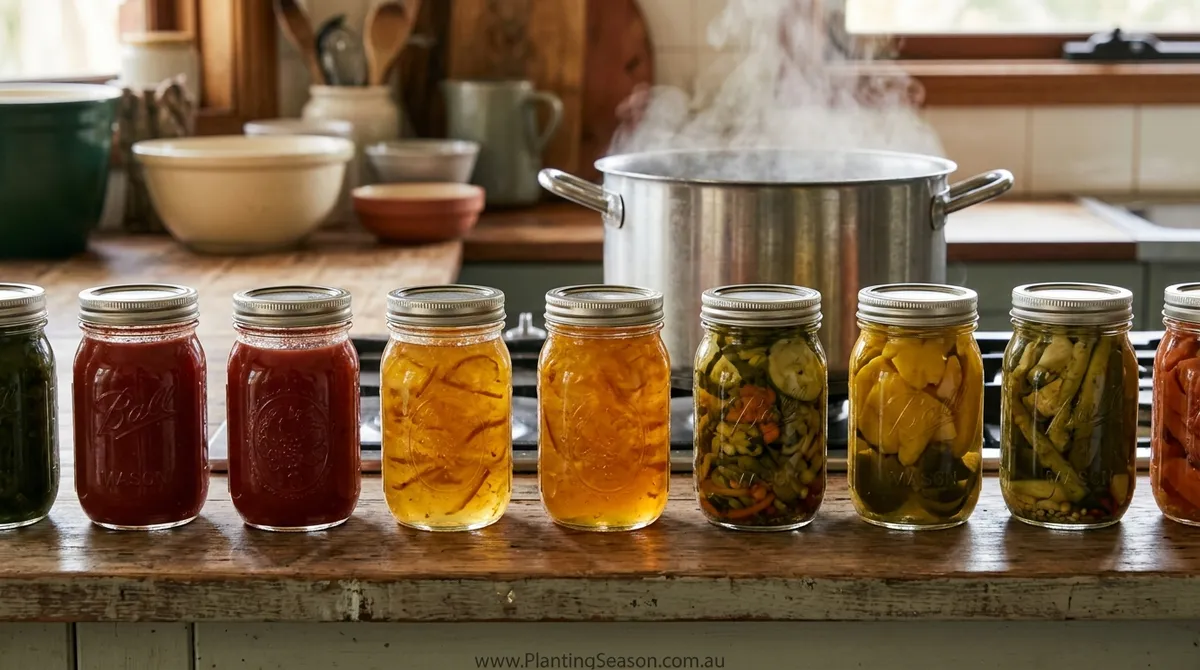
Australia's Food Safety Information Council says to stick to high-acid fruit, add citric acid to tomatoes and tropical fruit (mango, pawpaw, banana), and bottle vegetables only in vinegar. Food Standards Australia New Zealand lists home bottled food that was not processed properly among the higher risk foods for botulism.
Bottling fruit in a water bath or Fowlers unit
Peaches, apricots, plums, pears and apples bottle well. The tested way is a boiling water bath with times from the USDA, the only agency that has tested home bottling. For hot-packed fruit at up to 300 m above sea level, leaving 1.25 cm of headspace:
- Peaches, pears and plums: 20 minutes for jars up to 473 ml, 25 minutes for jars from 474 to 946 ml.
- Sliced apples: 20 minutes for either size.
- Higher up: add 5 minutes from 301 to 900 m and 10 minutes from 901 to 1,800 m.
A Fowlers Vacola unit can stand in for the pot only if it keeps the water at a full rolling boil, 2.5 cm over the jar tops, for the whole time. Jars over 946 ml have no tested time.
Passata
Every jar of tomatoes needs bottled lemon juice or citric acid: 15 ml lemon juice or 1/4 teaspoon citric acid in a jar up to 473 ml, double that in a jar up to 946 ml. An Australian tablespoon is 20 ml, so measure in millilitres. Processing is 35 to 40 minutes. The passata guide has the full method and a yield calculator.
Jam and marmalade
Cook to about 104.5°C or until a spoonful wrinkles on a cold saucer, fill hot into sterilised jars with 6 mm of headspace, and boil the filled jars for 5 minutes (10 if the jars were only washed). Do not cut the sugar in a traditional recipe. More in the jam guide.
Pickles and relish
Vinegar is what makes a vegetable safe to bottle. Tested pickle recipes are written for vinegar of 5% acidity, and some vinegars sold here are weaker, so check the label. Never add more water than the recipe says, and process the jars. The pickling guide covers cucumbers, beetroot and zucchini.
Never in a water bath
Beans, corn, pumpkin, potatoes, mushrooms, meat, stock and soups. These need a pressure canner or, far more simply, the freezer. See pressure canning.
Sources we checked (October 2026): Food Safety Information Council, Home bottling and canning; FSANZ, Clostridium botulinum; USDA Complete Guide to Home Canning (2015) through the National Center for Home Food Preservation: Peaches, Pears, Plums, Apples (sliced), Tomato acidification, General Information on Jams and Jellies.
Common questions
For high-acid food, yes: fruit, jam, tomatoes with added acid, and vegetables in vinegar, processed for a tested time. Plain vegetables and meat are not safe in a water bath or Fowlers unit.
The tested way is to boil jars for 10 minutes. For fruit, tomatoes and pickles processed 10 minutes or longer, the jars do not need sterilising at all, only washing.
After 12 to 24 hours the lid is pulled down and does not flex when pressed. On Fowlers jars the lid stays on when the clip is removed. Unsealed jars go in the fridge.
Use it within a year, stored dark and below 21°C if you can. Throw out any jar with a bulging lid, off smell or mould without tasting it.
What to plant, flock and hive jobs for the month, in one short email. No spam.
Unsubscribe any time.