How to Prune Tomato Plants
Updated June 2026
A practical guide to tomato pruning, sucker removal, and disease prevention for Australian gardens
All our tomato guides: when to plant in your region, varieties and fixes.
Tomato pruning is one of those tasks that makes a genuine difference to your harvest. A well-pruned tomato plant produces larger fruit, ripens earlier, and stays healthier through the season. In humid climates like South East Queensland, good pruning is also your best defence against fungal diseases.
This guide covers everything you need to know about pruning tomato plants in Australian conditions, from identifying suckers to end-of-season management.
🌱 Plant profile: Tomato, with sowing times for your region, companion plants and common pests.
Why Prune Tomato Plants?
Left to their own devices, indeterminate tomato plants will grow into enormous, tangled bushes. Every leaf axil (the point where a branch meets the main stem) produces a new shoot called a sucker. Each sucker becomes a full stem with its own branches, flowers, and fruit. That sounds like more tomatoes, but the reality is different.
An unpruned plant spreads its energy across dozens of stems. The result is lots of small, slow-to-ripen fruit and a dense canopy where moisture gets trapped and diseases take hold. Pruning concentrates the plant's energy into fewer stems, which means:
- Larger fruit. Fewer stems means more energy goes into each tomato.
- Earlier ripening. The plant can put its resources into maturing existing fruit rather than constantly producing new growth.
- Better airflow. An open plant dries faster after rain or watering, which reduces fungal problems.
- Easier harvesting. You can see and reach the fruit without fighting through a jungle of foliage.
- Stronger staking. Two or three stems are far easier to tie to a stake or trellis than a sprawling bush.
Determinate vs Indeterminate Tomatoes: Know Before You Prune
This is the most important distinction in tomato pruning. Getting it wrong can cost you your harvest.
Indeterminate (vining) tomatoes: prune these
Indeterminate varieties grow continuously until frost or disease kills them. They keep producing new stems, flowers, and fruit all season. These are the ones that benefit from pruning. Popular indeterminate varieties in Australian gardens include:
- Grosse Lisse, the classic Aussie backyard tomato
- Tommy Toe, a prolific cherry type
- Mortgage Lifter, large heirloom beefsteak
- Black Russian, dark-skinned heirloom
- Sweet Bite and Sweet 100, productive cherry varieties
- Brandywine, a favourite heirloom with outstanding flavour
- Green Zebra, striped salad tomato
- Tigerella, striped and reliable
Determinate (bush) tomatoes: do not prune these
Determinate varieties grow to a fixed size, flower, set fruit, and then stop. All their fruit ripens within a few weeks. Pruning determinate tomatoes removes fruiting branches and reduces your harvest. The only pruning you should do on determinate varieties is removing dead or yellowing leaves. Common determinate varieties include:
- Roma, the standard paste tomato
- Principe Borghese, Italian drying tomato
- Apollo, widely sold at Bunnings
- Tiny Tim, dwarf variety for pots
- Patio Prize, compact container variety
How to Identify Tomato Suckers
Tomato suckers grow in the leaf axil, which is the V-shaped joint where a side branch meets the main stem. They emerge at roughly a 45-degree angle between the two. A sucker looks like a small version of the main growing tip, with its own tiny leaves.
Suckers are easiest to spot and remove when they are small, around 3 to 5 cm long. At this size, you can pinch them off cleanly with your fingers. Let them grow bigger and you will need secateurs, which increases the wound size and the chance of infection.
Do not confuse suckers with flower trusses. A flower truss grows directly from the main stem, not from a leaf axil. It will have small yellow flowers or tiny green fruit forming. Never remove a flower truss.
Step-by-Step Tomato Pruning
Follow these steps for pruning indeterminate tomato plants. This method works for all staked or trellised vining tomatoes.
- Choose your stems. Decide how many main stems you want. Two to three stems is the sweet spot for most gardens. In humid areas like SEQ, stick to two stems for better airflow.
- Select your keeper suckers early. To grow a two-stem plant, let the first strong sucker below the first flower truss grow into a second main stem. For three stems, keep one more sucker further down. All other suckers get removed.
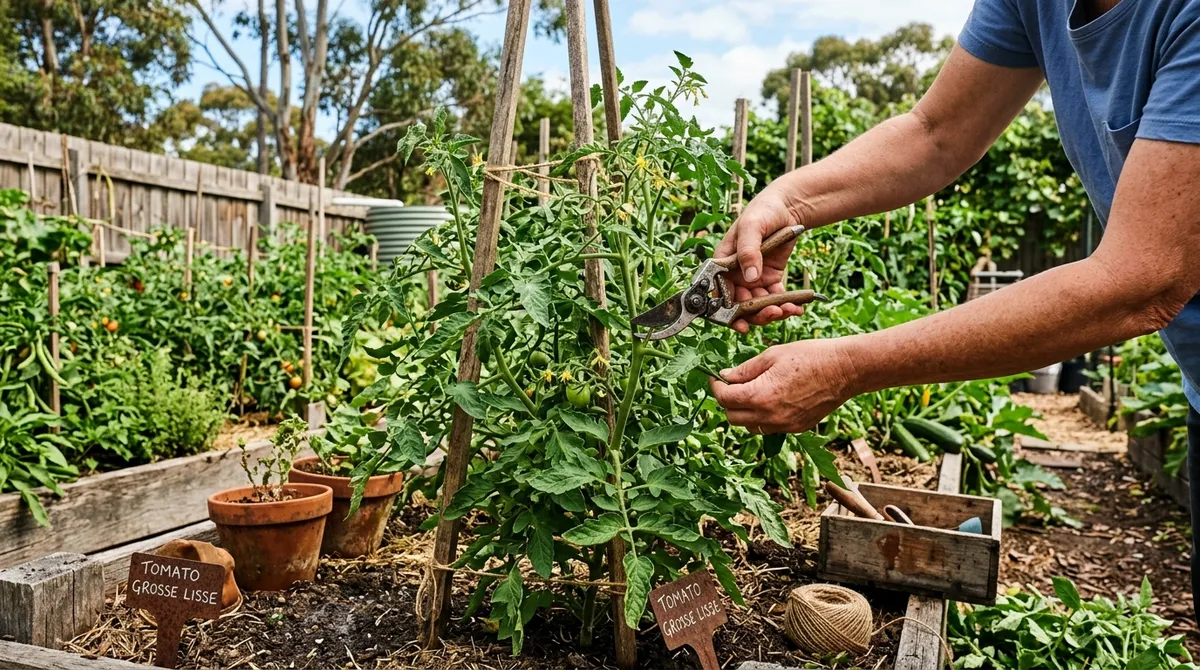
- Pinch suckers when small. Check plants at least once a week. Grip the sucker between your thumb and forefinger and snap it sideways. It should break cleanly at 3 to 5 cm. If a sucker has grown thicker than a pencil, use clean secateurs to avoid tearing the stem.
- Remove suckers in the morning. Stems are turgid (full of water) in the morning and snap cleanly. In the afternoon, stems become more flexible and tend to tear rather than break, leaving a ragged wound.
- Tie stems to supports after pruning. Each time you prune, check that your remaining stems are secured to their stake, cage, or trellis string. Unsupported stems bend and break under fruit weight.
- Continue weekly. Suckers regrow constantly through the season. Make sucker removal part of your weekly routine when you check and water your tomatoes.
Lower Leaf Removal for Disease Prevention
Removing the lower leaves from tomato plants is just as important as sucker removal, especially in humid climates. In South East Queensland, where summer humidity and afternoon storms create perfect conditions for fungal diseases, lower leaf management is critical.
The lowest leaves on a tomato plant are the first to develop problems. Rain and irrigation splash soil (and the fungal spores it contains) onto these leaves. They sit in the most humid zone of the plant, close to the ground, with poor airflow. Diseases like early blight, septoria leaf spot, and bacterial speck almost always start on the lower leaves.
When and how to remove lower leaves
- Once the first fruit truss has set fruit, remove all leaves below it.
- As the season progresses, continue removing leaves below each ripening fruit truss.
- Use clean secateurs for leaf removal rather than tearing. Cut close to the stem but do not cut into it.
- Remove no more than two or three leaves per week to avoid stressing the plant.
- Bin or dispose of removed leaves. Do not compost diseased foliage.
When to Start Pruning Tomato Plants
Start pruning when the first suckers appear, usually when the plant is 30 to 45 cm tall. At this stage, the plant is growing fast and suckers pop up quickly. Getting onto them early is far easier than trying to sort out a tangled plant later.
In most Australian growing regions, tomatoes go in between September and November. Pruning typically begins two to four weeks after transplanting, once the plant has established and started putting on rapid growth.
Continue pruning through the entire growing season. In frost-free areas like SEQ, where tomatoes can grow well into autumn, you may be pruning for six months or more.
How Much to Remove
The goal is to maintain two or three strong stems with good airflow between them. Here is a practical guide:
- All suckers except the one or two you have chosen as extra main stems.
- All leaves below the lowest ripening fruit truss.
- Any leaves showing signs of disease (yellow spots, brown patches, grey mould).
- Inward-facing branches that cross through the centre of the plant and block airflow.
- Never remove flower trusses, healthy upper leaves, or the main growing tip (until end-of-season topping).
End-of-Season Pruning
About four to six weeks before your last expected harvest (or before the first frost in cooler regions), top your tomato plants. Topping means cutting off the main growing tip of each stem. This stops the plant from producing new flowers and forces it to put all its energy into ripening the fruit already on the vine.
In SEQ, where frost is rarely a concern, top your plants when you notice fruit set slowing down in late autumn, usually around April or May. In Melbourne, Sydney, and Adelaide, top in February or March to give existing fruit time to ripen before cool weather sets in.
At the same time, remove any small, green fruit that clearly will not have time to ripen. This directs the plant's remaining energy to the larger fruit.
Common Tomato Pruning Mistakes
Pruning determinate varieties
The most common mistake. Pruning bush tomatoes removes the branches that produce fruit. If your Roma or Apollo tomatoes gave a poor harvest, this might be why.
Removing flower trusses by accident
Flower trusses grow from the main stem, not from leaf axils. Before you snap anything off, look for tiny flowers or buds. If you see them, leave it alone.
Pruning in wet weather
Pruning wounds are entry points for disease. Pruning when foliage is wet (from rain or morning dew) spreads fungal spores directly into fresh cuts. Wait until the plant is completely dry.
Using dirty tools
Bacterial and fungal diseases spread easily on secateurs. Wipe blades with methylated spirits between plants, especially if you have noticed any signs of disease.
Removing too much at once
Taking off more than a third of the plant's foliage at once causes stress, reduces photosynthesis, and can lead to sunscald on exposed fruit. Prune gradually over several sessions if the plant has gotten away from you.
Waiting too long to start
Suckers left for a few weeks become thick, woody stems that are hard to remove cleanly. Start early and prune regularly. Five minutes a week prevents hours of untangling later.
Frequently Asked Questions
Should I prune determinate tomato plants?
No. Determinate tomatoes (bush types like Roma, Principe Borghese, and Apollo) grow to a set size and fruit all at once. Pruning them removes potential fruiting branches. Only remove dead or diseased leaves from determinate varieties.
What are tomato suckers and should I remove them?
Tomato suckers are small shoots that grow in the joint between the main stem and a branch (the leaf axil). On indeterminate varieties, removing suckers directs the plant's energy into fewer stems and larger fruit. Leave suckers on determinate varieties.
When should I start pruning my tomato plants?
Start pruning indeterminate tomatoes when the first suckers appear, usually when the plant is 30 to 45 cm tall. Prune in the morning when stems snap cleanly and wounds dry quickly. Continue removing suckers weekly through the growing season.
How many stems should I leave on a tomato plant?
For indeterminate varieties, two to three stems is ideal in most Australian conditions. This gives a good balance of fruit production and airflow. In humid climates like South East Queensland, two stems works best to reduce disease pressure.
Should I remove the lower leaves from tomato plants?
Yes. Remove leaves below the lowest fruit truss once the fruit on that truss starts to ripen. Lower leaves are the first to develop fungal problems because rain and irrigation splash soil onto them. Removing them improves airflow and reduces the spread of diseases like early blight and septoria leaf spot.
See also: Tomato in the Plant Library · How to Grow Roma Tomatoes · Preserving Tomatoes
Plant profile
The tomato profile has sowing times for your region, companion plants and common pests.