
Trellis and Support by Crop
Updated June 2026
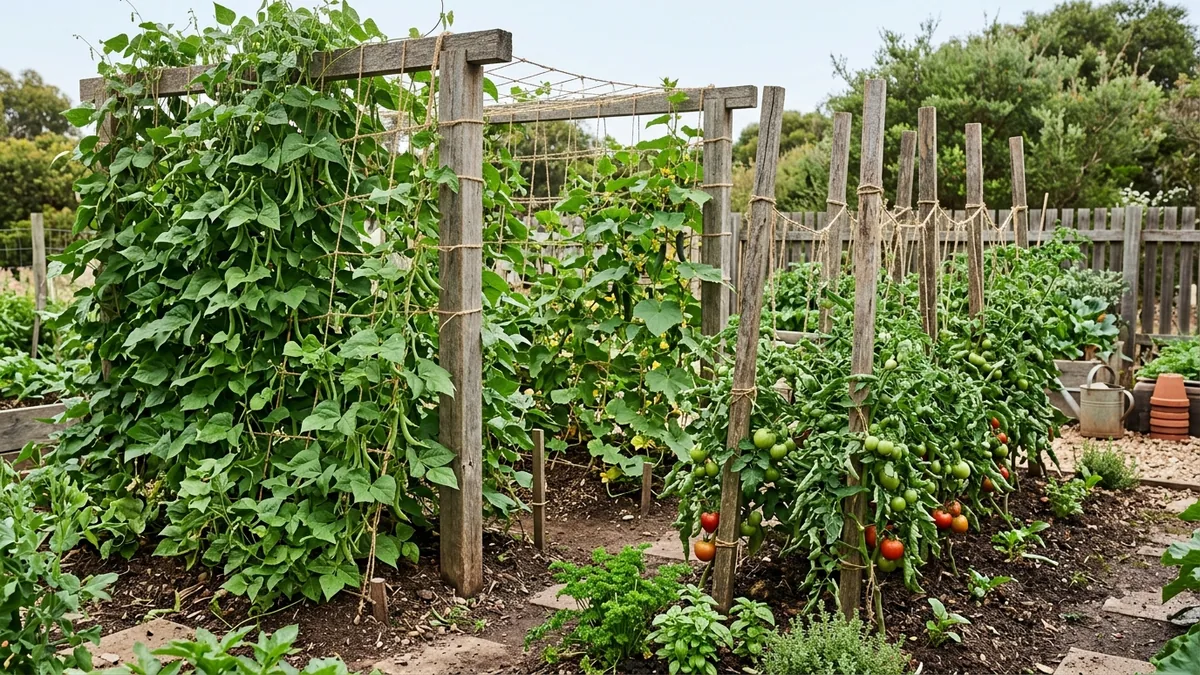
How to support tomatoes, cucumbers, beans, peas, squash and more for healthier plants and cleaner fruit
Giving your crops something to climb is one of the simplest ways to grow more in less space and harvest better fruit. A stake, cage, trellis or net does more than tidy up a sprawling plant. It changes how the plant grows, how it breathes and how clean its fruit stays.
Growing upwards opens the plant out so air moves freely through the leaves, which means less of the damp, still conditions that fungal diseases love. It frees up the ground, so you fit more into a bed. It lifts fruit off the soil, so it stays clean and rots far less often. And it puts everything at a height where you can see and pick it without crawling around. This guide runs through the right support for each common crop, then covers the materials and how to set them up.
Support by crop
Tomatoes
Match the support to the type. For an indeterminate (vining) tomato, drive a single sturdy stake of about 1.8 metres into the ground at planting time and tie the stem to it as it grows. Bushy determinate types are better held in a tomato cage that supports the whole plant. For rows of indeterminate vines, a string or Florida-weave trellis (a line of stakes with twine woven along both sides of the plants) carries a lot of growth cheaply. Whatever you choose, tie loosely so you never strangle the stem as it thickens.
Cucumbers
Cucumbers love to climb. Give them an A-frame or a panel of vertical netting or mesh and the tendrils will grip and pull themselves up with little help. Training them up saves a lot of ground space, keeps the fruit off the soil and gives you straighter, cleaner cucumbers. Make sure the mesh is fixed sturdily, because a fruiting vine is heavier than it looks.
Beans
Climbing (pole) beans are vigorous and need real height. Give them poles of two metres or more, a teepee of four to six stakes lashed at the top, or vertical strings running from a top wire to the ground. Bush beans are the easy ones. They stay compact and self-supporting, so they need no stakes or trellis at all.
Peas
Peas need only light support, but they crop better with it. Use pea netting, twiggy prunings pushed into the soil (the traditional pea sticks), or a panel of wire mesh. The tendrils grab on by themselves once they reach it. Even dwarf peas yield more and stay cleaner with a low frame to lean on.
Squash and pumpkin
These are heavy. A sturdy arch or strong trellis can carry small squash and small pumpkin types, but only if you support each developing fruit in a sling made from an old stocking, mesh or cloth, tied to the frame so its weight does not tear the vine away. Large pumpkins are simply too heavy for any practical trellis and are best left to run along the ground.
Melons (rockmelon and watermelon)
Small melon varieties can climb a strong trellis if every fruit is cradled in a sling as it swells, the same as for squash. Stick to small types only. Full-size watermelons are far too heavy to grow vertically and should be left on the ground.
Peppers and capsicum and chilli
These do not climb, but a heavy crop can snap a branch. A single short stake per plant, tied loosely, keeps laden branches from breaking under the weight of the fruit, especially in wind.
Passionfruit and grapes
These are permanent woody vines that need a permanent home. Train them on horizontal wires, which means a trellis or a fence strung with galvanised wire. Grapes do best on a two-wire system or more, with the main arms trained along the wires. Passionfruit wants strong mesh or wires fixed against a sunny fence or wall, where it can spread and crop for years.
Which support for which crop
| Crop | Best support | Notes |
|---|---|---|
| Tomato (vining) | Single 1.8 m stake or string trellis | Drive in at planting, tie loosely |
| Tomato (bushy) | Tomato cage | Holds the whole determinate plant |
| Cucumber | A-frame or vertical mesh | Tendrils self-climb, straighter fruit |
| Climbing beans | 2 m+ poles, teepee or strings | Vigorous, needs real height |
| Bush beans | None | Compact and self-supporting |
| Peas | Pea netting, pea sticks or mesh | Even dwarf types crop better |
| Squash, small pumpkin | Strong arch or trellis with slings | Big pumpkins stay on the ground |
| Melon (small types) | Strong trellis with fruit slings | Small varieties only |
| Capsicum and chilli | Single short stake | Stops heavy branches snapping |
| Passionfruit, grapes | Horizontal wires on a trellis or fence | Permanent woody vines |
Materials and spacing
For uprights, hardwood stakes and steel star pickets are the strongest and last for years, which matters for heavy crops and permanent vines. Bamboo is cheap, light and fine for beans, peas and lighter jobs, though it weathers and snaps over time. For wires, use galvanised wire so it does not rust through, strained between solid end posts. For climbing surfaces, mesh or netting gives tendrils plenty to grab.
Always tie stems with soft ties such as garden twine, soft cloth strips or stretchy plant tape. Never use bare wire against a stem, as it cuts in as the plant thickens. Tie in a loose figure-eight so there is room to grow.
Put supports in at planting time, not later. Pushing a stake or trellis into an established root system can drive straight through the roots and set the plant back. Setting up early also means the plant climbs from the start instead of sprawling first. Finally, give climbers enough height. A bean or cucumber that runs out of trellis tumbles back on itself, so build taller than you think you need.
Plan it into your beds
Supports work best when you plan them into the bed before you plant, so tall climbers do not shade shorter crops and trellises sit where you can reach both sides. Use the Bed Planner to lay out your beds with supports and companions in mind, and to see how much vertical growing you can fit into the space you have.
Plan your vertical garden
Map your beds, place your trellises and track every climbing crop through the season in the Planting Season app.
Open the App →Frequently Asked Questions
Do cucumbers need a trellis?
Cucumbers do not strictly need a trellis, but they grow far better with one. Trained up netting or an A-frame they get more airflow, suffer less fungal disease, take up much less ground space and produce straighter, cleaner fruit that is easier to pick. The tendrils self-climb once you point them at the support.
What is the best support for tomatoes?
It depends on the type. Bushy determinate tomatoes do well in a tomato cage. Tall indeterminate vines are best on a single sturdy stake of about 1.8 metres or on a string or Florida-weave trellis. Whatever you use, drive the stake in at planting time and tie the stems loosely so you do not strangle them as they thicken.
Do bush beans need support?
No. Bush beans are compact and self-supporting, so they need no stakes or trellis. Climbing or pole beans are the ones that need support, with poles of two metres or more, a teepee of four to six stakes, or vertical strings to climb.
Can you grow pumpkins on a trellis?
Small pumpkins and squash can be grown on a strong arch or sturdy trellis if you cradle each heavy fruit in a sling made from an old stocking, mesh or cloth tied to the frame, so the vine does not tear. Large pumpkins are too heavy and are best left to run along the ground.
When should I put supports in?
Install supports at planting time, or as soon as seedlings are in. Pushing a stake or trellis into the soil later risks driving it through the root system and damaging the plant. Setting it up early also means the plant climbs the support from the start rather than sprawling first.
See also: How to Grow Tomatoes and Bed Planner