
Raised beds and wicking beds in Australia
Raised beds fix poor soil and sore backs. Wicking beds fix patchy watering and hot dry summers. This page helps you choose between them and planting straight into the ground, then covers materials, sizes, soil, building a wicking bed, watering, refilling an old bed and what to plant first in each of the ten Australian climate regions.
Updated 19 October 2026. Planting months come from Planting Season's regional data. Sources are listed at the end.
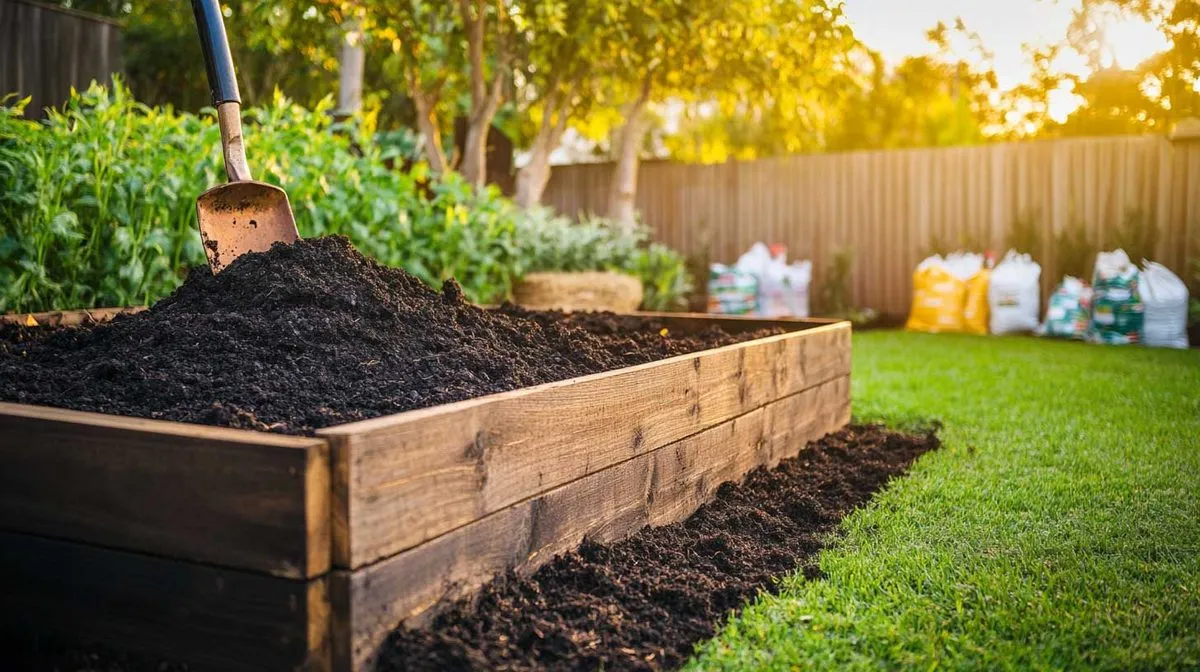
The short answer. Build a raised bed if your soil is clay, sand, compacted or contaminated, or if you want the garden at waist height. Build a wicking bed if your summers are hot and dry, your water is restricted or you are away often enough to miss a watering. Plant in the ground if your soil is already dark and crumbly and drains after rain, because it costs nothing and holds more water than any box. In Darwin and North Queensland, use a raised bed and treat wicking as a dry season tool.
Raised bed, wicking bed or in-ground: which one?
Start with your soil and your summer, in that order. Soil decides whether you need a raised bed at all. Summer and your water bill decide whether it should be a wicking bed. The table gives our pick for each common situation.
| Your situation | Our pick | Why |
|---|---|---|
| Renting | Portable wicking container, or a freestanding raised bed on paving | Gardening Australia has shown renters building portable wicking beds from a polystyrene box or a 10 to 20 litre food-grade bucket, which move with you. Ask your landlord before digging or fixing anything to the ground. |
| Heavy clay | Raised bed, filled with a bought mix | You skip the clay and the poor drainage. Do not dig the clay into the mix: Sustainable Gardening Australia warns against filling a wicking bed with soil from surrounding gardens, especially clay. |
| Sandy soil that dries out fast | Wicking bed, or a raised bed with extra compost | A reservoir under the roots does the job that sand cannot, and compost holds water in the mix. |
| Hot, dry summers (Adelaide, Perth, inland areas) | Wicking bed | Our Adelaide and Perth regional notes record extreme December to February heat of 30 to 40°C and low rainfall. Gardening Australia says a wicking bed keeps moisture available to roots in hot, windy weather. |
| Water restrictions | Wicking bed, filled by hand | Restrictions differ by utility, so check yours. In Perth, Water Corporation allows hand watering any day, ideally before 9am, and a reservoir you fill on one of those mornings fits that rule easily. |
| Bad back or limited mobility | Raised bed at 40 to 60 cm, or 75 to 80 cm for wheelchair access | These are the heights in our build guide. Gardening Australia has built wicking beds in old crates just over 70 cm tall, which suit a standing gardener. |
| Tropical wet season (Darwin, North Queensland) | Raised bed with excellent drainage | The NT Government advises planting on beds at least 10 to 15 cm high so water drains away in the wet season. Wicking only works if the overflow can shed heavy rain. |
| Cold, short season (Hobart, Canberra, Melbourne hills) | Raised bed | Raised beds warm up faster in spring, which matters where the warm months are few. See the cold climate notes. |
| Balcony or courtyard | Pots, or a small wicking container | See the guide to container vegetable gardening. |
| Good soil and plenty of room | In-ground | It costs nothing. Gardening Australia says pumpkin and corn suit in-ground beds. |
What that means in each region
- South East Queensland and Northern Rivers: our SEQ data runs on a warm-wet season from October to March and a cool-dry season from April to September. Raised beds drain through the wet months. In our view wicking beds suit the cool-dry months best, and need their overflow open from October.
- Sydney and coastal NSW: our Sydney note says warm-season fruiting crops start two to four weeks later in spring because spring soil is cooler. A raised bed warms sooner than the ground around it.
- Melbourne and Victoria: the warm season runs from October to April. A raised bed is the easy way to get a head start in spring, and wicking helps through summer heat spells.
- Adelaide and SA and Perth and WA: the strongest case for wicking beds in the country. Both regions share extreme summer heat and low rainfall.
- Hobart and Tasmania and Canberra and ACT: raised beds, with a cloche, cold frame or greenhouse for the tender crops. Wicking is an optional extra rather than a need.
- North Queensland and Darwin and the Top End: raised beds for the November to April wet season, and wicking beds in the May to October dry season with the overflow kept clear.
Materials: what to build a raised bed from
Our raised garden bed build guide covers the full timber bed step by step. This section is the comparison, with the part most people ask about, treated pine, explained properly.
| Material | Lifespan | What to know |
|---|---|---|
| Untreated hardwood (spotted gum, ironbark and similar) | 8 to 15 years | Naturally rot-resistant and food-safe, and the standard choice, at a moderate cost. |
| Corrugated steel (Colorbond or Zincalume) | 20+ years | Durable and tidy, but it heats up in direct sun and can cook roots near the edges in a hot region. Line the inside with mulch or shade cloth. |
| Concrete or besser blocks | Essentially permanent | Cheap, stackable with no tools beyond a level, and can be rendered or painted. |
| Recycled containers (bathtubs, wine barrels, stock troughs) | Varies | Drill drainage holes. Avoid tyres and anything that held chemicals. |
| Treated pine | See below | Cheapest, but the preservative matters. ACQ or copper azole only, and line the soil side. |
The lifespans are the ones in our build guide. If we were building a single bed in Brisbane or Perth, we would pick hardwood or blocks over steel, because steel gets the hottest in exactly the places where summer is hardest on roots.
Treated pine and food gardens
Treated pine is the cheapest timber at the hardware store, so it is the one everyone asks about. The answer depends on which preservative is in it.
CCA (copper chrome arsenate) is the older treatment, and it contains arsenic. The NSW EPA says CCA timber must not be used for residential decking, garden furniture, picnic tables, exterior seating, patios or handrails, and that CCA became a restricted chemical product from July 2012. CCA timber in Australia must be marked “Treated with copper chrome arsenate”, but labels fade and not every green-tinged timber is CCA. The EPA's advice is that if you cannot tell what a treated structure is made from, handle it as if it is CCA. The EPA also notes that existing CCA structures do not need to be removed and that CCA vegetable planters can be lined with plastic.
ACQ (alkaline copper quaternary) and copper azole are the common replacements. The NSW EPA describes both as less hazardous to the environment and human health than CCA, and says both can be used outside, in and above the ground. The EPA page does not single out vegetable beds, so a liner is a sensible cheap precaution.
Good sources have disagreed about the old timber. A 2010 Gardening Australia factsheet reported CSIRO's view that arsenic intake from CCA timber near a vegie garden is within tolerable limits if you paint or line the bed, while its presenter, Josh Byrne, said he was not comfortable using it with food plants. Both agreed on the cheap precaution of a liner.
What we recommend: use hardwood if you can. If budget says pine, buy ACQ or copper azole timber and staple builder's plastic to the soil side of the boards, leaving the base open for drainage. Do not build food beds from old green sleepers or second-hand pine of unknown history. This matches our build guide, which says to avoid CCA and treats ACQ pine as the safer budget option.
Sizes and heights
These figures come from our build guide, and they hold for raised beds and wicking beds alike.
- Width: no wider than 1.2 metres, so you can reach the middle from either side. Against a fence or wall, keep it under 60 cm.
- Length: whatever suits the space. Standard lengths are 1.8, 2.4 or 3 metres, and longer beds may need internal bracing so wet soil does not bow the sides.
- Height: a minimum of 20 cm for most vegetables, 30 cm for carrots and potatoes, 40 to 60 cm to cut down on bending, and 75 to 80 cm for wheelchair access.
- Paths: at least 50 cm between beds for walking and a wheelbarrow, and 90 cm if you need wheelchair access.
- Sun and direction: 6 to 8 hours of direct sun for most vegetables, with the long side of the bed running north to south. Keep beds out from under trees and away from tall fences on the northern side.
Tall beds need a lot of fill. A 2.4 by 1.2 metre bed at 30 cm deep holds about 0.86 cubic metres, and the same bed at 60 cm holds about 1.7. Order it in bulk from a soil supplier rather than in bags, which is far cheaper. In a wicking bed the reservoir takes up the lower part of the depth, so you buy less soil and more gravel or scoria.
Soil mixes
For an ordinary raised bed we use the mix in the build guide: 50 per cent garden soil or loam, 30 per cent aged compost and 20 per cent coarse sand or perlite. Do not fill a bed with pure potting mix, which is expensive and drains too fast, or with pure garden soil, which is heavy and compacts. Fresh fill settles by 10 to 15 per cent in the first few months, so overfill slightly and top up with compost at the start of each season.
A wicking bed needs a different top layer, and the difference is deliberate. The coarse sand or perlite in the 50/30/20 mix is there to speed up drainage. In a wicking bed the soil has to pull water up from the reservoir, so the sources we checked use a much richer, finer mix. Gardening Australia recommends a 50/50 blend of organic soil and compost. Sustainable Gardening Australia recommends half mushroom compost and half organic soil mix, and says wicking beds work best with a higher than usual compost portion.
| Bed type | Mix | Source |
|---|---|---|
| Ordinary raised bed | 50% garden soil or loam, 30% compost, 20% coarse sand or perlite | Planting Season build guide |
| Wicking bed, soil layer | About 50% compost and 50% organic soil, no coarse sand | Gardening Australia; Sustainable Gardening Australia |
| Portable wicking container | Two parts soil to one part compost | Gardening Australia, “Resourceful Renters” |
Compost matters in all three. Our composting for beginners guide and compost calculator help you make your own, and many councils give away bins and compost, so check the free council stuff page before you buy.
How a wicking bed works and how to build one
A wicking bed is a garden bed with a waterproof reservoir under the soil. Water rises from the reservoir into the soil by capillary action, the same way it climbs a paper towel, and roots take what they need. It was devised by Australian engineer Colin Austin, and Sustainable Gardening Australia describes it as a giant self-watering pot in the form of a garden bed.
What the evidence says about water savings
Wicking beds are popular, but the research is thinner than the claims. A 2016 trial by University of South Australia researchers (Semananda, Ward and Myers) grew glasshouse tomatoes in wicking beds and in carefully managed surface-irrigated pots. The wicking beds performed as well or better, with significantly better water use efficiency, yield and fruit quality, and they needed watering much less often. The authors noted that little published research existed to support the popular claims. Yarra Valley Water says wicking beds save up to 80 per cent of water compared with other beds, citing the Water Conservancy, and a guest in Gardening Australia's renters segment claims about half the water of ordinary pots. We treat 80 per cent as a ceiling rather than a promise, and the safer claim is the one the trial supports: the same crop for less water and far less watering effort.
How deep, and how the sources differ
Sources disagree on the exact depths, so here they are side by side.
| Part of the bed | Sustainable Gardening Australia | Gardening Australia | University of South Australia trial |
|---|---|---|---|
| Total depth | 600 mm | Crate just over 70 cm tall; IBC cut in half | Not applicable |
| Reservoir | 300 mm zone, of which 150 mm is gravel or scoria; fill to about 200 mm | About 200 mm (IBC); about 10 cm of scoria plus a 10 cm covering layer (crate) | 150 and 300 mm performed the same |
| Soil above | 300 mm | No more than 300 mm | 300 mm outperformed 600 mm |
| Soil mix | Half mushroom compost, half organic soil mix | 50/50 organic soil and compost | Not stated |
| Mulch | 5 to 7 cm of straw | 50 to 70 mm of organic mulch such as straw | Not stated |
Sustainable Gardening Australia adds that wicking bed builders agree water will not wick further than about 300 mm, which is why deeper soil does not help. Our recommendation is a reservoir of about 20 cm under about 30 cm of soil, so 50 cm in total. That sits inside what all three sources support, it keeps the soil within wicking range, and it needs less fill than a 60 cm bed.
Building it, step by step
- Pick a level, sunny spot. Wicking beds work best level, because water spreads evenly, and vegetables need full sun. Use a spirit level.
- Make a waterproof shell. Line the bed with builder's plastic or pond liner with no tears or holes. Gardening Australia protects the plastic with old carpet under and over it, and hammers in any protruding nails first. If you are reusing an IBC (intermediate bulk container), choose a food-grade one that has not held chemicals, and file the cut edges smooth.
- Add the reservoir. Lay slotted agricultural pipe along the base, connected to a vertical PVC fill pipe, and cover it with scoria or gravel. Sustainable Gardening Australia prefers scoria because it holds water.
- Add the barrier. Cover the gravel with geotextile fabric so soil particles cannot wash into the reservoir and block it. Shade cloth can substitute, though Sustainable Gardening Australia notes it lets some soil through.
- Fit the overflow. Drill a hole through the side where the gravel meets the soil, and fit a short pipe or tank outlet. This sets the reservoir level and stops the root zone from becoming waterlogged. An adjustable elbow lets you point the overflow up to keep the reservoir full or down to let it drain freely in heavy rain, and Gardening Australia fits one for exactly that reason.
- Fill with soil. Add about 30 cm of the rich mix from the table above. Do not use clay topsoil from the garden.
- Plant, then mulch. Mulch with 5 to 7 cm of straw and keep the fill pipe clear.
- Fill the reservoir through the pipe until water runs from the overflow. Water the seedlings from above for the first week or so, because the soil takes about a week to start wicking.
- Cap the openings. Put a cap or fly mesh over the fill pipe and the overflow so mosquitoes cannot breed in the reservoir.
Cheaper versions work too. Polystyrene boxes (the broccoli boxes from the greengrocer) and 10 to 20 litre food-grade buckets make good small wicking containers, and Gardening Australia's renters segment built them for roughly $5 to $10. In a small box the reservoir sits at the base and the overflow hole goes about 5 cm up.
When a wicking bed suits
- Hot, dry regions such as Adelaide, Perth and inland areas, where summer water use is the main cost.
- Water restrictions, because you fill the reservoir by hand at an allowed time instead of running a sprinkler.
- Leafy crops, herbs and tomatoes. Gardening Australia suggests lettuce, spinach, silverbeet and herbs for a new wicking bed, and the University of South Australia trial used tomatoes.
- Busy or travelling gardeners, since Gardening Australia says the reservoir may need only a weekly top-up in summer.
When it does not suit
- The tropical wet season. In North Queensland and Darwin the wet season runs from November to April, with heavy monsoonal rain in our regional data. A reservoir that cannot shed that rain leaves roots in standing water. Set the overflow low and open, and treat the wicking bed as a dry season (May to October) tool. See root rot for what waterlogging does.
- Waterlogging anywhere with heavy rain. The same applies in SEQ and Northern Rivers from October to March and in any long wet spell. Check that the overflow is not blocked, and if yours has an adjustable elbow, point it down.
- Salt build-up. As water rises and evaporates from the top, dissolved salts stay behind. In a second glasshouse trial, the same University of South Australia group found that salts and the sodium absorption ratio were high in the surface layer of wicking beds compared with surface irrigation. They said recycled water affects salinity and sodicity, which may reduce yield, and called for more research on managing surface salt. Use rainwater or mains water, and test bore or recycled water before you rely on it. As our own practical suggestion, a few times a year water heavily from the top until the overflow runs, which pushes accumulated salt through, and refresh the top of the soil if a white crust appears.
- Deep taproots and sprawlers. Pumpkin and corn suit in-ground beds, according to Gardening Australia.
- Mosquito regions with an uncapped reservoir. The Queensland Government's advice on mosquito breeding sites includes checking screens and seals on rainwater tanks. A wicking reservoir is a small tank and deserves the same screen.
- Algae. Gardening Australia warns that a reservoir can become a breeding ground for blue-green algae, which can be toxic. Keep light out of it by cladding the sides and capping the inlet.
Watering and mulching
Raised beds that are not wicking
Our watering guide has the full method: deep and infrequent beats little and often, water at the soil rather than the leaves, and a drip line or soaker hose gives the best return in a vegetable bed. The same guide notes that anything in a pot needs far more water than the same plant in the ground. A raised bed with an open base sits between the two, so expect to water it a little sooner than the ground beside it.
Water rules vary by utility and change with conditions. As one example, Water Corporation in Perth says hand watering is allowed any day, ideally before 9am, and that gardens need about 10 mm of water twice a week in summer. That is 10 litres per square metre each time. Check your own utility's current rules before you plan around any of this.
Mulch
Mulch does more for a raised bed than extra watering. The NT Government's vegetable sowing information sheet recommends mulching between plants straight after planting to cool the soil, conserve moisture and stop weed germination. Our mulching guide gives depths for ordinary beds: 5 to 8 cm of sugarcane mulch, or 10 to 15 cm of loose straw because it compresses. In a wicking bed use the 5 to 7 cm the wicking sources quote, and keep the fill pipe and overflow clear. Always water before you mulch, and keep mulch away from stems.
Water-saving reading for your region
If you are planning for a dry summer, our El Nino garden guides are tuned to individual regions: the national guide, South East Queensland, Sydney, Melbourne, Adelaide and Perth.
Filling an old bed again
A bed that has grown vegetables for a few seasons is lower, tired and sometimes carrying disease. Resetting it takes an afternoon.
- Clear it. Pull the spent crop. Bin any plants that were diseased rather than composting them, and check the roots for galls. If you suspect a soil problem, read about nematodes, fusarium wilt and verticillium wilt first.
- Check the frame. Replace rotten boards and re-staple any liner that has torn. Hardwood beds last 8 to 15 years, according to our build guide, so a bed older than that is due for new sides.
- Top up the fill. Soil settles by 10 to 15 per cent in the first few months and keeps dropping. Fork over the top, then add compost and garden soil in roughly the 30 and 50 parts of the 50/30/20 mix, with a little coarse sand, until the bed is full again. For a quick refresh, our build guide says to top up with compost at the start of each season.
- Change what you grow. Do not plant the same crop family in the same bed two seasons in a row. In a bed you want to rest, a cover crop is the cheapest soil improvement there is, see our green manure guide. Add feed only as needed, using the fertilising guide.
- For a wicking bed, also check that the overflow and fill pipe run clear, flush the reservoir by watering heavily from the top until the overflow runs, and replace the top of the soil if it has a white salt crust. If the geotextile has failed and soil has washed into the gravel, the reservoir will need lifting out and rebuilding.
- Mulch and replant with something quick, such as lettuce or radish, while the soil settles.
What to plant first in each region
A new bed is full of loose, fertile, disease-free soil, so almost anything will grow in it. Our build guide suggests starting with easy, fast crops: lettuce, radish, herbs, beans and spinach. The table gives the sowing months in our regional data for six crops that suit a new bed. Outside a crop's months, plants bolt, stall or fail.
| Region | Lettuce | Radish | Silverbeet | Bush beans | Tomato | Snow peas |
|---|---|---|---|---|---|---|
| South East Queensland | Jan to Oct | Mar to Sep | All year | Feb to May and Aug to Oct | Feb to Apr and Aug to Sep | Mar to Aug |
| Northern Rivers | Jan to Oct | Mar to Sep | All year | Feb to May and Sep to Oct | Feb to Apr and Sep | Mar to Sep |
| Sydney and coastal NSW | Jan to Oct | Mar to Sep | All year | Sep to Feb | Jul to Sep | Apr to Aug |
| Melbourne and Victoria | Mar to Sep | Mar to Sep | Mar to Oct | Oct to Dec | Oct to Dec | Mar to Aug |
| Adelaide and SA | Apr to Oct | Mar to Sep | All year | Sep to Feb | Aug to Nov | Mar to Aug |
| Perth and WA | Apr to Oct | Mar to Sep | All year | Mar to May and Sep to Oct | Jul to Sep | Mar to Aug |
| Hobart and Tasmania | Aug to Mar | Aug to Mar | Sep to Feb | Oct to Dec | Sep to Oct | Feb and Aug to Nov |
| Canberra and ACT | Aug to May | Sep to Mar | Aug to Feb | Nov to Jan | Oct to Nov | Aug to Nov |
| North Queensland | May to Aug | May to Sep | May to Sep | Apr to Aug | Apr to Sep | May to Aug |
| Darwin and the Top End | May to Aug | May to Sep | May to Sep | Apr to Aug | Apr to Jul | May to Aug |
Sowing months from Planting Season regional data (plants.js baseline with regions.js overrides). Beans are the bush type. Tomatoes in cool regions are started indoors and planted out after frost, see the cold climate notes.
Sowing months are the same data that drives the Planting Season calendar and app. For the crops in season right now where you live, open your region page or see what to plant this month. For other crops, the plant library has the month-by-month sow window and growing notes for every region.
Hot climate notes
- Choose the cooler material. Colorbond and steel beds heat up in direct sun, which can cook roots near the edges, our build guide warns. Timber and blocks are gentler in hot regions. If you already have a steel bed, line the inside with mulch or shade cloth.
- Mulch deeply. It cools the soil and slows evaporation, according to the NT Government's sowing information sheet.
- Shade the tender crops. Lettuce is a dry season crop in Darwin and North Queensland, sown May to August in our data. In Darwin it bolts quickly in wet season heat and needs shade cloth even in the dry season, and in North Queensland it wants afternoon shade. Our heat and shade planner gives shade cloth timing and percentages for your region.
- Adelaide and Perth: cool-season vegetables bolt and turn bitter in summer heat, so our regional notes move their sowing to March to August, and warm-season crops such as tomato must be established before the heat, with seed started from August to October. Wicking beds earn their keep here.
- Darwin and North Queensland: plan the main vegetable crops for the dry season, May to October. Raised beds should be at least 10 to 15 cm high for wet season drainage according to the NT Government, which our 20 cm minimum comfortably exceeds. Keep wicking reservoirs capped against mosquitoes, and see our Darwin and North Queensland pages.
- Not sure which region you are in? Find my region works from your postcode.
Cold climate notes
- Spring is the raised bed's advantage. Our build guide says raised beds warm up faster in spring, which matters in Melbourne, Hobart and Canberra.
- Melbourne: tomatoes are sown indoors in August and September in our data. Plant out from mid October in inner city and bayside suburbs, from Cup Day (the first Tuesday of November) for most suburbs once the soil passes 16°C, and in late November in the hills. Bush beans go in from October to December.
- Hobart: start tomatoes indoors in September and plant out after the last frost in early October; the data suggests early varieties such as Stupice or Tommy Toe, and notes a greenhouse lifts yields. Basil has a narrow window of November to December. Lettuce can be sown from August to March, but winter sowings need a cloche or cold frame.
- Canberra: the last frost is around 1 November and the first around 10 April, which leaves a warm growing window of about five months. Start tomatoes indoors in October and plant out after the last frost in early November. Bush beans go in from November to January.
- Keep the cold out. Mulch keeps the soil warmer on cold nights, according to our mulching guide, and Gardening Australia notes that timber cladding adds insulation to a wicking bed. Use the frost dates tool to find your last frost, and have a cloche ready for the early crops.
Lay out your bed before you build it
The free bed planner draws your bed to scale, checks plant spacing and companions, and suggests what suits the season.
Open the bed planner →Guides, tools and region pages
Everything on this page links to something deeper. Here they are grouped by the problem you are solving.
Build and fill
Soil and compost
Water and mulch
Small spaces and pots
Crops for a new bed
Problems that show up in raised beds
Your region
Get next month's planting calendar, free
One short email at the start of each month with the crops to sow in your region, plus seasonal tips and harvest reminders. No spam, and you can unsubscribe any time.
Common questions
Sources we checked
All pages opened on 19 October 2026. Where official sources and gardening bodies disagree, the page says so.
- NSW EPA, Copper chrome arsenate (CCA) treated timber, updated 14 July 2021.
- NSW EPA, Alternative copper based timber treatments to copper chrome arsenate, updated 14 July 2021.
- ABC Gardening Australia, Vegie Garden Timber, Josh Byrne, 12 June 2010.
- Sustainable Gardening Australia, Wicking beds and the Wicking Beds handout.
- ABC Gardening Australia, Sticking to Wicking, Sophie Thomson, 3 April 2026.
- ABC Gardening Australia, Wicking Works, Sophie Thomson, 11 March 2017.
- ABC Gardening Australia, Building a Wicking Bed, Sophie Thomson, 24 May 2014.
- ABC Gardening Australia, Resourceful Renters, Costa Georgiadis, 17 April 2020.
- Semananda, Ward and Myers, Evaluating the Efficiency of Wicking Bed Irrigation Systems for Small-Scale Urban Agriculture, Horticulturae 2016.
- Semananda, Ward and Myers, Assessing Reliability of Recycled Water in Wicking Beds for Sustainable Urban Agriculture, Earth 2021.
- Northern Territory Government, Information Sheet IS4, Vegetable Sowing Calendar for Darwin and Katherine Regions, July 2005.
- Yarra Valley Water, Summer smart gardens.
- Water Corporation (WA), Using water outdoors: do's and don'ts and How much water does my garden need.
- Queensland Government, Remove potential mosquito breeding sites.
- Planting Season regional planting data (plants and regions), and our own guides linked above.
Wicking bed claims about water savings are not settled. Treat the numbers as a guide, follow your local water rules, and check any timber label before you build a food bed from it.