Silver leaf: identify, prevent, control
Updated October 2026
Infection happens through fresh wounds in damp, overcast weather, mostly from autumn to early spring; silvering shows the following spring and summer.
Silver leaf is a fungal disease that infects the wood of fruit trees through fresh pruning cuts and other wounds. A toxin from the fungus separates the leaf layers, so light reflects off them with a dull, silvery sheen. Plums and cherries are especially prone and can lose whole limbs or die, which is why stone fruit is pruned in summer rather than winter.
Chondrostereum purpureum
How to identify it
- Leaves on one branch, or on the whole tree, take on a dull, metallic silver or leaden sheen that is easiest to see when you compare them with a healthy branch.
- Silvered leaves may later turn brown at the edges, split easily when you press them and drop early.
- Cut through a branch carrying silvered leaves and the wood inside has a dark brown or purplish stain in the centre.
- Affected branches die back over one to several seasons, often starting from a pruning cut or broken limb.
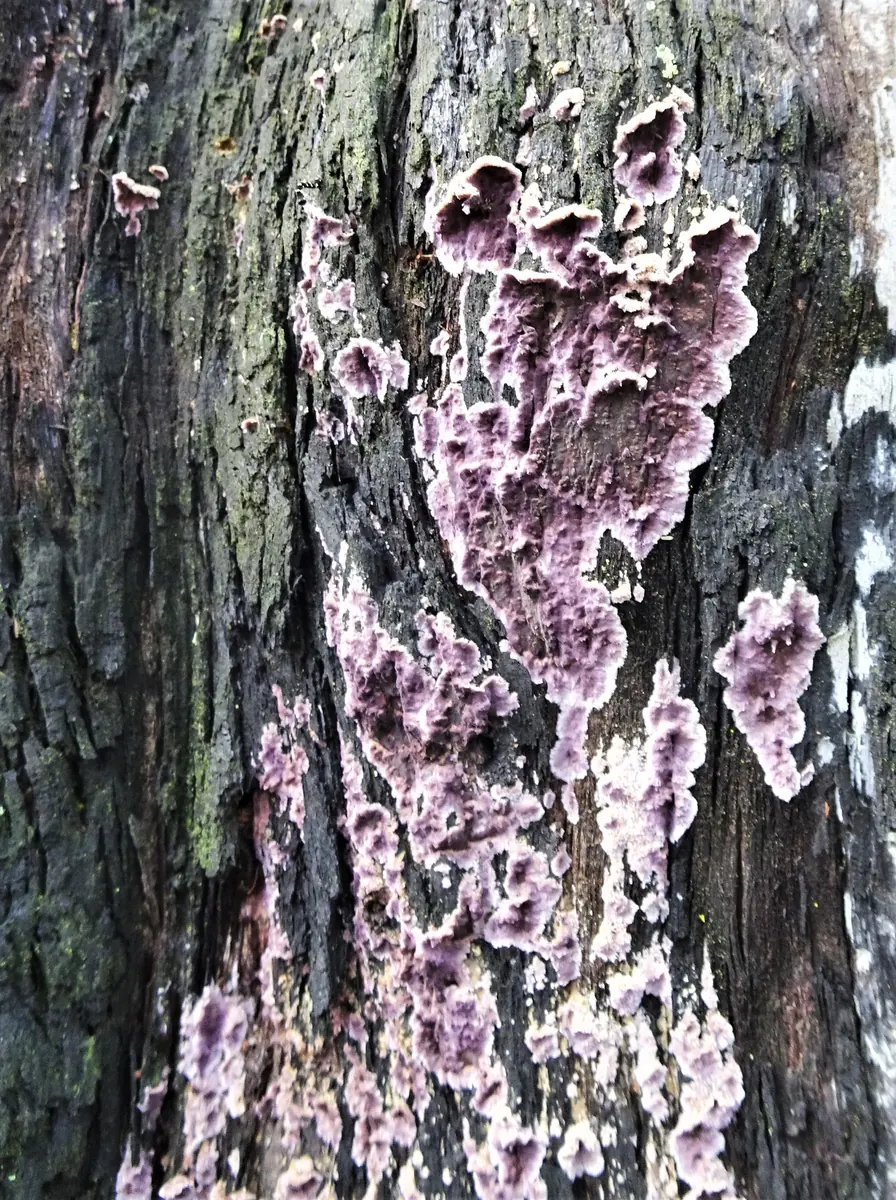
- On dead wood, and sometimes on living trunks, the fungus forms thin, crusty or bracket-shaped fruiting bodies that are purple to lilac when fresh, fading to brown with a pale rim.
What it is often confused with
Spider mite
Mite damage makes leaves pale and speckled, with fine webbing and mites underneath. Silver leaf is an even metallic sheen with no speckling, and the wood is stained.
Bacterial canker
Bacterial canker oozes amber gum from sunken bark and kills buds. Silver leaf rarely produces much gum and shows as silvered leaves with stained wood.
When and where it is worst
Silver leaf occurs in stone fruit and apple districts across southern Australia but is most common where the growing season is humid and autumns and winters are damp, such as Tasmania, southern Victoria, the Adelaide Hills, the tablelands of New South Wales and around Canberra. Plums and cherries are the most often damaged on our site, and peaches, apricots and apples can also be infected; apples tolerate it better than stone fruit, which often die.
The fruiting bodies on dead wood release spores in damp, overcast weather, mostly from autumn through winter into spring. Spores land on fresh wounds such as pruning cuts, broken branches or hail damage, and the fungus grows into the wood. Wounds are only open to infection for a few weeks, so pruning in dry summer weather, when spores are scarce and cuts heal fast, greatly reduces the risk.
Plants it affects
These plants in our library list it as a problem to watch for.
How to prevent it
- Prune plums, cherries and other stone fruit in summer, straight after harvest, on a dry day, and avoid winter pruning altogether.
- Seal larger pruning cuts and grafts with a wound dressing as soon as you make them.
- Remove dead branches, old stumps and prunings of any susceptible tree from the garden, because the fungus fruits on dead wood.
- Check for and repair storm or hail damage promptly, cutting back ragged wounds to clean wood and sealing them.
- Disinfect secateurs and saws after cutting infected wood.
Organic control, step by step
- As soon as you see silvered leaves, cut the affected branch back in dry weather until the cut face shows clean wood with no brown stain, then go a little further, about 15 cm, to be safe.
- Seal the cut with a wound dressing.
- Burn the infected wood where that is allowed or put it in the rubbish; do not keep it in a firewood pile in the garden.
- If silvering affects the whole tree and the trunk is stained, remove the tree and the stump, because it will not recover and will produce spores.
Conventional control
- There is no fungicide spray that cures silver leaf, and NSW DPI lists no registered biological control; prevention through summer pruning and wound care is the main defence.
- Use a wound dressing product labelled for pruning cuts on fruit trees.
- If you use any product near harvest, read the label, check the crop is listed and keep to the withholding period.
Frequently asked questions
Why do my plum leaves look silvery?
The most likely cause is silver leaf. Cut a small branch from the silvered area; a brown stain in the centre of the wood confirms it. A uniform dull sheen across a stressed tree without wood staining can instead be a stress symptom called false silver leaf.
Why are stone fruit pruned in summer?
Mainly because of silver leaf and bacterial canker. Spores of both are most active in cool, wet weather, while summer cuts heal quickly and are rarely infected.
Can a tree recover from silver leaf?
Trees sometimes recover if infection is caught early and the affected limbs are cut out well below the stain. Trees with silvering throughout and a stained trunk usually decline and should be removed.
What are the purple crusts on my dead plum branch?
Those are likely the fruiting bodies of the silver leaf fungus. They release spores in damp weather, so remove and dispose of that wood.
Related problems
Sources: NSW DPI, Silver leaf; Yates New Zealand, Silver leaf. Identification and control follow these sources. Always read the product label before use.