Shot hole: identify, prevent, control
Updated October 2026
Spores wake in wet weather in late winter and early spring around bud swell; holes and fruit spots show from spring into summer.
Shot hole is a fungal disease of stone fruit and almonds that makes small spots on the leaves which then drop out, leaving the leaf looking as if it has been hit with shotgun pellets. It also marks fruit and can kill buds. Apricots and almonds on our site list it most often, but peaches, nectarines, plums and cherries can be affected too.
Wilsonomyces carpophilus (syn. Stigmina carpophila)
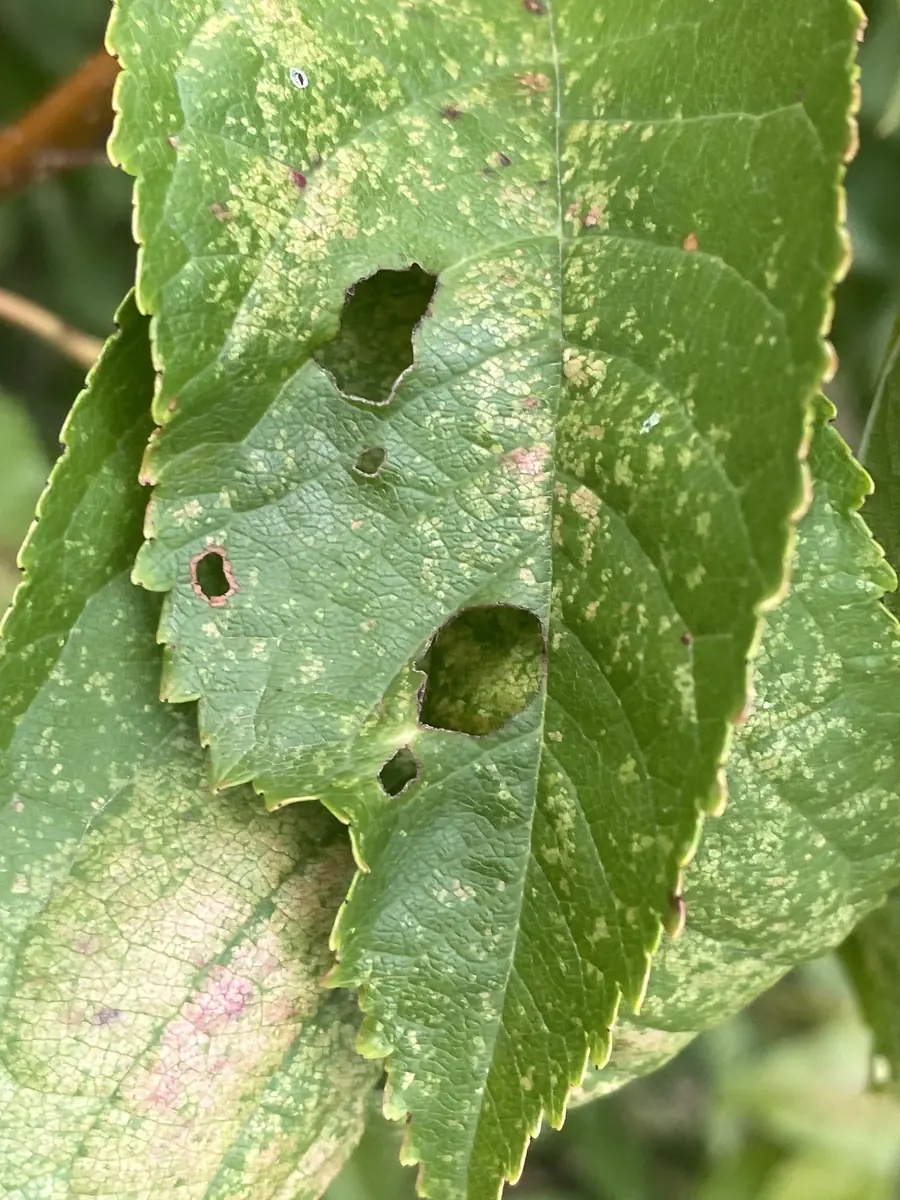
How to identify it
- On young leaves you first see tiny red or purple specks that grow into round brown spots a few millimetres across with a reddish or purplish rim.
- The centre of each spot dries and falls out, leaving a clean round hole, and badly affected leaves look riddled with holes.
- Look closely at older spots for tiny black dots in the centre, which are the fungus producing spores.
- On apricot and peach fruit the spots become small, raised, rough or scabby blemishes that can crack or form deep indentations.
- Infected buds turn dark and shiny, often with a little gum, and fail to open in spring.
- In bad years trees drop many leaves early in summer, which weakens them for the following season.
What it is often confused with
Bacterial canker
Bacterial canker can also leave holes in leaves, but the spots start water-soaked without a reddish rim, and the tree usually has gummy cankers on the branches.
Brown rot
Brown rot can cause a few holes in young leaves, but its main signs are blighted blossoms and fruit rotting with fawn spore tufts.
Leaf spot
General leaf spots stay in the leaf and do not drop out cleanly. Neat round holes with reddish rims point to shot hole.
When and where it is worst
Shot hole is common in districts with wet springs, such as coastal and tableland New South Wales, Victoria, the Adelaide Hills, Tasmania and the south-west of Western Australia, and it is a known disease of almond orchards along the Murray. Apricots and almonds are the hosts listed on our site, and peaches, nectarines, plums and cherries can also get it.
The fungus survives the winter in infected buds, bud scales and twig lesions. Wet weather in late winter to early spring wakes the spores, and rain around bud swell splashes them onto new growth. Infection needs about 24 hours of continuous wetness, and spores can germinate at temperatures as low as 1°C, so cold, drizzly springs suit it. Further spread happens in wet spells through spring, and spores build up again in autumn.
Plants it affects
These plants in our library list it as a problem to watch for.
How to prevent it
- Prune out twigs with dead buds or lesions and remove them from the garden, ideally in dry weather after harvest.
- Keep the canopy open so leaves and buds dry quickly after rain.
- Rake up and remove fallen leaves in autumn.
- Avoid overhead watering that keeps leaves and buds wet.
- Keep trees well fed and watered so they recover quickly from leaf loss.
Organic control, step by step
- Remove infected twigs and buds as part of your summer and winter tidy-up.
- Spray copper in autumn at about 90 per cent leaf fall to protect the buds over winter.
- Spray copper again at bud swell in late winter, before the buds open, covering every twig.
- In a wet spring, a further copper or lime sulphur spray at petal fall can help, but only if the label allows that timing on your crop, as some products can damage soft new leaves.
Conventional control
- Copper fungicides (copper hydroxide or copper oxychloride) are the main home garden option, applied at leaf fall and at bud swell.
- Lime sulphur at bud swell is registered on some home garden labels for stone fruit diseases; check shot hole and your crop are listed.
- Read the label, check the crop is listed and keep to the withholding period before you pick fruit or nuts.
Frequently asked questions
What is making round holes in my apricot leaves?
If the holes started as small brown spots with reddish rims, it is most likely shot hole. Insects chewing leaves leave ragged holes and you usually find the culprit.
Can I spray once I see the holes?
Spraying in summer does not fix the damaged leaves. Clean up infected twigs and leaves, then protect the buds with copper at leaf fall and again at bud swell.
Does shot hole affect almonds?
Yes. On almonds it mainly spots leaves and the hulls of young nuts. Heavy infection causes early leaf drop, which can weaken the tree and reduce next year's crop.
Is shot hole the same as bacterial canker?
No. Shot hole is a fungus that spots leaves, fruit and buds. Bacterial canker is caused by bacteria and also kills branches with gummy cankers. Copper sprays at leaf fall help with both.
Related problems
Sources: NSW DPI, Shot hole; UC IPM, Shot hole or Coryneum blight. Identification and control follow these sources. Always read the product label before use.