Citrus scab: identify, prevent, control
Updated October 2026
Infection happens on soft new leaves and young fruit during wet weather in spring and early summer, mostly in coastal Queensland and New South Wales.
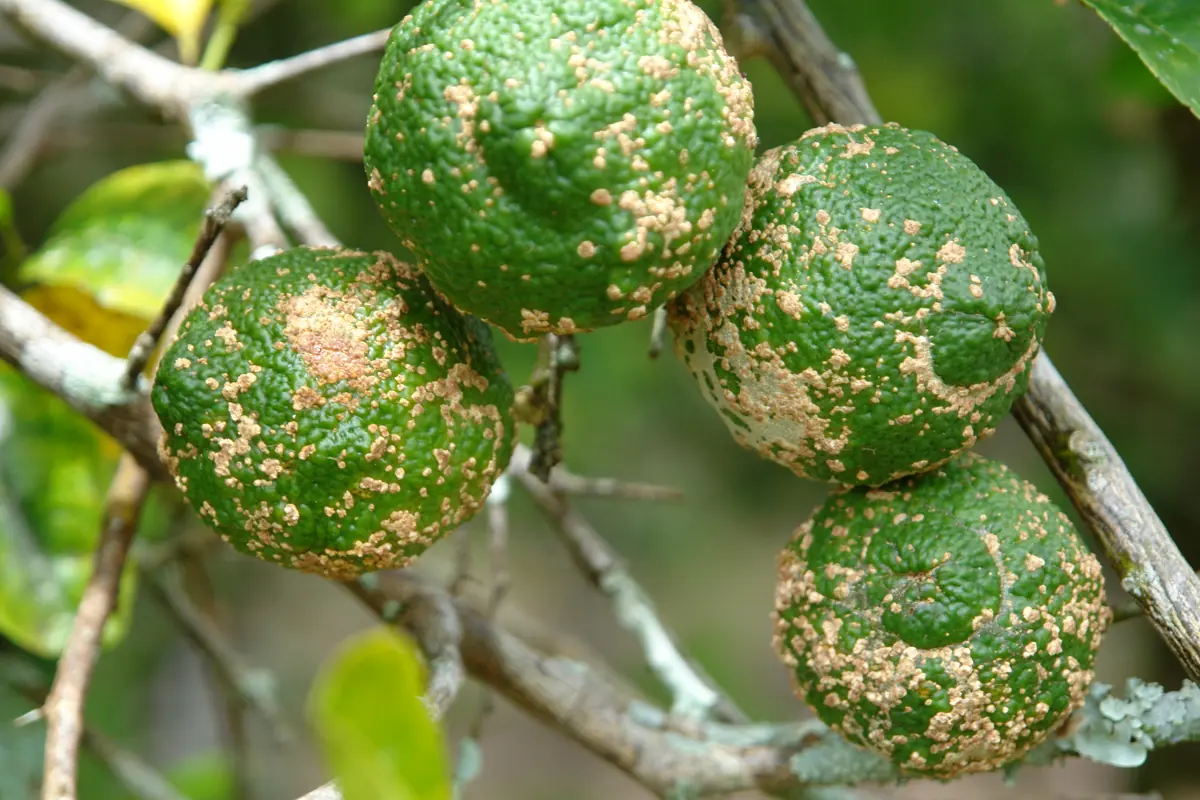
Citrus scab, often called lemon scab or verrucosis, is a fungal disease that raises corky, wart-like scabs on young leaves, twigs and fruit. It is a serious blemish of lemons along the east coast and also affects rough lemon and Rangpur lime rootstocks. The fruit inside is fine to eat, but scabbed lemons look poor and badly affected young leaves stay twisted.
Elsinoe fawcettii
.jpg)
How to identify it
- On young leaves you first see small raised spots, often with a bright yellow edge, that make the leaf pucker, twist or tear at the margin.
- On fruit the scabs are raised, rough and corky, grey or pinkish at first and turning light brown as they age.
- Scabs often run together into larger patches, with sunken, cracked centres on older lesions.
- Twigs can carry small scabby patches too, which keep producing spores into the next season.
- Damage is usually worst on lemons, with oranges and limes much less affected.
What it is often confused with
Melanose
Melanose leaves many tiny, dark, sandpaper-like specks, often in streaks. Scab lesions are larger, raised, corky warts and distort young leaves.
Thrips
Thrips leave a smooth, silvery grey scar, often in a ring around the stem end of the fruit. Scab is raised and rough, not flat.
When and where it is worst
In Australia lemon scab occurs along the east coast, where frequent rain and humid nights suit it, from North Queensland through South East Queensland to the NSW coast. Inland and southern gardens with drier springs see it far less. Lemons are the main host on our site, while oranges and blood oranges can carry minor scabbing, especially when grown near infected lemons.
Spores form in the scabs and spread in rain splash and wind. Only about four hours of wetness is needed for infection, so showery spring weather during the new flush is the danger time. Leaves and fruit are only susceptible while young, and fruit becomes resistant once it is about 3 cm across.
Plants it affects
These plants in our library list it as a problem to watch for.
How to prevent it
- Buy clean nursery trees, because scab moves long distances on infected plants.
- Prune to keep the canopy open and remove deadwood and scabbed twigs so leaves dry quickly after rain.
- Avoid overhead watering, which wets young leaves for long periods.
- If scab is a constant problem on the coast, consider planting a lemon variety with less susceptibility or grafting on a less susceptible rootstock.
- Water and feed so the tree flushes evenly, which shortens the window when soft growth is exposed.
Organic control, step by step
- Cut off and remove badly scabbed twigs and fallen scabby fruit during winter to cut the spore load.
- Spray copper as the spring flush starts and before flowering to protect new leaves.
- Spray copper again at petal fall to protect young fruit, and repeat every three to four weeks while the weather is wet until fruit reaches about 3 cm.
- Accept a little scabbing on the skin of home lemons; it does not affect the juice.
Conventional control
- Copper fungicides (copper oxychloride or copper hydroxide) are the main home garden option and are timed to new flush, before flowering and at petal fall.
- Some home garden products containing mancozeb list citrus diseases; use one only if its label lists scab on citrus.
- Read the label, check citrus and scab are listed and keep to the withholding period before you pick fruit.
Frequently asked questions
Are lemons with scab safe to eat?
Yes. Scab only damages the skin. The juice and flesh are fine, although scabby skin is not ideal for zesting.
Why does only my lemon get scab when my orange is fine?
The common form of citrus scab in Australia attacks lemons, rough lemon and Rangpur lime far more than sweet oranges. Oranges near a scabby lemon may still pick up a few spots in wet years.
Is sweet orange scab the same thing?
No. Some strains of sweet orange scab already occur in coastal Australia, but the Florida strains, which attack oranges and mandarins much more widely, have not been found here. If you see heavy scabbing on oranges or mandarins that looks unusual, call the Exotic Plant Pest Hotline on 1800 084 881.
When is it too late to spray?
Once fruit is larger than about 3 cm and leaves have hardened, they no longer get infected, so spraying then achieves little. Plan for next spring instead.
Related problems
Sources: NSW DPI, Lemon scab (Primefact 750); Pacific Pests, Pathogens and Weeds, Common citrus scab; Plant Health Australia, Sweet orange scab fact sheet. Identification and control follow these sources. Always read the product label before use.