
Do Coffee Grounds, Eggshells, Banana Peels, Wood Ash and Epsom Salts Work?
Updated November 2026
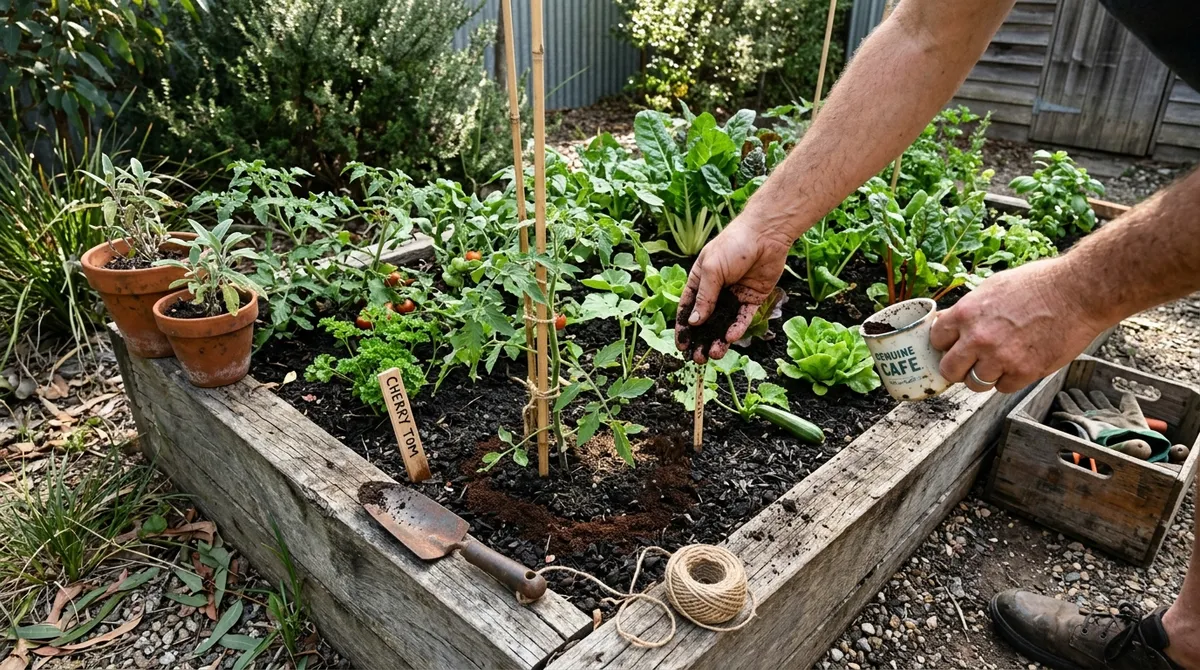
Gardening advice is full of kitchen scraps and household products that are supposed to feed plants, from coffee grounds and eggshells to banana peels, wood ash and Epsom salts. Some have a real but modest effect, some have been tested and shown to do little, and some are tradition with no tests behind them. This page sorts them into plain evidence notes. It says what has been tested, what is tradition, and how to use each safely if you choose to.
Quick answer
- Coffee grounds: tested, and fresh grounds applied directly reduced plant growth. Compost them.
- Eggshells: a slow calcium source. No good evidence they prevent blossom end rot or deter slugs.
- Banana peels: contain potassium, but no controlled tests of garden benefit. Compost them.
- Wood ash: supplies potassium and raises pH, so test soil first and use it sparingly.
- Epsom salts: help only where soil is low in magnesium, which a soil test shows.
The evidence at a glance
| Item | What it contains | Tested evidence | Verdict |
|---|---|---|---|
| Coffee grounds | Some nitrogen, potassium and organic matter | A University of Melbourne study found fresh grounds applied directly reduced the growth of every plant tested | Compost it, do not spread thickly |
| Eggshells | Calcium carbonate | No tested benefit for blossom end rot, slugs or growth in a season | Compost it, crushed, as a slow soil amendment |
| Banana peels | Some potassium | No controlled tests of garden benefit | Compost it |
| Wood ash | Potassium, calcium carbonate | Raises pH and adds potassium, which is well documented | Sparingly, on acidic soil that needs it |
| Epsom salts | Magnesium sulfate | Washington State University extension horticulturists find no benefit unless magnesium is deficient | Only where a soil test shows low magnesium |
| Compost | Slow-release nutrients and organic matter | Well established | Yes, the best all-round amendment |
Coffee grounds
What has been tested. A 2016 study by Hardgrove and Livesley at the University of Melbourne, published in Urban Forestry and Urban Greening, applied used coffee grounds directly to urban garden soils. Plants grew worse in every treatment, regardless of soil type or added fertiliser, and the researchers concluded that fresh grounds should not be used as a direct soil amendment. They ruled out soil acidity and nitrogen as the cause and pointed to plant-toxic compounds in the grounds.
What is tradition. The idea that coffee grounds are a good acid fertiliser is widespread but not supported. Used grounds are close to neutral, so they do not meaningfully acidify soil.
How to use them. Add them to the compost heap as part of the nitrogen-rich green layer, mixed with plenty of carbon-rich brown material. Many composters keep grounds to no more than about a fifth of the compost volume. See our coffee grounds guide.
Eggshells
What is true. Eggshells are mostly calcium carbonate, the same chemical as garden lime, so finely ground shell can slowly add a little calcium and raise soil pH slightly.
What is tradition. Blossom end rot on tomatoes is usually caused by uneven watering that stops calcium reaching the fruit, not by too little calcium in the soil, so burying eggshells does not fix it, and shells are too slow to break down to help in time. The idea that sharp shell scatters keep slugs away has not held up in tests that we are aware of.
How to use them. Rinse, dry, crush finely and add them to the compost. They are a reasonable way to use up a waste product but not a substitute for steady watering or a soil test.
Banana peels
What is true. Banana peels contain potassium and some other nutrients, and they break down quickly in compost.
What is tradition. Burying peels at the roots of roses or tomatoes, or soaking them to make a tea, is popular. We found no controlled tests showing a measurable benefit, and the amount of potassium in a few peels is small compared with a feed. Whole peels in a pot can also draw fruit flies.
How to use them. Add them to the compost, chopped, or to the worm farm in moderation. Our worm farm section covers what to feed.
Wood ash
What is true. Ash from clean, untreated wood contains potassium and calcium carbonate, so it raises soil pH and adds potassium. Its strength varies with the wood and the fire.
What is tradition. The idea that more is better. Too much ash can push pH too high, which locks out iron and other nutrients, and it is not suitable for acid-loving plants such as blueberries or for potatoes, where high pH increases scab.
How to use it. Test soil pH first, use a light dusting only on soil that is acidic and low in potassium, and never use ash from painted, treated or coated wood or from charcoal briquettes. See our wood ash guide and our soil pH guide.
Epsom salts
What is true. Epsom salts are magnesium sulfate, and magnesium is an essential plant nutrient. If a soil test shows magnesium is deficient, a small amount can help, and the problem shows as yellowing between the veins of older leaves.
What has been tested. Washington State University extension horticulturists, led by Linda Chalker-Scott, reviewed the claims in a fact sheet and found no reliable evidence that Epsom salts improve tomatoes, peppers or roses where soil magnesium is already adequate. Epsom salts contain no nitrogen, phosphorus or potassium, so they do not replace a fertiliser.
What is tradition. Using Epsom salts to fix blossom end rot, sweeten tomatoes or green up leaves. Blossom end rot is a calcium and watering issue, not a magnesium one.
How to use them. Get a soil test first. If it confirms low magnesium, use a registered magnesium fertiliser or dolomite, following the label.
What does work
- A soil test. It tells you whether the garden is short of anything and what its pH is. See our soil pH guide.
- Compost and mulch. They feed soil organisms and improve structure, and they have the strongest evidence of all.
- Steady watering. It prevents more of the problems blamed on missing nutrients, including blossom end rot, than any additive.
- A registered fertiliser, used at the label rate, when the soil test or the plant shows a real need. See our fertilising guide.
Sources. Hardgrove SJ and Livesley SJ (2016), Applying spent coffee grounds directly to urban agriculture soils greatly reduces plant growth, Urban Forestry and Urban Greening. Chalker-Scott L and colleagues, Washington State University Extension fact sheet FS308E on Epsom salts. Where we say a claim is tradition, we mean we found no controlled test supporting it, which does not prove it is always false.
How to read a fertiliser label
Every packaged fertiliser lists three numbers, the percentage of nitrogen (N), phosphorus (P) and potassium (K). Nitrogen drives leafy growth, phosphorus supports roots and flowers, and potassium supports fruit and the general vigour of the plant. A leafy greens feed leans on nitrogen, and a tomato feed leans on potassium. Follow the label rate. A soil test tells you whether your soil needs phosphorus at all, because many established gardens already have plenty.
Frequently asked questions
Are coffee grounds good for the garden?
Not when spread fresh and thick. A University of Melbourne study found fresh grounds applied directly reduced plant growth. Add them to compost instead, in moderation.
Do eggshells help tomatoes?
Not in a season. Blossom end rot is caused mainly by uneven watering, and eggshells break down too slowly to help. Crush them into compost as a slow calcium source.
Is banana peel good fertiliser?
It contains some potassium and breaks down quickly in compost, but we found no controlled tests of a garden benefit. Compost it.
Is wood ash good for plants?
It adds potassium and raises soil pH, which helps on acidic soil that needs it. Test the soil first, use a light dusting, and avoid it around blueberries and potatoes.
Do Epsom salts help plants?
Only where soil is low in magnesium, which a soil test shows. Washington State University extension horticulturists found no benefit on plants with adequate magnesium.
Related guides
See what to plant this month
Pick your region for a month-by-month calendar tuned to your climate.
Find your region →