Psyllids: identify, prevent, control
Updated October 2026
Most active on soft new growth in spring and again in late summer to autumn, especially in sheltered, humid gardens.
Psyllids are small sap-sucking insects, related to aphids, that look like miniature cicadas as adults and jump or fly off when disturbed. Their nymphs feed on new leaves and often make the leaf grow around them, so you see curled edges, pits, pimples or blisters rather than the insects themselves. This page covers the psyllid problems listed for bay laurel and lemon myrtle.
How to identify it
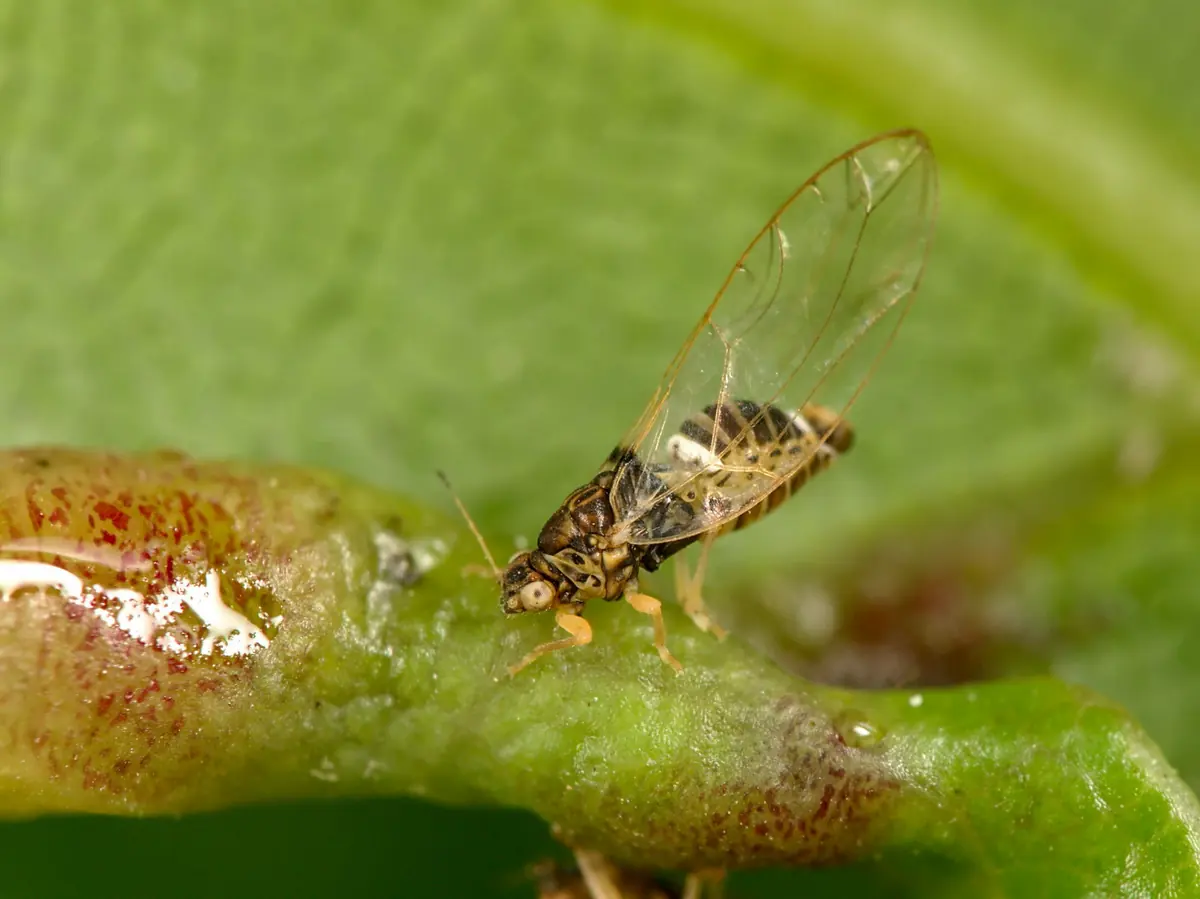
- Adults are 2 to 4 mm long with clear, roof-shaped wings held over the body, and they spring off the leaf when you brush the plant.
- Nymphs are flat, pale and slow-moving, and many kinds produce white waxy threads, sticky honeydew or small protective covers.
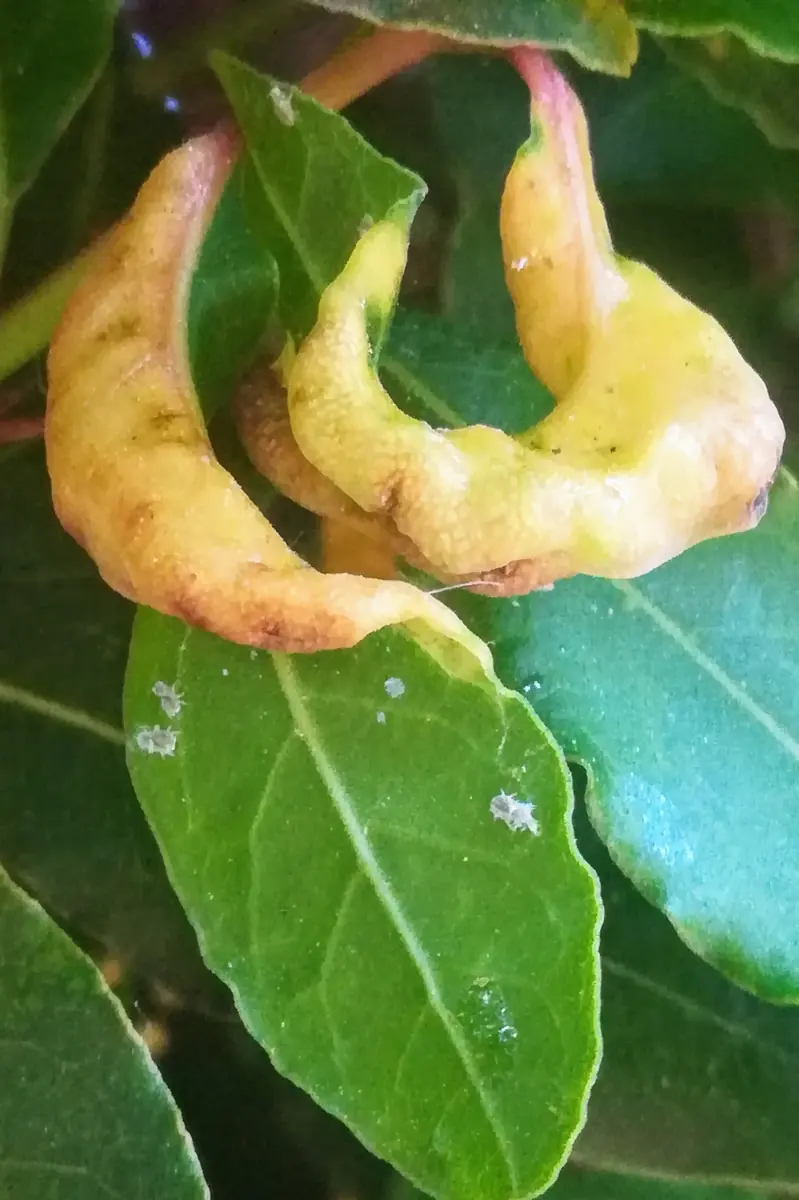
- On bay, the bay psyllid known overseas as bay sucker makes the edges of young leaves thicken, turn pale yellow and roll downwards into a tube, with pinkish nymphs and white wax inside the roll.
- On lemon myrtle, psyllid feeding shows on new growth as small raised pimples, pits or distorted, discoloured young leaves that stay marked after they harden.
- Heavily affected shoots can carry sooty mould growing on the honeydew, and damaged leaves often yellow and drop early.
What it is often confused with
Rust
Myrtle rust on lemon myrtle shows as bright yellow, powdery spore masses on new leaves and shoots that rub off on a tissue. Psyllid damage has no powder, and you can usually find nymphs or wax on the leaf.
Scale
Scale insects stay fixed in one place under a hard or waxy cover on leaves and stems. Psyllid adults jump and fly, and nymphs sit in curled or pitted leaf tissue.
Aphids
Aphids cluster in visible colonies on shoot tips and do not make the leaf form pits or tight rolls. Psyllid nymphs are flatter and often hidden in distorted leaf tissue.
When and where it is worst
Australia has hundreds of native psyllid species, many tied to particular native plants in the myrtle family, so lemon myrtle grown in South East Queensland and northern New South Wales, its home range, can pick up native psyllids on its flush. Psyllid damage on lemon myrtle is most noticeable on young, fast-growing plants and hedges that are trimmed often, because each trim triggers a flush of soft leaves.
The bay psyllid that rolls the leaf edges of bay laurel is a well-known pest in Europe, North and South America. We could not find an official record confirming it is established in Australia, so if you see thickened, rolled bay leaf margins with waxy nymphs inside, take clear photos and report it to the Exotic Plant Pest Hotline on 1800 084 881 so it can be identified. Psyllids in general breed fastest in warm, humid weather in spring and late summer to autumn when plants are flushing.
Plants it attacks
These plants in our library list it as a problem to watch for.
How to prevent it
- Check new growth weekly in spring and late summer, looking under young leaves and inside any curled edges.
- Avoid heavy nitrogen feeding and frequent hard trimming, which produce a steady supply of soft growth that psyllids prefer.
- When you buy bay or lemon myrtle, choose plants with clean, flat new leaves.
- Encourage ladybirds, lacewings, hoverflies and small parasitic wasps with flowering plants nearby, and avoid broad-spectrum sprays that kill them.
- Give plants good airflow and avoid crowding them in damp, sheltered corners.
Organic control, step by step
- Pinch off and bin rolled, pitted or distorted shoots as soon as you see them, before the nymphs mature.
- Hose shoots firmly to dislodge adults and exposed nymphs.
- Spray new flush with a horticultural oil (petroleum or botanical) or a potassium soap, covering both sides of the leaves, and repeat after one to two weeks; nymphs already sealed inside rolled leaves are hard to reach, so aim to protect the next flush.
- Use bay and lemon myrtle leaves from clean shoots in the kitchen and discard damaged ones.
Conventional control
- Horticultural oils (paraffin or petroleum oil) and potassium soaps registered for psyllids or sap-sucking insects on ornamentals are the main home garden options.
- Natural pyrethrins can knock down adults; use them only where the label lists the plant and pest, and spray in the evening to protect bees.
- Because bay and lemon myrtle leaves are eaten, read the label, check the plant is listed and keep to any withholding period before harvesting leaves.
Frequently asked questions
Why are the edges of my bay leaves rolled and yellow?
Overseas this is the classic sign of the bay psyllid, whose nymphs live inside the rolled, thickened edge under white wax. We could not confirm the insect is established in Australia, so photograph the damage and report it to the Exotic Plant Pest Hotline on 1800 084 881. Rolled edges can also come from scale, mites or cold damage.
Are leaves damaged by psyllids safe to cook with?
Psyllids do not make leaves toxic, but damaged leaves are tough and less flavourful. Wash leaves well, discard any with wax or sooty mould, and do not harvest leaves within the withholding period of any spray.
Is it psyllids or myrtle rust on my lemon myrtle?
Rub a cloth over the damaged new leaves. Myrtle rust leaves bright yellow powder on the cloth, while psyllid damage does not. Lemon myrtle is very susceptible to myrtle rust, so it is worth checking carefully.
Do I need to spray psyllids?
Usually not on established plants. Removing damaged shoots and letting predators build up is often enough, and sprays mainly help when you want to protect a new flush on a young plant.
Related problems
Sources: Royal Horticultural Society, Bay sucker; Atlas of Living Australia, occurrence records for Lauritrioza alacris (none found, checked 2026-10-11). Identification and control follow these sources. Always read the product label before use.