Phylloxera: identify, prevent, control
Updated October 2026
Populations peak from November to March; weak, yellowing patches of vines are easiest to spot in summer.
Grape phylloxera is a tiny yellow insect that feeds on grapevine roots and sometimes on leaves. On vines growing on their own roots it causes a slow decline and can kill them within about six years, and there is no treatment. Phylloxera is only found in some regions of Victoria and New South Wales, so moving vines, cuttings, soil and used equipment is regulated to keep it from spreading.
Daktulosphaira vitifoliae
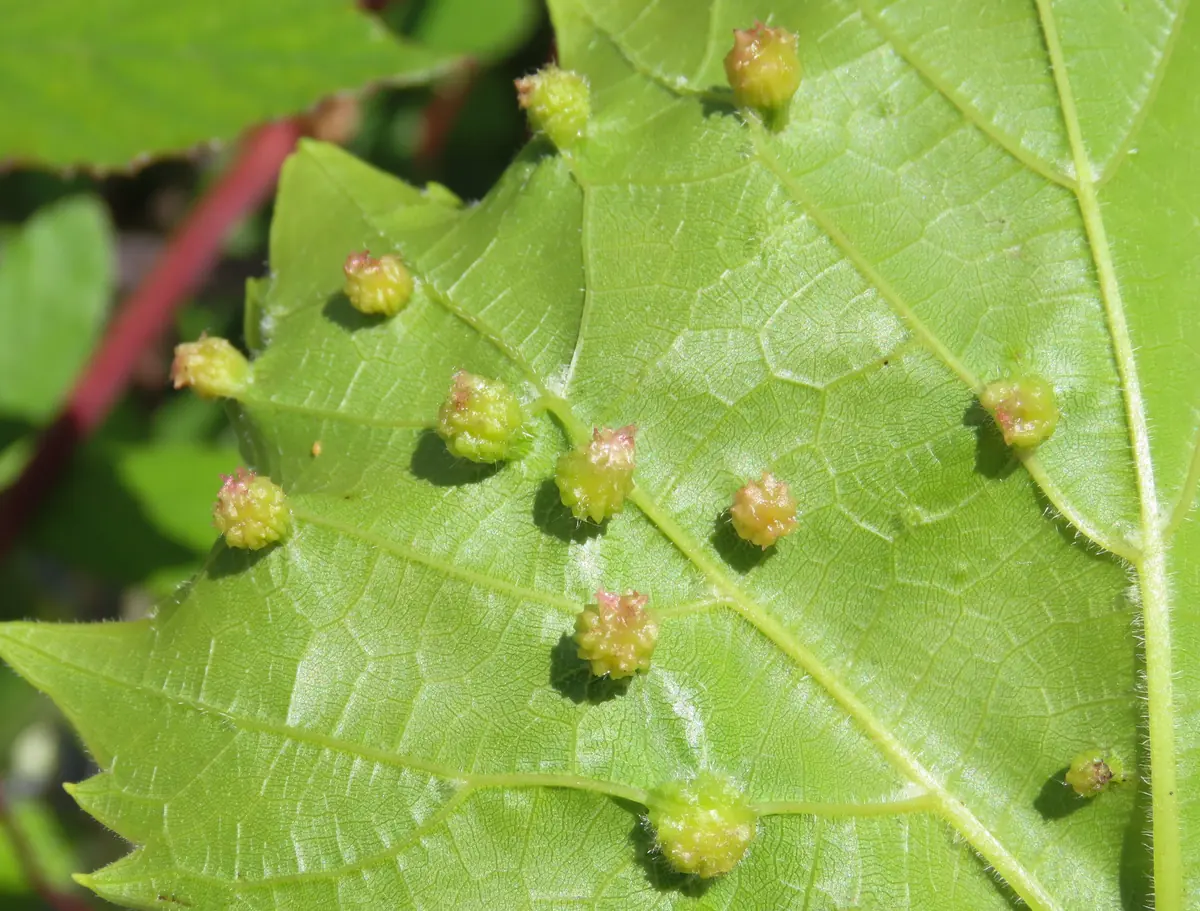
How to identify it
- Above ground, you first notice a small patch of two or three vines that are weaker than their neighbours, with shorter shoots, smaller leaves and less fruit.
- Leaves on affected vines turn from rich green to pale green and then yellow, and the patch of weak vines widens each year.
- Strong weeds or grass growing at the base of an obviously struggling vine is a hint that the roots, not the soil, are the problem.
- Dig carefully at the base of a weak vine and look at the young feeder roots for small, hooked, yellowish swellings, and at older roots for rough, rotting lumps.
- With a x10 lens you may see the insects themselves, oval, yellow to brown and only about 1 mm long, clustered on the root galls.
- Leaf galls, small pimple-like swellings on the underside of leaves, are uncommon in Australia but do occur in some areas.
What it is often confused with
Nematodes
Root-knot nematodes also cause root swellings and vine decline, but their galls are within the root and you will not see insects on the surface. A laboratory test sorts them out.
Root rot
Root rot is linked to waterlogged soil and shows dark, soft, dead roots without galls. Phylloxera damage starts as galls on living roots.
When and where it is worst
Phylloxera is confined to parts of Victoria and New South Wales, where several regions are declared Phylloxera Infested Zones. South Australia, Western Australia, the Northern Territory and Tasmania are recognised as phylloxera-free, and other areas are treated as risk zones because their status is unknown. Backyard grapevines, including ornamental and table grapes, can host phylloxera just like vineyard vines.
The insects live on the roots through the year and breed fastest in warm weather, with numbers peaking from November to March. They spread by crawling through cracks in dry soil and over the surface, and are carried long distances on rooted vines, cuttings, soil, boots, vehicles and equipment, and even in grapes and grape waste. Vines grafted onto resistant rootstocks tolerate phylloxera, while vines on their own roots are most at risk.
Plants it attacks
These plants in our library list it as a problem to watch for.
How to prevent it
- Buy grapevines only from accredited nurseries and, if you live in or near a wine region, choose vines grafted onto phylloxera-resistant rootstock.
- Do not swap cuttings, rooted vines or soil from other people's gardens or vineyards, and never bring grapevine material across state borders without checking the rules.
- If you live in a Phylloxera Infested Zone, do not move grapevines, cuttings, grapes, soil or used vineyard equipment out of the zone without a permit.
- When visiting vineyards, stay on paths, do not walk among the vines and clean soil off your shoes before visiting another vineyard or your own garden.
- Check your vines each summer for a patch that is weaker than the rest.
Organic control, step by step
- There is no organic or chemical cure for phylloxera, so prevention and grafted vines are the only lasting answer.
- Keep infested vines well watered and fed, which can prolong their life but will not save them.
- If phylloxera is confirmed, follow your state agriculture department's advice on removing vines and replanting on resistant rootstock.
Conventional control
- No insecticide is registered in Australia to control phylloxera on grapevine roots; there is no treatment.
- In Victoria phylloxera is a declared notifiable pest: if you suspect it, you must report it to Agriculture Victoria within 7 days by phoning 136 186, and in other states contact your state agriculture department or the Exotic Plant Pest Hotline on 1800 084 881.
- Treat any product claiming to cure phylloxera with suspicion, and always read the label, check the crop is listed and keep to the withholding period for anything you apply to grapes.
Frequently asked questions
Do home gardeners have to report phylloxera?
Yes. In Victoria it is a notifiable pest and anyone who owns or occupies the land must report a suspected case within 7 days, and other states also require reporting. Contact your state agriculture department or call the Exotic Plant Pest Hotline on 1800 084 881.
Can I take a grapevine cutting from a friend's garden?
Only if you are sure it is legal to move it. In and around Phylloxera Infested Zones, and into phylloxera-free states, moving grapevine material without a permit is an offence. Buying certified vines from a nursery is the safe choice.
Is there a spray for phylloxera?
No. The insects live on the roots and there is no registered treatment. Vines grafted onto resistant rootstocks are the only long-term protection.
Are the pimples on my grape leaves phylloxera?
They might be, but leaf galls from phylloxera are uncommon in Australia. Erineum mite, which causes blistered leaves with felt underneath, is far more common. If you are unsure, send photos to your state agriculture department.
Related problems
Sources: Agriculture Victoria, Grapevine phylloxera; Agriculture Victoria, Phylloxera information for visitors, home gardeners and winemakers; Vinehealth Australia, Grape phylloxera; Department of Agriculture, Fisheries and Forestry, Grape phylloxera. Identification and control follow these sources. Always read the product label before use.