Pear and cherry slug: identify, prevent, control
Updated October 2026
Two generations a year in southern Australia: a smaller one peaking around November and a much larger one from mid to late summer.
Pear and cherry slugs are not slugs at all but the larvae of a small black sawfly. They feed on the upper surface of leaves on pears, cherries, plums, quinces and hawthorns, leaving a lacy brown skeleton. They rarely kill a tree, but a bad late summer attack can strip most of the leaves and weaken next season's crop.
Caliroa cerasi
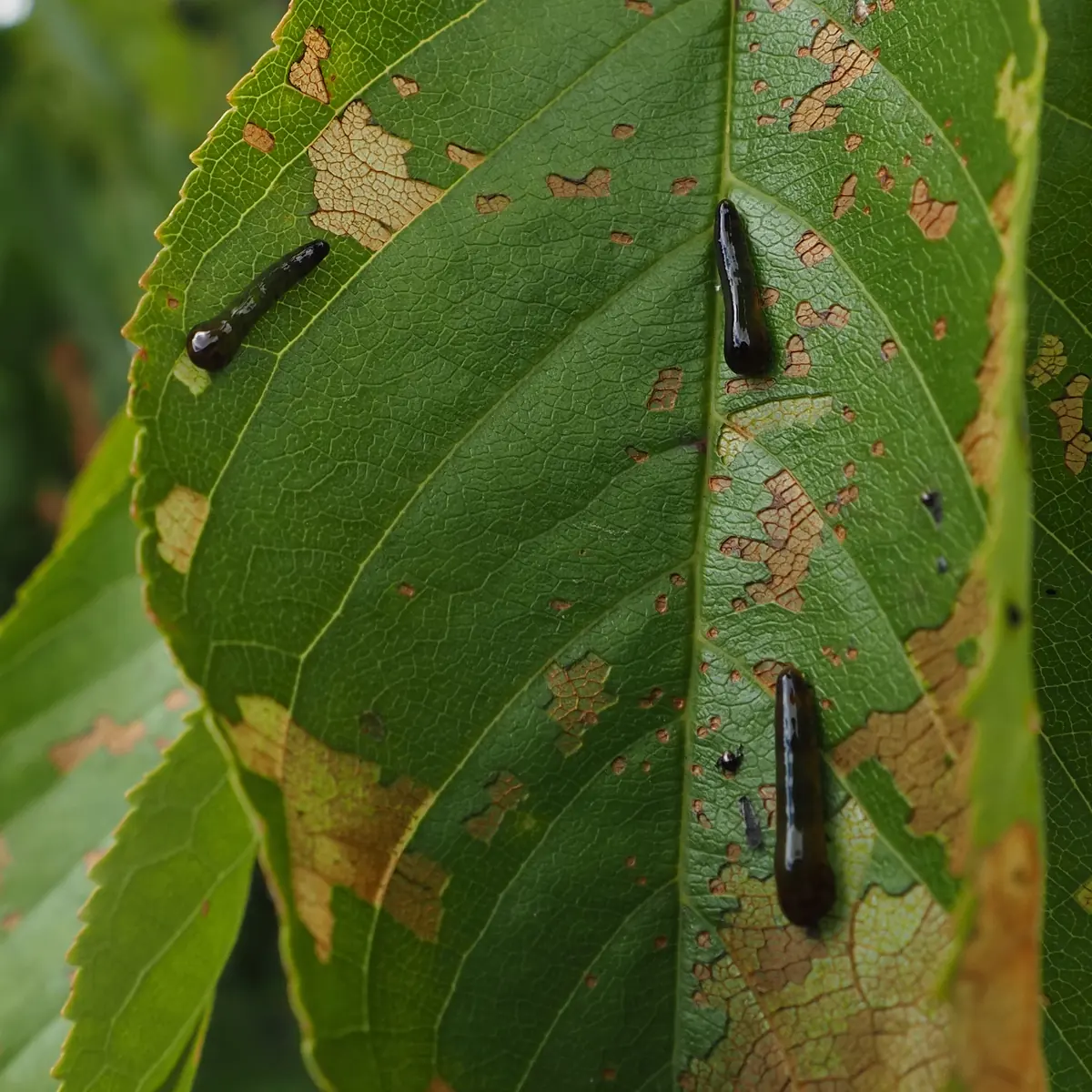
How to identify it
- Look on the upper side of the leaves for small, glossy, dark olive to black larvae about 5 to 10 mm long that are fatter at the head end, like a tiny leech or tadpole.
- The larvae are covered in a slimy coating, which is why they look like slugs, and they turn yellowish just before they drop to the soil to pupate.
- Feeding scrapes away the upper leaf surface between the veins, leaving a see-through, window-like patch that soon turns brown.
- In a heavy attack whole trees turn brown in late summer, as if scorched, and leaves fall early.
- The adult is a small, shiny black sawfly about 5 mm long that cuts tiny slits in leaves to lay its eggs.
What it is often confused with
Slugs
True slugs are much larger, grey or brown, feed at night and leave silvery trails and ragged holes. Pear and cherry slugs sit on the top of leaves in daylight and only scrape the surface.
Caterpillars
Caterpillars chew right through leaves, leaving holes and droppings. Pear and cherry slugs leave the lower skin of the leaf intact as a brown window.
When and where it is worst
This European sawfly is widespread across southern Australia, including New South Wales, the ACT, Victoria, Tasmania, South Australia and the south-west of Western Australia. It is a common sight in cool and temperate gardens from Hobart and Melbourne to Canberra, Adelaide and the tablelands. Pears and cherries are the hosts listed on our site, and it also attacks plums, quinces, apples, hawthorns and ornamental cherries and pears.
The insects spend winter as pupae in the soil under host trees. Adults emerge in spring and the first generation of larvae feeds from about October, peaking around November. These larvae drop to the soil, pupate, and a second, much larger generation appears from mid to late summer, often after cherries have been picked, and it can strip trees by February and March.
Plants it attacks
These plants in our library list it as a problem to watch for.
How to prevent it
- Start checking the upper surface of leaves from October, especially on lower branches you can easily see.
- Act on the first, smaller generation in spring, because that is the key to preventing the big summer generation.
- Keep flowering plants nearby to encourage hoverflies, lacewings, paper wasps and birds that eat the larvae.
- After harvest keep watching cherries, which are often hit hard once the fruit is off.
- A thick layer of mulch under the tree may reduce the number of adults emerging from the soil in spring.
Organic control, step by step
- On small trees, pick the larvae off by hand or hose them off the leaves with a strong jet of water.
- Dust the larvae lightly with fine wood ash, hydrated lime, talc or flour on a dry day; the powder sticks to their slimy coating and dries them out.
- If numbers are high, spray spinosad, an organic-certified insecticide, where the label lists pear and cherry slug, covering the upper leaf surface.
- Repeat checks two weeks later, because eggs hatch over several weeks.
Conventional control
- Spinosad is the most widely used home garden insecticide for pear and cherry slug and is suitable for organic gardens; apply when larvae are young.
- Natural pyrethrins can also be used where the label lists the pest and crop; spray in the evening to protect bees.
- Read the label, check the crop is listed and keep to the withholding period before you pick fruit.
Frequently asked questions
What are the black slimy slugs on my cherry tree leaves?
They are almost certainly pear and cherry slugs, the larvae of a sawfly. They scrape the top of the leaf, leaving brown see-through patches.
Will pear and cherry slug kill my tree?
No, but heavy leaf loss in late summer reduces the food the tree stores for next spring, which can mean a smaller crop. Young trees are set back the most.
Does dusting with ash or flour really work?
Yes, on small trees. The larvae rely on their slimy coating to stay moist, and a fine dry powder makes them shrivel. Reapply after rain.
When is the best time to control them?
In spring, when the first generation appears around October and November. Controlling those larvae stops the much larger generation that arrives in late summer.
Related problems
Sources: NSW DPI via Tree Fruit, Pear and cherry slug; Yates Australia, Pear and cherry slug; Sustainable Gardening Australia, Pear and cherry slug. Identification and control follow these sources. Always read the product label before use.