Pea weevil: identify, prevent, control
Updated October 2026
Adults fly into flowering peas from late winter to spring, from about August to November, mainly in southern Australia.
Pea weevil is a small seed beetle that attacks only peas, including garden peas, field peas and snow peas. The adult lays eggs on young green pods, and the grub bores straight into a developing seed, where it feeds unseen. Most home gardeners notice it only when they find round holes in dried or saved peas, often with a beetle still inside.
Bruchus pisorum
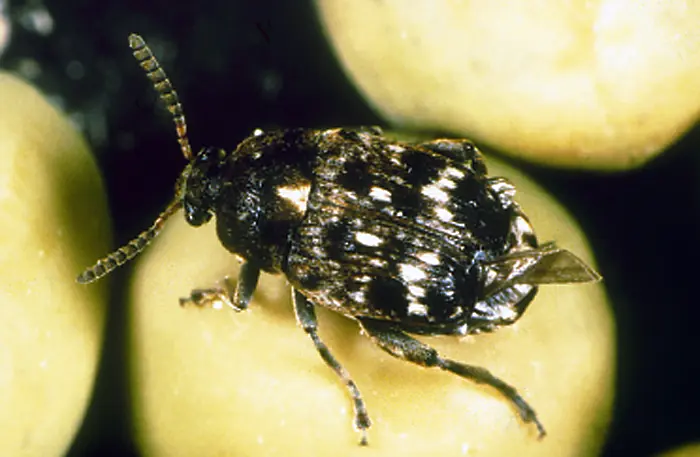

How to identify it
- Adults are small, stout beetles about 5 mm long, brown to black with patches of white and grey scales and a pale, heart shaped mark near the tip of the body.
- In spring you may see the beetles on pea flowers, where they feed on pollen before laying eggs.
- Tiny yellowish eggs are laid singly on the outside of young pods, and each one has a small cream to yellow spot where the grub bored in.
- Inside a green pea seed, a small cream grub sits in a hollow it has eaten, but the outside of the pea usually looks normal.
- In dried peas you find a round window or hole about 3 mm across where the adult has chewed its way out, and some peas still hold a live beetle.
What it is often confused with
Pod borer
Pod borer caterpillars bore through the pod wall and leave droppings and webbing, while pea weevil grubs leave almost no sign until the dried pea shows a neat round hole.
Caterpillars
Caterpillars chew leaves and pods from the outside and are easy to see, but a pea weevil grub never leaves the seed it bores into.
When and where it is worst
Pea weevil is a pest wherever peas are grown in southern Australia, including Western Australia, South Australia, Victoria and southern NSW. It has one generation a year. Adults spend summer, autumn and winter sheltering under bark, in sheds and in stored peas, then fly to flowering pea crops as days warm up in late winter and spring. Females must feed on pea pollen before they can lay eggs, which happens on young pods from about September to November.
The grubs feed inside the seeds for several weeks while the peas fill out and dry. The new adults either chew their way out in late spring or stay in the dried peas, which is how saved seed and stored peas carry the pest into the next season. Garden peas and snow peas that are picked young are usually harvested before the grubs do much damage.
Plants it attacks
These plants in our library list it as a problem to watch for.
How to prevent it
- Sow early and pick garden peas and snow peas as soon as they are ready, because pods picked green and young are much less affected.
- Do not leave old pods to dry on the vine, as these produce the beetles for next year.
- Pull out and remove pea plants as soon as you have finished harvesting.
- Check any peas you save for seed and throw out those with holes or dark windows in them.
- Freeze saved pea seed for at least a week before storing it, which kills any grubs or beetles hiding inside.
- Cover small plantings of peas with fine insect mesh before flowering if you are growing them for dry seed, which works well because garden peas pollinate themselves and do not need insects to set pods.
Organic control, step by step
- Pick pods regularly and young, which is the simplest and most effective control for fresh peas and snow peas.
- Shake flowering pea plants over a light coloured tray early in the morning to collect and destroy adult beetles.
- Harvest dry peas as soon as they are ready, then freeze them for a week before storing to kill any weevils inside.
- Clean up spilt peas and old pea straw around the garden and shed, where adults can shelter until spring.
Conventional control
- Commercial pea crops are sprayed against adult weevils at flowering, but we could not find a home garden insecticide registered in Australia that lists pea weevil, so cultural control is the right approach in the garden.
- Sprays at flowering also harm bees and other beneficial insects, and they cannot reach grubs already inside the seeds.
- If you do use any garden insecticide on peas, always read the label, check that peas are listed, and keep to the withholding period before you pick.
Frequently asked questions
Are peas with weevil holes safe to eat?
They are not harmful, but they are hollowed out and often hold a dead or live beetle. Throw them out rather than cook or plant them.
Will pea weevil attack my broad beans or other beans?
No. Pea weevil only breeds in peas. Broad beans, beans and other legumes have their own pests, such as pod borer and the broad bean weevil, which is a different beetle.
Why do my saved peas have beetles in them months later?
The adults that develop inside the seeds often stay put until spring. Freezing your saved seed for a week as soon as it is dry kills them and stops them spreading in your storage area.
Related problems
Sources: Cesar Australia, Pea weevil; WA DPIRD, Management of pea weevil; PIRSA PestFacts, Pea weevil watch: monitor now, spray smart. Identification and control follow these sources. Always read the product label before use.