
Australian native ground covers for the vegetable garden
Updated November 2026
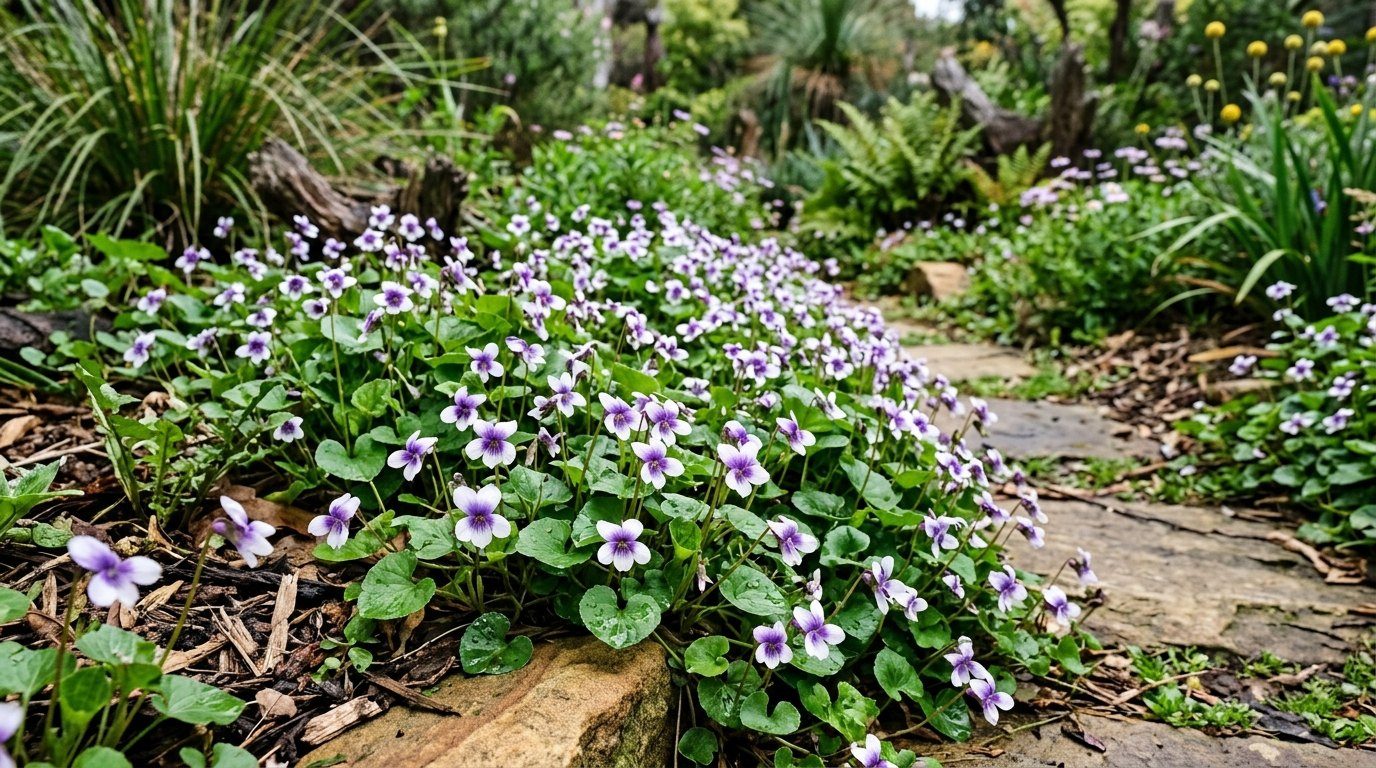
Living mulch for paths, bed edges and the ground under fruit trees.
Native ground covers are low Australian plants that can act as a living mulch on paths, under fruit trees and around the edge of vegetable beds. The best ones for a food garden are native violet for shade, creeping boobialla and creeping saltbush for dry sun, and Hardenbergia for a tough spreading cover. Plant them to cover bare soil in the places you do not grow crops, and keep them back from seedlings and tree trunks.
Why a ground cover helps a food garden
Bare soil dries out, crusts over and grows weeds. A living cover shades the surface, so the soil underneath stays cooler and holds water longer, in the same way as the mulch described in our mulching guide. A cover that stays green in the dry months also gives shelter to small creatures at ground level. Ground beetles and frogs are both helped by cool, damp cover. This is general garden ecology, not a claim that one ground cover will bring either, so treat it as a likely benefit rather than a promise.
- Paths and edges: A low cover fills the gaps between stepping stones and softens bed edges, so weeds have less room.
- Under fruit trees: A cover over the root zone shades the soil and keeps the mulch from blowing away, as long as it does not touch the trunk.
- Small native bees: Small open flowers are easy for small bees to reach. See native plants for bees and stingless bees.
- Cover for ground-dwelling helpers: Thick low growth gives shelter to the small animals that live at soil level. The good bugs guide covers the insects worth encouraging.
Native ground covers compared
The sources below give different amounts of detail, so this table includes only what each source states.
| Plant | Habit and size | Position and soil | Useful for |
|---|---|---|---|
| Native violet (Viola hederacea) | Spreading mat-former | Shade and under trees, per our guide | Shaded borders, between pavers, under trees |
| Creeping boobialla (Myoporum parvifolium) | Spreads to cover about 1 square metre per plant | Full sun, freely drained soil | Dense, weed-suppressing cover on dry, sunny ground |
| Hardenbergia violacea 'Happy Wanderer' | 0.4 to 0.5 metres high, 2 to 5 metres spread | Full sun, clay, loam or sand | Mass planting as ground or fence cover |
| Creeping saltbush (Atriplex semibaccata) | 0.1 to 0.3 metres high, 1 to 3 metres spread | Full sun, clay or loam, neutral or alkaline | Soil cover on dry or salty ground |
Native violet
Native violet (Viola hederacea) is the one to use in shade. Our guide describes it as a spreading mat-former with delicate white and purple edible flowers that suits shaded borders, the gaps between pavers and the ground under trees. It already has its own page, so this guide does not repeat its growing details. See how to grow native violet. For the edible flowers, be certain of the species before you eat any, as our guide advises. If you grow shade-tolerant crops nearby, our vegetables that grow in shade guide helps you plan the space.
Is native violet invasive?
People do search for this. Native violet spreads by runners, so in a moist, shaded spot it will move across bare ground and can reach neighbouring beds. That is the reason to put an edge, such as a path or a mulched strip, between it and your crops. We have not found it on a state weed list. It is an Australian native, and if you live next to bushland, check your council list and local native plant society, because a plant that behaves in one region may spread from seed or runners in another.
Creeping boobialla (Myoporum parvifolium)
Creeping boobialla is a hardy evergreen native that suits full sun and freely drained soil. The Grow Me Instead guide describes it as a dense, weed-suppressing ground cover that spreads to cover about 1 square metre per plant, with white or pink flowers from winter to summer and sweet fleshy fruits that feed native birds. It is a good choice for a dry, sunny bank or path edge, where there is not enough water for a mat of violets. Grow Me Instead lists it under its Western Australia region, so it may suit that state best. If you live elsewhere, ask your local native plant society whether it is a good local choice.
The fruits feed native birds, so you may see more small birds around, and some of them may also peck at nearby soft fruit. Net berries and stone fruit if birds become a problem, as described in the birds in the garden guide.
The Myoporum weed question
Searches for Myoporum ground cover can mix up species, because several different plants, some of them from overseas, are sold under the name Myoporum or boobialla. The plant to look for is creeping boobialla, and the label should show the full name Myoporum parvifolium, not just boobialla or Myoporum. Check the name, and check your council list before planting any other Myoporum.
Hardenbergia ground cover
The Botanic Gardens of South Australia describe Hardenbergia violacea 'Happy Wanderer' as a low shrub up to 1.2 metres that can also climb, evergreen, clumping and spreading, about 0.4 to 0.5 metres high with a spread of 2 to 5 metres. It grows in clay, loam or sand, in full sun, with minimal extra water once settled, and tolerates drought and moderate frost. It has purple pea-type flowers and attracts native butterflies, and the caterpillars feed on it. The source says it responds well to hard pruning, and suits mass planting as ground or fence cover. The page lists it as indigenous to the Adelaide region.
The spread of 2 to 5 metres is the key fact. Hardenbergia is not a plant to put beside a small bed unless you are willing to cut it back each year. Use it on a fence line, or as a cover on a slope beside the vegetable area, and prune it hard when it reaches the edge of the bed. Butterfly caterpillars will chew the leaves, which is a trade-off for butterflies. The source does not mention weed status, so check your council list, especially outside South Australia.
Creeping saltbush and prostrate grevillea
Creeping saltbush is a mat that spreads 1 to 3 metres and stays under 0.3 metres, according to the South Australian plant selector, which also says it suits soil and erosion control in saline areas. It is covered in more detail on the saltbush page, including its weed status. Prostrate grevilleas are low spreading forms of a larger plant group that is covered on the grevillea page, which also covers which species suit which region.
How to use ground covers around crops
- Keep covers out of the beds. A ground cover competes with seedlings for water and light, so edge beds with a path, a board or a strip of mulch.
- Keep covers off the trunk. Leave a clear ring of bare mulch around each fruit tree, because a cover pressed against the bark holds moisture there. See the mulching guide.
- Match the cover to the light. Violet for shade, boobialla and saltbush for dry sun.
- Water to establish. New plants need regular water for the first season, as in the watering guide.
- Edge once or twice a year. Cut back the runners that reach the beds.
If you want a cover that you grow and then dig in, see the green manure and cover crops guide, which is a different job from a permanent living mulch.
When to plant by region
Plant ground covers when the soil is warm enough to grow but there is time for roots to settle before heat or frost. See when to plant natives for more.
| Region | Climate | What to aim for |
|---|---|---|
| South East Queensland and Northern Rivers | Subtropical | Autumn to early spring, with water until established. |
| Sydney and Coastal NSW | Warm temperate | Autumn or spring. |
| Melbourne and Victoria | Cool temperate | Spring after the last frost (about 10 September) or autumn before the first frost (about 15 May). |
| Adelaide and SA | Mediterranean | Autumn, with winter rain to help (last spring frost about 20 August, first autumn frost about 1 June). |
| Perth and WA | Mediterranean | Autumn, with winter rain to help. |
| Tasmania | Cool temperate | Spring after the last frost (about 5 October), or early autumn before the first frost (about 25 April). |
| Canberra and ACT | Cool highlands | Late spring after the last frost (about 1 November), or early autumn before the first frost (about 10 April). |
| North Queensland and Darwin and Top End | Tropical wet and dry | The start of the wet season (November) or the dry season with regular watering. |
Frost dates are regional midpoints from our frost dates page. Darwin and Top End, North Queensland, Northern Rivers, Perth and WA, South East Queensland and Sydney are frost free at the regional midpoint, though hinterland and inland spots can frost.
Weed status and where to check
Some ground covers that are native to one part of Australia spread into bushland in another. Weed status is local. We have not found creeping boobialla, hardenbergia, creeping saltbush or native violet on a state weed list, but these plants can spread from seed or runners in some areas, so check your council list before you plant. Choose plants local to your area where you can, and ask your local native plant society. Your state agency, such as NSW DPI WeedWise, Agriculture Victoria, Business Queensland, WA DPIRD, PIRSA or Tasmania NRE, publishes current weed lists, and Grow Me Instead is a guide to alternatives to weedy garden plants.
Questions
Is native violet invasive?
It spreads by runners, so it can move into nearby beds in moist shade. We have not found it on a state weed list, but check your council list and put an edge between it and your crops.
Which native ground cover is best for full sun and dry soil?
Creeping boobialla and creeping saltbush are both described as suiting full sun and dry or free-draining soil, according to Grow Me Instead and the Botanic Gardens of South Australia.
Is Myoporum a weed in Australia?
Creeping boobialla (Myoporum parvifolium) is an Australian native, and we have not found it on a state weed list. Several different plants are sold as Myoporum, so check the full plant name and your council list.
How big does Hardenbergia 'Happy Wanderer' spread?
The Botanic Gardens of South Australia list it at 0.4 to 0.5 metres high and spreading 2 to 5 metres, and say it responds well to hard pruning.
Can I plant a ground cover under fruit trees?
Yes, but keep a clear ring of mulch around each trunk so the cover does not press against the bark, and water the cover as well as the tree while it establishes.
Do native ground covers help bees and frogs?
Small open flowers are easy for small bees to reach, and thick low cover gives shelter at ground level. These are general benefits, not guarantees for a single plant.