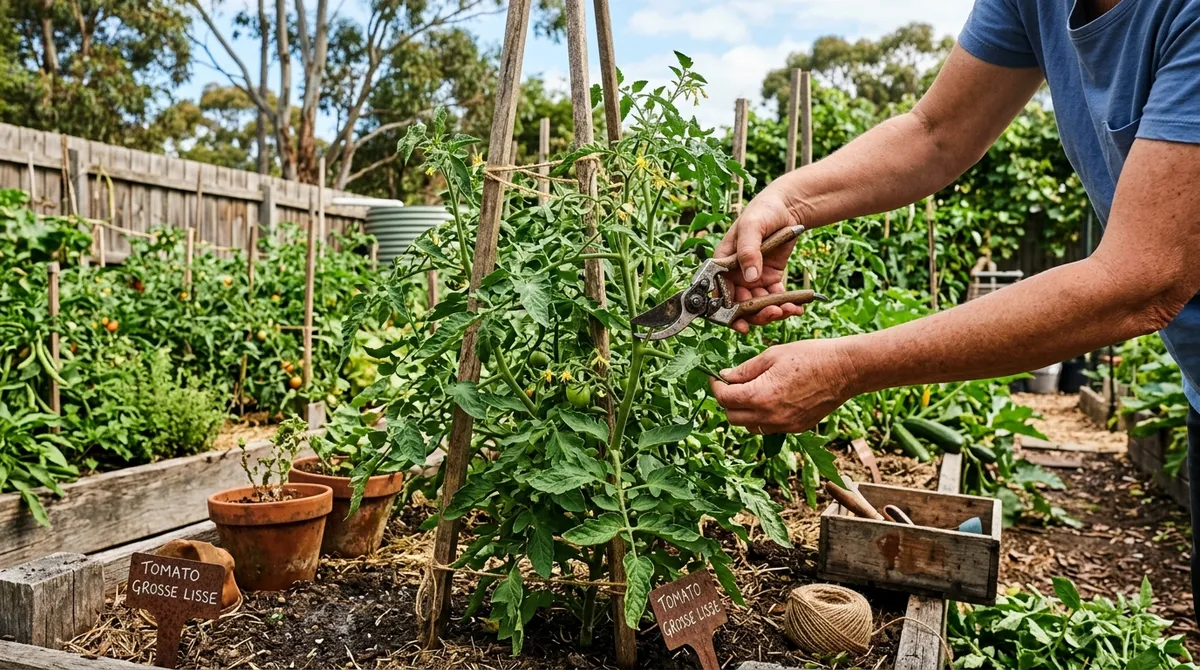
Staking and Spacing Tomatoes
Updated November 2026
Stakes, cages and string trellis, with the heights and spacing that keep plants upright and healthy.
All our tomato guides: when to plant in your region, varieties and fixes.
A tomato plant that falls over wastes fruit, snaps stems and invites disease. Good support and enough space between plants fix all three. This guide covers the four common ways to support tomatoes, how tall and how strong each one needs to be, how far apart to plant, and how to tie plants without damaging them. It is part of our how to grow tomatoes set, so planting months and feeding are covered there.
Quick answers
- Stake: about 1.8 m tall, driven 30 cm into the ground, and set at planting.
- Spacing: 60 cm between plants and 80 to 90 cm between rows.
- Ties: soft, loose and renewed about every 25 cm of growth.
- Bush types: a cage or short stake. Vine types: a tall stake or string.
🌱 Plant profile: Tomato, with sowing times for your region, companion plants and common pests.
Choose a support by plant type
Your variety's habit decides the support. Indeterminate (vine) tomatoes can grow past 1.8 m and keep producing, so they need a tall stake, string or frame. Determinate (bush) tomatoes stop at a set height of about 0.5 to 1 m and are fine in a cage or beside a short stake. Check the habit in our tomato varieties guide.
| Plant type | Best support | Height |
|---|---|---|
| Vine slicers and beefsteaks, such as Grosse Lisse and Brandywine | Strong single stake or string trellis | 1.8 m, up to 2 m for heavy beefsteaks |
| Vine cherry types, such as Tommy Toe and Sungold | Tall stake or string trellis | 1.8 m or more |
| Bush types, such as Roma and Mighty Red | Wire cage or short stake | 60 to 100 cm |
| Dwarf types, such as Tiny Tim and Tatura Dwarf | None, or a light stake | Under 60 cm |
Single stake
A single stake is the simplest system and works well for vines pruned to one or two stems.
- Use a sturdy stake about 1.8 m long. Drive it 30 cm into the ground about 10 to 15 cm from the stem, at or soon after planting.
- Tie the main stem to the stake with a soft tie every 25 cm or so as the plant grows.
- Tie below each flower truss, where the stem is strongest, and leave room for the stem to thicken.
- Add a second tie under any heavy truss so the weight does not drag the stem down.
Timber stakes or steel posts both work. Scrub stakes and let them dry between seasons so any disease from last year's plants does not carry over.
Tomato cage
A cage supports the side branches without any tying, which makes it popular with gardeners who do not want to check ties every week. It suits bush varieties best.
- Make or buy a cage from stiff wire mesh with gaps of about 15 cm, so you can reach in to pick the fruit.
- Set the cage over the seedling at planting, and pin it down with stakes or pegs in windy spots.
- For a vine in a cage, prune to three or four stems and tuck them inside as they grow.
- Check that the cage is tall and strong enough. Light tomato cages sold for small plants often fold under a full-size vine.
String trellis
A string trellis is the method most commercial growers use for vines, and it works well for a row of plants in the home garden.
- Set a strong post at each end of the row, and run a wire between them about 1.8 to 2 m above the ground.
- Tie a length of string to the wire above each plant and fix the other end loosely to the base of the stem, or to a peg beside it.
- Twist the plant around the string as it grows, or clip it on with tomato clips every 25 cm.
- Remove side shoots weekly, so each plant keeps one or two stems on the string.
For other climbing crops and structures, see our trellis and support guide.
How far apart to plant tomatoes
Our planting data gives 60 cm between tomato plants, and we use about 80 to 90 cm between rows. Spacing matters because crowded plants shade each other, dry slowly after rain and pass disease from leaf to leaf. Our blight guide shows what happens when leaves stay wet.
| Support | Between plants | Between rows |
|---|---|---|
| Single stake | 60 cm | 80 to 90 cm |
| Wire cage, large vine or bushy plant | 60 to 90 cm | 90 cm |
| String trellis, one or two stems | 45 to 60 cm | 80 to 90 cm |
| Bush variety with no pruning | 60 cm | 80 to 90 cm |
| Pots | One plant per pot | Leave room to reach every pot |
The stake, tie and cage measurements on this page follow Virginia Tech Cooperative Extension's tomato guide (publication 426-418), converted to metric. Extension and grower guides we checked agree on 45 to 60 cm in the row for staked and trained plants, and our figure of 60 cm sits at the generous end, which suits humid regions.
How to tie up tomatoes
- Use a soft material such as cloth strips, soft tape or stretchy plant ties. Thin wire and fishing line cut into stems.
- Make a loop around the stake first, cross it, then loop it loosely around the stem so there is space for growth.
- Tie about every 25 cm of stem growth, and always support the stem just below a flower truss.
- Check the ties every week when you prune and water, and loosen any that have become tight.
- If you keep a second stem, tie it to its own support.
When the plant outgrows its support
A healthy vine will reach the top of a 1.8 m stake well before the season ends. You have two choices. You can top the plant by cutting off the growing tip of each stem, which stops further height and sends energy into the fruit that is already set. Or you can unclip the stems from a string trellis and lower them, letting the lowest part of the stem lie in a loop along the ground while the top stays within reach. Either way, remove the leaves below the lowest ripening truss first, as our pruning guide explains.
Local conditions in Australia
- In humid South East Queensland and the Northern Rivers, lean towards the wider spacing and fewer stems per plant so leaves dry quickly.
- In windy places such as the southern coasts, use sturdier stakes or posts and tie more often, because a tall plant full of fruit acts like a sail.
- In hot regions, tomatoes drop flowers above about 32 °C by day, so a support that lets you hang shade cloth over the plants is useful during heatwaves.
Common mistakes
- Staking late. A stake pushed in beside an established plant can damage the roots, so set the support at planting.
- A stake that is too short. Vines grow past 1.8 m, so choose a tall stake or plan to top the plant.
- Ties that are too tight or too thin. As the stem thickens it can be strangled, so use soft ties and leave room.
- A cage that is too weak. A flimsy cage collapses under a heavy vine and is hard to replace once the plant is big.
- Crowding. Plants closer than 45 cm shade each other, hold moisture on their leaves and are slower to ripen.
Frequently asked questions
How tall should a tomato stake be?
Use a stake about 1.8 m tall for vine tomatoes, driven about 30 cm into the ground. Virginia Tech Cooperative Extension recommends a 6 foot stake driven 1 foot deep, which is the same measurement in metric.
How far apart should tomato plants be?
Our planting data gives 60 cm between plants. Allow about 80 to 90 cm between rows, and give large caged plants up to 90 cm each way.
When should I put in the stake?
At planting. A stake pushed in later can spear the roots of an established plant, so set the support before or just as you plant the seedling.
How do I tie up a tomato plant?
Use a soft tie such as cloth strips or soft tape, loop it once around the stake and then loosely around the stem, and tie below a flower truss where the stem is strong. Retie about every 25 cm of growth and check the ties each week.
Do bush tomatoes need staking?
A cage or a short stake helps, because a heavy crop of Roma or other paste fruit will pull a bush over. Dwarf types for pots often need no support at all.
Is a cage or a stake better?
Stakes and string are best for vines that you prune to one to three stems, and cages suit bush varieties and gardeners who prefer not to tie. A cage must be tall and strong enough, because a vine grown in a flimsy cage collapses under its own weight.
What do I do when my tomato grows past the top of the stake?
Either cut off the growing tip, which is called topping, or unclip the stem and lower it along the string so the top stays within reach. Topping about four to six weeks before your last expected harvest also helps the remaining fruit ripen.
See also: How to Grow Tomatoes, How to Prune Tomatoes and Tomatoes in Pots
Plant profile
The tomato profile has sowing times for your region, companion plants and common pests.