Panama disease: identify, prevent, control
Updated October 2026
Can show at any time, but symptoms are most obvious in hot weather or after a dry spell, in banana growing areas of Queensland, northern NSW, the Northern Territory and northern WA.
Panama disease, also called Fusarium wilt of banana, is caused by a soil fungus that enters through the roots and blocks the water conducting tissue of the plant. Race 1 has been in Australia for a long time and attacks varieties such as Lady Finger, Ducasse and Sugar, while tropical race 4 (TR4) also kills Cavendish and is one of the most serious threats to the banana industry. The fungus survives in soil for decades and there is no cure, so keeping it out is the only real defence.
Fusarium oxysporum f. sp. cubense

How to identify it
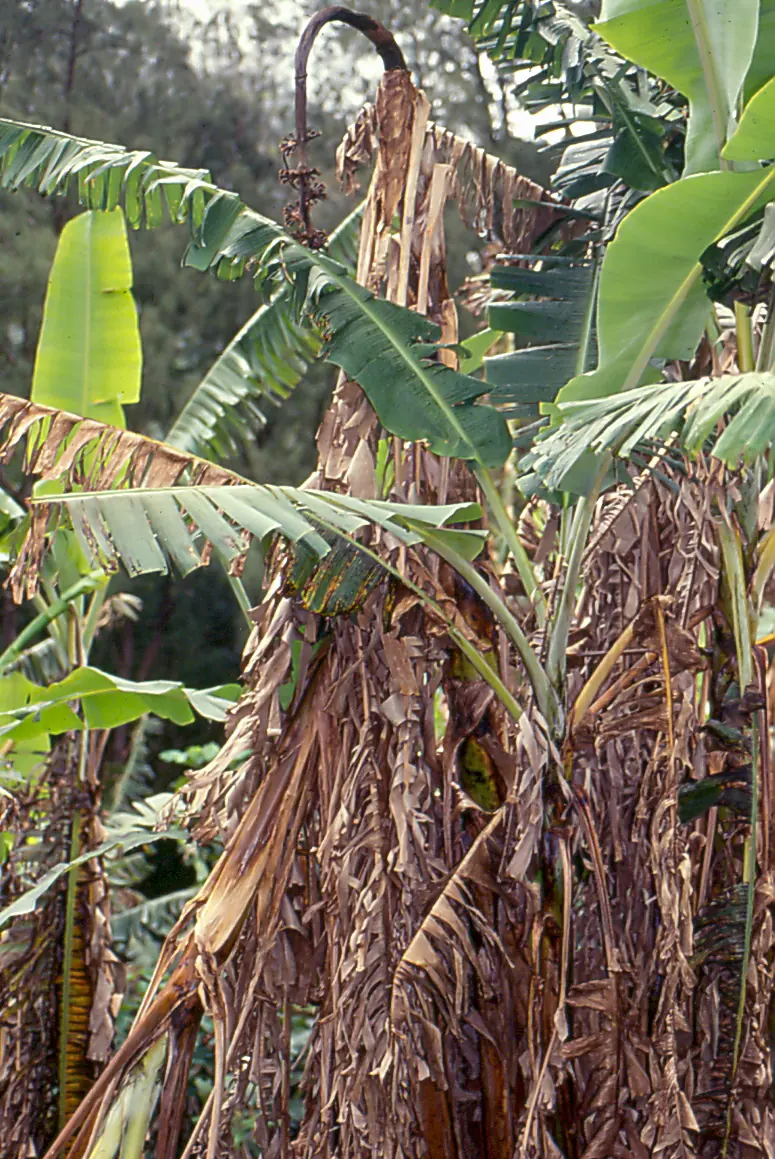
- The oldest leaves turn yellow, starting at the edges, and the yellowing moves inward and up the plant over a few weeks.
- Yellow leaves collapse at the leaf stalk and hang down around the trunk like a skirt, while the youngest leaves in the centre may stay green and upright for a while.
- The base of the trunk, or pseudostem, may split lengthways just above the ground.
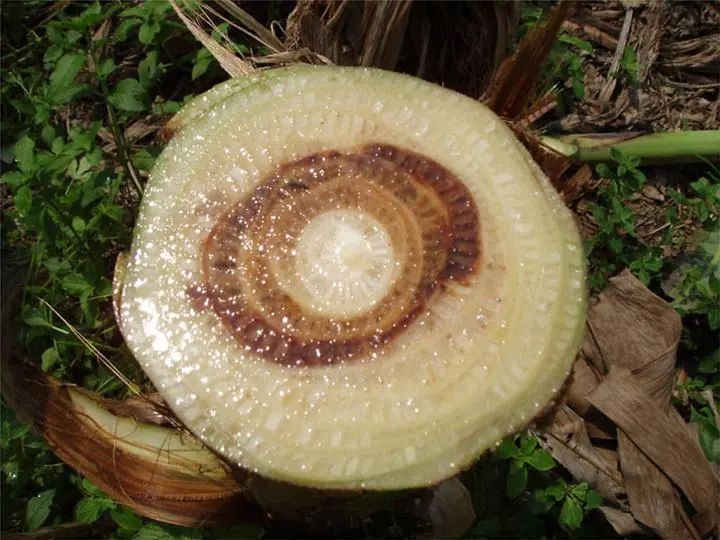
- Inside the trunk, the water conducting strands are stained red brown to purple, showing as dots or rings in a cross section, but Biosecurity Queensland asks you not to cut a suspect plant.
- Infected plants stop growing, produce small or no bunches, and eventually die, while their suckers become infected too.

What it is often confused with
Banana bunchy top
Bunchy top makes new leaves narrow, upright and crowded at the top, with dark green dot and dash lines on the veins. Panama disease yellows and collapses the older leaves first.
Yellow Sigatoka
Yellow Sigatoka makes distinct yellow streaks and brown spots on the leaves but does not collapse the leaves at the stalk or stain the inside of the trunk.
Banana weevil borer
Weevil borers weaken plants so they fall over, but cutting the base shows tunnels in the corm rather than stained water conducting strands.
When and where it is worst
Race 1 Panama disease is present in northern NSW, Queensland and the Carnarvon district of Western Australia, and it is common in backyard Lady Finger and Ducasse bananas in South East Queensland and the NSW north coast. Tropical race 4 was found in the Northern Territory in the 1990s and in Queensland in 2015, where Business Queensland reports it is contained to a small number of properties in the Tully Valley in Far North Queensland.
The fungus spreads in soil and water, on roots, suckers and infected plants, and on tools, footwear, vehicles and machinery carrying soil. It can survive in soil for decades without bananas, so a planting site that has had Panama disease is lost for susceptible bananas. Symptoms show most clearly in hot weather when the plant needs a lot of water.
Plants it affects
These plants in our library list it as a problem to watch for.
How to prevent it
- Buy banana plants only from an accredited supplier of tissue cultured plants, and never plant suckers, bits or soil from another garden or farm.
- In Queensland, you need a biosecurity certificate to move banana plants, soil or banana machinery between biosecurity zones or into Queensland from interstate, so check the rules with Biosecurity Queensland first.
- Choose varieties that suit your district, as Cavendish types resist race 1, while Lady Finger, Ducasse and Sugar bananas are susceptible.
- Clean soil off boots, tools and wheelbarrows before moving between banana plantings, and do not visit commercial banana farms in your gardening clothes.
- Grow bananas in well drained soil, because waterlogged, stressed plants show the disease sooner.
- Do not move water, soil or compost from around infected plants to other parts of your garden.
Organic control, step by step
- If you suspect Panama disease, do not cut, dig up or move the plant, and keep people and pets away from the soil around it.
- Report it, and follow the advice you are given on how to destroy the plant and its suckers on site.
- Do not replant susceptible bananas in the same spot, and do not compost or move soil and plant material from that area.
- Keep the rest of your bananas healthy with mulch, compost and good drainage, which helps them tolerate race 1 for longer.
Conventional control
- No fungicide or soil treatment can cure Panama disease or clean infected soil, and none is registered for home gardeners.
- Removal of infected plants may need to follow official directions, so report a suspect plant before using any chemical on it.
- If you use any product on your bananas, always read the label, check that bananas are listed, and keep to the withholding period.
Frequently asked questions
Do I have to report Panama disease?
Tropical race 4 must be reported. In Queensland, Business Queensland asks you to report suspected Panama disease within 24 hours to Biosecurity Queensland on 13 25 23 or the Exotic Plant Pest Hotline on 1800 084 881. Because you cannot tell race 1 from TR4 by eye, it is best to report any suspect plant and let officers decide.
Can I plant Cavendish where my Lady Finger died of Panama disease?
Cavendish resists race 1, so it can grow where race 1 has killed a Lady Finger, but it is not resistant to tropical race 4. Only do this once you know which race you have, and use tissue cultured plants.
Is fruit from a plant with Panama disease safe to eat?
Yes. The fungus does not affect people. The fruit is usually small and poor, and you must not move the plant, its suckers or soil from around it.
Related problems
Sources: Business Queensland, Panama disease tropical race 4; Panama TR4 Protect (Australian Banana Growers' Council), About Panama TR4; IPPC, Australia pest report: Panama disease tropical race 4. Identification and control follow these sources. Always read the product label before use.