Growing Mushrooms at Home: A Beginner's Guide
Updated June 2026
No garden bed needed, just a shady spot and a little patience
Mushrooms are different from every other food you can grow at home. They are not plants. They do not need soil, sunlight, or photosynthesis. They grow on organic material in the dark, breaking down dead matter and turning it into food. That makes them perfect for spaces where nothing else will grow: shady corners, garages, laundries, and balconies that never see direct sun.
Australia has a growing home mushroom scene, and getting started is straightforward. You can buy a ready-made kit and have mushrooms on the bench in two weeks, or you can set up a bucket or log system that produces flushes for months.
🌱 Plants in this guide: Oyster Mushroom and Shiitake. Each plant profile has sowing times for your region, companion plants and common pests.
How Mushrooms Grow: The Basics
Mushrooms are the fruiting body of a fungus, similar to how an apple is the fruit of a tree. The main organism is the mycelium, a network of white threads that grows through the substrate (the material the mushroom feeds on). When conditions are right, the mycelium produces mushrooms to release spores and reproduce.
There are two phases to mushroom growing:
- Colonisation. Mycelium grows through the substrate. This phase needs warmth (20 to 25 degrees), darkness, and minimal airflow. It takes 2 to 4 weeks depending on the species and substrate.
- Fruiting. Mushrooms emerge from the colonised substrate. This phase needs cooler temperatures (15 to 22 degrees for most species), high humidity (80 to 95%), fresh air exchange, and indirect light. Fruiting takes 7 to 14 days per flush.
Understanding these two phases is the key to successful mushroom growing. Most failures happen because people do not change conditions between phases.
Best Mushrooms for Beginners
Oyster mushrooms (Pleurotus species)
Oyster mushrooms are the best starting point. They colonise fast, tolerate imperfect conditions, grow on cheap substrates, and produce large yields. There are several varieties:
- Grey oyster (Pleurotus ostreatus). The most versatile. Fruits in a wide temperature range (10 to 24 degrees). Mild flavour, meaty texture. Good for stir-fries and soups.
- Pink oyster (Pleurotus djamor). The fastest grower. Prefers warmer temperatures (18 to 30 degrees), making it ideal for Australian summers. Bright pink colour fades when cooked. Tastes slightly like bacon when fried crispy.
- King oyster (Pleurotus eryngii). Produces thick, meaty stems that are prized in cooking. Slower to fruit than grey or pink varieties. Prefers cooler conditions (12 to 18 degrees).
- Golden oyster (Pleurotus citrinopileatus). Beautiful yellow clusters. Prefers warm conditions. Mild, slightly nutty flavour.
Shiitake (Lentinula edodes)
Shiitake mushrooms are the second easiest species for home growers. They take longer to produce (6 to 18 months on logs) but the flavour is outstanding. Shiitake can be grown on hardwood logs outdoors or on supplemented sawdust blocks indoors. They prefer cooler conditions (12 to 20 degrees) and are well-suited to southern Australian climates.
Lion's mane (Hericium erinaceus)
Lion's mane produces distinctive white, shaggy fruiting bodies that taste like seafood when cooked. It grows on supplemented sawdust blocks and needs high humidity and cooler temperatures. It is more challenging than oyster mushrooms but manageable for a second project.
Method 1: Ready-Made Grow Kits
Grow kits are the easiest entry point. They arrive as a block of colonised substrate (usually sawdust and grain) in a bag or box. All the hard work of inoculation and colonisation has been done for you. You just need to trigger fruiting.
How to use a grow kit
- Open the bag or box and cut a slit or X-shape in the bag where indicated.
- Place the kit in a spot with indirect light and good airflow. A kitchen bench, laundry, or bathroom works well.
- Mist the exposed area with a spray bottle 2 to 3 times per day. The goal is to keep humidity high without soaking the substrate.
- Mushroom pins (tiny bumps) will appear in 5 to 10 days. Once pinning starts, continue misting and maintain airflow.
- Harvest when caps are fully open but before edges start curling upward. This is usually 7 to 14 days after pinning.
Most kits produce 2 to 4 flushes over 6 to 8 weeks. After each harvest, soak the block in water for a few hours to rehydrate, then resume misting. Yields decrease with each flush, but you can still get good mushrooms from the second and third rounds.
Method 2: The Bucket Method
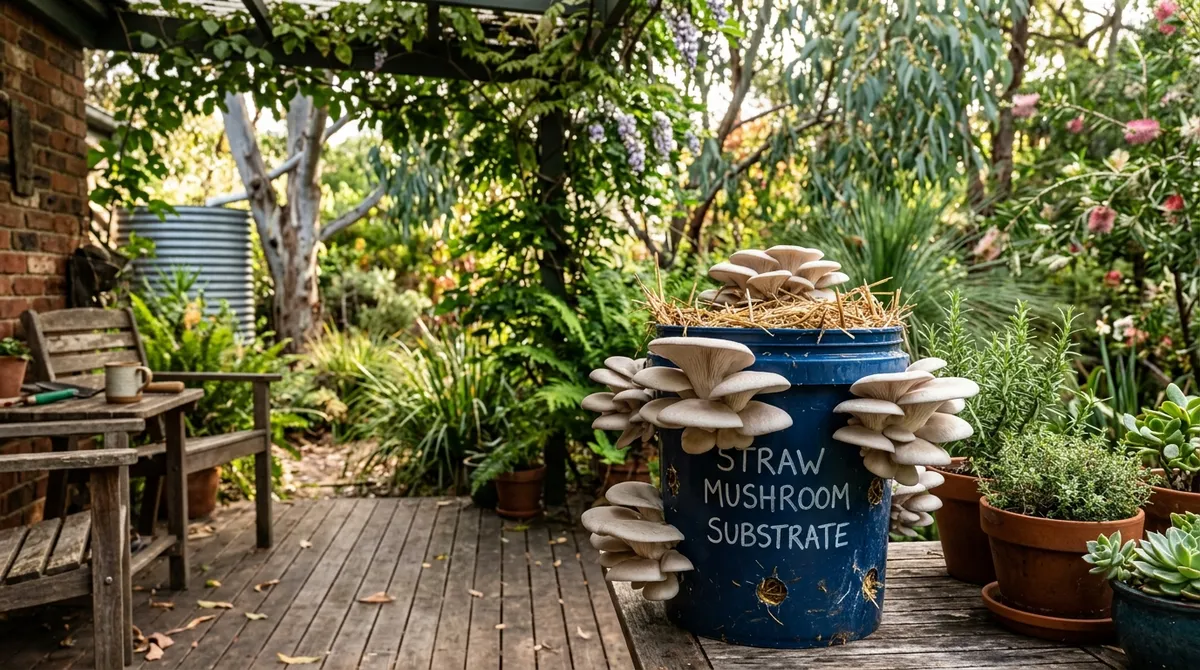
The bucket method is the cheapest way to grow mushrooms at scale. It uses a standard 20-litre bucket, straw substrate, and grain spawn. You can produce 1 to 2 kg of oyster mushrooms per bucket per flush.
What you need
- A 20-litre bucket with a lid
- A drill with a 12 mm bit
- Wheat straw or sugar cane mulch (one bucket worth)
- Grain spawn (available from Australian mushroom suppliers online). You need about 500 g per bucket.
- A large pot or esky for pasteurising straw
Step-by-step process
- Drill holes. Drill 12 mm holes around the bucket in a grid pattern, roughly 10 cm apart. These are where the mushrooms will fruit. Drill holes all the way around and on the base.
- Pasteurise the straw. Cut or chop the straw into 5 to 10 cm lengths. Soak in water heated to 65 to 80 degrees for 60 to 90 minutes. An esky works well for maintaining temperature. This kills competing moulds and bacteria without sterilising completely (some beneficial microbes survive and help the mycelium).
- Drain and cool. Drain the straw thoroughly. It should be moist but not dripping (the squeeze test: squeeze a handful, and only a few drops should come out). Let it cool to below 30 degrees.
- Layer spawn and straw. Place a layer of straw in the bucket (about 5 cm deep), then scatter a handful of grain spawn. Repeat layers until the bucket is full, finishing with a straw layer. Press down firmly.
- Seal and colonise. Put the lid on. Store the bucket in a warm, dark spot (20 to 25 degrees) for 2 to 3 weeks. White mycelium will grow through the straw. When you see white threads poking out of the holes, colonisation is complete.
- Fruit. Move the bucket to a shaded spot outdoors or a well-ventilated room. Mist the holes 2 to 3 times daily. Mushrooms will emerge from the holes within 7 to 14 days.
Method 3: The Log Method
Log growing is the traditional method for shiitake and oyster mushrooms. It takes longer to produce mushrooms (6 to 18 months) but requires minimal ongoing effort and produces flushes for 3 to 6 years from a single log.
Choosing logs
Hardwood logs are essential. Eucalyptus, she-oak, ironbark, and fruit tree prunings all work. Cut logs should be 10 to 15 cm in diameter and 50 to 100 cm long. Use freshly cut wood (within 2 to 4 weeks of felling). Old, dry logs will not colonise well because the bark has begun to separate and competing fungi may have already moved in.
Inoculation
Drill holes 15 cm apart in a diamond pattern using a 12 mm drill bit. Push in dowel spawn (wooden dowels colonised with mycelium, available from mushroom suppliers) and seal the holes with food-grade wax to prevent drying and contamination.
Incubation
Stack inoculated logs in a shady spot with good air circulation. Under a tree canopy or on the south side of a building works well. Keep the bark moist by watering during dry spells. The mycelium will colonise the sapwood over 6 to 18 months. You will know colonisation is progressing when you see white mycelium at the cut ends.
Forcing a flush
Once fully colonised, you can force fruiting by soaking the log in cold water for 24 hours. Remove the log, stand it upright or lean it against something, and mushrooms should appear within a week. Logs can be force-fruited every 6 to 8 weeks during the growing season.
Indoor vs Outdoor Growing
Indoor growing
Growing mushrooms indoors gives you more control over temperature and humidity. Grow kits and supplemented sawdust blocks work best indoors. The main challenges are maintaining humidity (dry air from heating and air conditioning dries out substrates) and ensuring fresh air exchange (mushrooms produce CO2 and need it removed).
A bathroom, laundry, or garage with a window typically provides the right conditions. You can also create a simple fruiting chamber from a large plastic tub with holes drilled in the sides and damp perlite on the bottom to maintain humidity.
Outdoor growing
Outdoor growing suits buckets, logs, and straw beds. Australian conditions work well for outdoor mushrooms in autumn through spring. Summer can be too hot and dry for most species unless you have deep shade and can maintain watering. Logs are the easiest outdoor method because they regulate their own moisture to some extent.
Position outdoor setups in full shade with protection from wind. Under a deck, beside a garden shed, or in a covered carport are all good spots. Never put mushroom substrates in direct sun.
Fruiting Conditions Explained
Getting the fruiting conditions right is the difference between a big flush and nothing at all. Here is what each species needs:
Humidity
Mushrooms are mostly water. They need 80 to 95% relative humidity during fruiting. Outdoors in a shady spot, this often happens naturally. Indoors, you need to mist regularly or use a humidity tent. A spray bottle used 2 to 3 times daily is the simplest approach. Do not spray the mushrooms directly once they are forming; mist the air around them.
Fresh air
Mushrooms need fresh air exchange to fruit properly. In stale air with high CO2, stems grow long and thin while caps stay small. If your mushrooms look leggy with tiny caps, increase airflow. A small fan on a timer (15 minutes every few hours) or simply cracking a window works.
Temperature
Most species fruit best between 15 and 22 degrees. Pink oysters tolerate up to 30 degrees. King oysters and shiitake prefer 12 to 18 degrees. Australian autumn and spring provide ideal fruiting temperatures outdoors. Winter is fine in subtropical regions. Summer is too hot for everything except pink and golden oysters.
Light
Mushrooms need some light to orient their growth, but direct sun will dry them out and kill them. Indirect light from a window or the ambient light in a shady outdoor spot is all that is needed.
Common Mistakes
Not enough humidity
This is the number one reason home mushroom growers fail. Pins form and then dry out before they can develop. If you see tiny mushroom bumps that shrivel and die, humidity is too low. Increase misting frequency or create a humidity tent from a plastic bag with holes.
Too little fresh air
The second most common mistake. Long, spindly stems with tiny caps are the telltale sign. Seal the humidity tent too tightly and you trap CO2 inside. Balance humidity with ventilation by using a tent with holes or misting frequently in an open area.
Contamination
Green, black, or orange mould on the substrate means contamination. Competing moulds got a foothold before the mycelium could colonise fully. The usual cause is incomplete pasteurisation, using wet spawn, or working in a dirty environment. A contaminated batch cannot be saved. Dispose of it in the compost and start fresh with clean technique.
Wrong substrate for the species
Oyster mushrooms grow on almost anything. Shiitake needs hardwood. Lion's mane needs supplemented sawdust. Match the species to the right substrate or you will get poor results regardless of conditions.
Giving up after one flush
The first flush is usually the biggest, but most substrates produce 2 to 4 flushes. Soak the substrate in water between flushes to rehydrate, then resume fruiting conditions. The total yield across all flushes is often double the first flush alone.
Frequently Asked Questions
What is the easiest mushroom to grow at home?
Oyster mushrooms are the easiest variety for beginners. They grow fast (harvest in 7 to 14 days after pinning), tolerate a wide temperature range, fruit on cheap substrates like straw or coffee grounds, and are very forgiving of imperfect conditions. Pink oysters are the fastest; grey oysters are the most versatile.
Can I grow mushrooms indoors?
Yes. Many mushrooms grow well indoors. Oyster mushrooms and shiitake can fruit in a laundry, bathroom, or garage with indirect light, good airflow, and humidity above 80%. Ready-made grow kits are designed for indoor use and produce mushrooms with minimal effort.
How do you grow mushrooms in a bucket?
Drill 12mm holes around a 20-litre bucket. Pasteurise straw by soaking in hot water (65 to 80 degrees) for one hour. Drain, cool, then layer the straw and grain spawn in the bucket. Seal the lid, store in a dark warm spot for 2 to 3 weeks while mycelium colonises, then move to a humid shaded area to fruit.
How long does it take to grow mushrooms?
From inoculation to first harvest, oyster mushrooms on straw take 4 to 6 weeks. Shiitake on logs take 6 to 18 months. Ready-made kits can produce mushrooms in 10 to 14 days. After the first flush, subsequent flushes appear every 1 to 2 weeks for several months.
Do mushrooms need sunlight?
Mushrooms do not photosynthesise and do not need direct sunlight. They do benefit from indirect light to help orient their growth. A shaded porch, a room with a window, or a garage with ambient light is sufficient. Avoid direct sun, which dries out the fruiting bodies.
Plant profiles
Each profile has sowing times for your region, companion plants and common pests.