Erinose mite: identify, prevent, control
Updated October 2026
Builds up with each new growth flush through the warm months in lychee districts from Far North Queensland to northern New South Wales.
Lychee erinose mite is a tiny mite, far too small to see without a strong lens, that lives on the undersides of lychee leaves. Its feeding makes the leaf grow a thick, felt-like coating called erinose, which starts pale and turns rusty brown. Heavy infestations weaken the tree, and if the mites move onto flower panicles the tree may set little or no fruit.
Aceria litchii
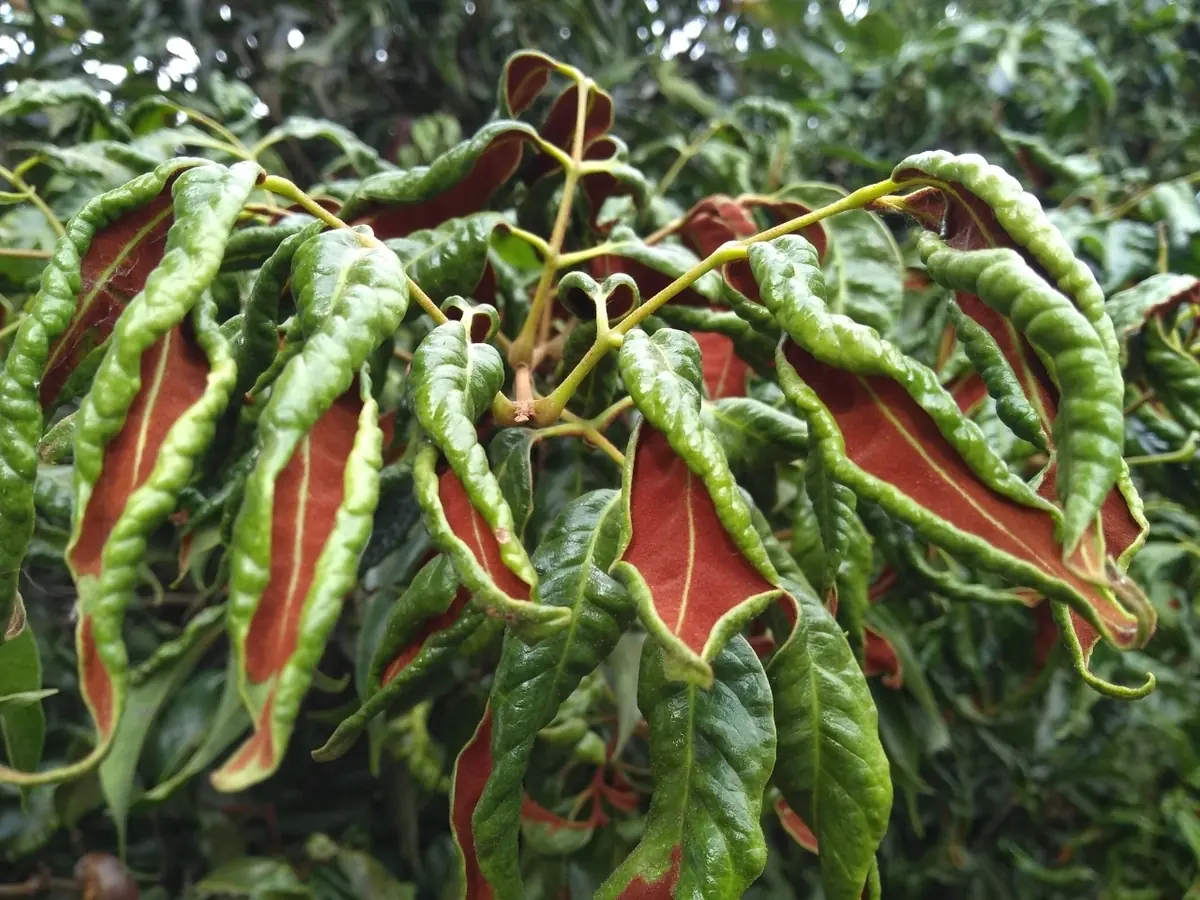
How to identify it
- The most obvious sign is a velvety, felt-like patch on the underside of leaves that is silvery or pale at first and becomes reddish brown with age.
- Directly above each felt patch the upper surface of the leaf bulges into hairy blisters, so the whole leaf looks thickened, wrinkled and twisted.
- New flush can be so distorted that leaves curl into tubes, while older infested leaves stay leathery and brown underneath.
- Infested flower panicles look brown and fuzzy and drop their flowers, and the felt can also appear on young fruit.
- To confirm, put a few affected leaves in a paper bag for a day, then look at the felt with a x20 lens; the tiny, worm-shaped mites move to the surface as the leaves dry.
What it is often confused with
Rust
Rust makes powdery orange or brown spore pustules that rub off on your finger. Erinose felt is part of the leaf, does not rub off as powder, and comes with blistering on the top of the leaf.
Leaf spot
Leaf spots are flat, dead patches with defined edges. Erinose is a raised, living, felty growth with matching bumps on the upper surface.
When and where it is worst
The mite is found in all lychee-growing districts in Australia, from Cooktown and the Atherton Tableland down through Central Queensland and South East Queensland to the Northern Rivers and Coffs Harbour. Lychee is the main host; longan is attacked less often, but it has been recorded on longan overseas and longans grown beside infested lychees are worth checking.
The mites shelter in the felt on older leaves and move onto each new flush of leaves, flowers and fruit as it appears, so their numbers track the tree's growth cycle. Under warm conditions the life cycle takes about 13 days. The worst times are the late winter to spring flowering flush and the summer and autumn leaf flushes after harvest. The mites spread on nursery trees and marcots, on wind and on visiting bees.
Plants it attacks
These plants in our library list it as a problem to watch for.
How to prevent it
- Start with clean planting material, because the mite is easily carried on nursery trees and especially on marcots taken from infested trees.
- Inspect any new lychee closely, including under the leaves, before planting it near your existing trees.
- Check every new flush for pale felt under the leaves so you catch an infestation while it is still small.
- Avoid handling clean trees straight after working on infested ones, as mites can be carried on hands, clothes and tools.
Organic control, step by step
- Prune off all the infested leaves and shoots you can reach, bag them and put them in the rubbish rather than the compost.
- Time the pruning so the tree's next flush can be protected straight away, as the mites move to new growth.
- If you use a sulphur-based product, apply it to the whole tree as the new flush starts, again when the flush has fully emerged, and a third time after the leaves expand but before they harden, about 10 to 14 days apart, and only if the label lists the use.
- Encourage predatory mites by avoiding broad-spectrum insecticides; native predators feed on erinose mite, although they rarely control it on their own.
Conventional control
- We could not confirm a home garden miticide whose label specifically lists lychee erinose mite; commercial growers use miticides under APVMA registration or permit on a three-spray program timed to each flush.
- Wettable sulphur is the usual home garden miticide; use it only if the label covers lychee or the situation you are treating, and never in very hot weather.
- Read the label, check the crop is listed and keep to the withholding period before you pick fruit.
Frequently asked questions
Why are the undersides of my lychee leaves brown and furry?
That felt is erinose, a growth the leaf makes in response to lychee erinose mite feeding. The mites themselves are invisible to the naked eye and live inside the felt.
Can erinose mite stop my lychee fruiting?
Yes. When the mites move onto flower panicles, the flowers turn brown and fuzzy and drop, and little or no fruit sets. Heavy leaf infestations also weaken the tree over time.
Does erinose mite affect longan?
It is mainly a lychee pest. Longan is attacked less often, but it has been recorded on longan overseas, so check longans growing near infested lychees.
Will one spray fix it?
No. The mites are protected inside the felt, so sprays only work on new flush. Queensland advice is three sprays per flush, about 10 to 14 days apart, combined with pruning out infested growth.
Related problems
Sources: Business Queensland, Lychee erinose mite; QLD DAF, Lychee pest and disease field guide. Identification and control follow these sources. Always read the product label before use.