
Walking Onions: How to Grow Egyptian and Tree Onions
Updated November 2026
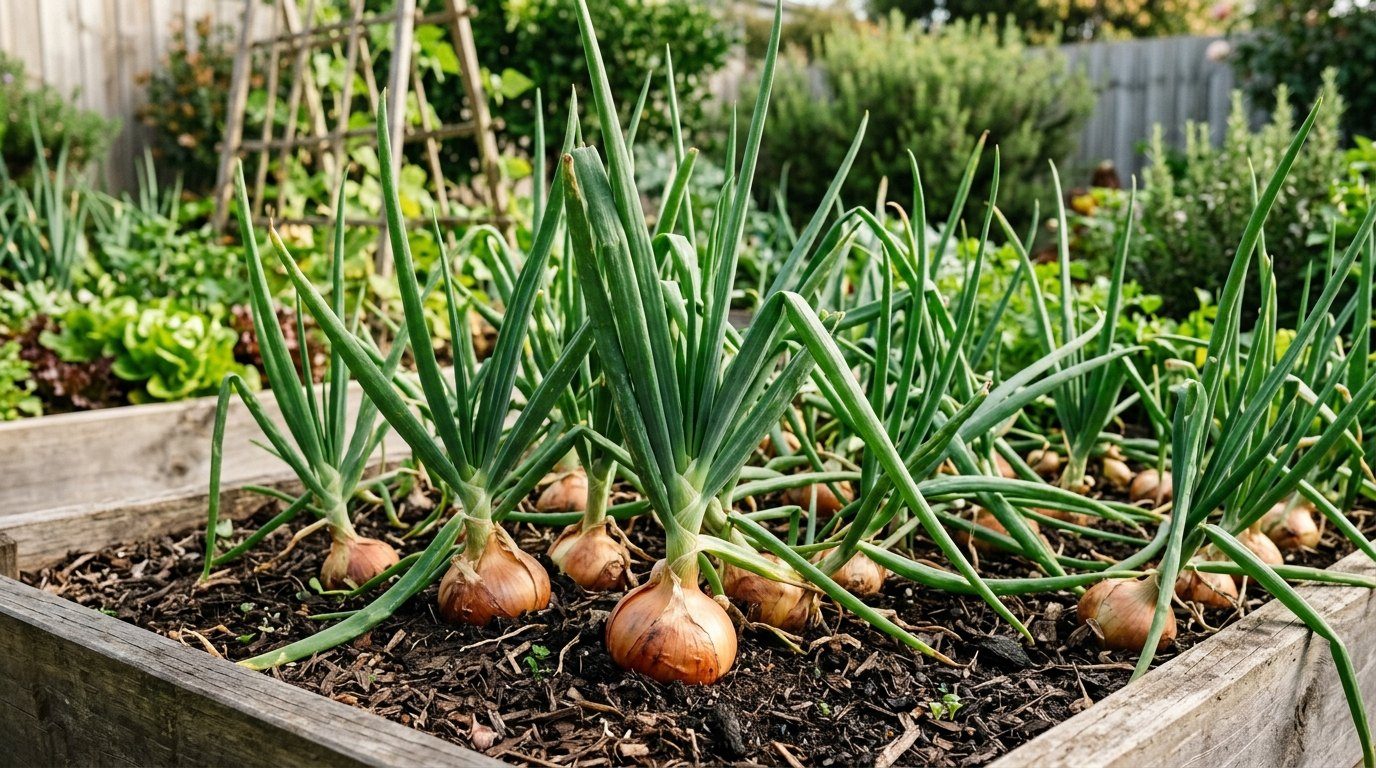
A perennial onion that plants itself, with green tops, small bulbs and topsets to pick.
Walking onions are a perennial onion that grows a cluster of tiny bulbs at the top of its stalk, and those bulbs root where they fall, so the patch slowly moves across the garden. You eat the green leaves, the small bulbs and the topsets, and one planting can last for years in most Australian climates.
What walking onions are
Walking onions (Allium x proliferum), also sold as Egyptian walking onions, tree onions and top-set onions, are a perennial onion that grows a cluster of small bulbs at the top of the flower stalk instead of seeds. Each cluster is called a topset, and the little bulbs in it are bulbils. A mature plant gives you green tops to use like spring onions, a small underground bulb to use like a shallot, and topsets that you can pickle, cook or replant.
Genetic studies suggest the plant is a hybrid, possibly of a shallot and a Welsh onion, which is why it behaves like both. It is grown from bulbils or divisions rather than from seed. If you are looking for the annual bulb onion or the bunching onion instead, see our onion guide and the spring onion guide linked below.
Why they walk
A topset stalk grows tall in spring and early summer. As the bulbils swell, the stalk gets heavy and bends over until the cluster touches the ground. The bulbils sprout where they land and root. Left alone, a patch moves a short distance every year, and the plant earns its name. Sometimes a second stalk grows out of the top of the first topset, so you can see a tiered cluster, which is where the name tree onion comes from.
That habit is useful if you want a self-spreading patch, and a nuisance if you want a tidy bed. Pick the topsets before they fall if you want to control where the plants go.
Where they suit in Australia
The plant is a perennial that does best in the cool season. It is tolerant of cold, so it suits the frosty regions without any protection. Our frost dates page shows Canberra, Tasmania, Melbourne and Adelaide all get regular frosts, and walking onions cope with those. We do not have walking onions in our sowing data, so the timing below is by climate and soil conditions rather than a fixed month.
| Region | When to plant bulbils or divisions | Notes |
|---|---|---|
| Canberra and ACT, Tasmania, Melbourne and Victoria | Autumn, as soon as the bulbils are available, or early spring | Cold-hardy. Autumn planting gives roots time to establish before winter. |
| Adelaide and SA, Perth and WA, Sydney and Coastal NSW | Autumn to early winter | Plant when the soil has cooled and the autumn rain returns. |
| South East Queensland and Northern Rivers NSW | Autumn and winter | Treat it as a cool-season crop and give it a well-drained spot through summer. |
| North Queensland, Darwin and Top End | The cooler dry months, in a raised bed | Wet season heat and humidity is the main risk. Good drainage helps the bulbs avoid rot. |
The practical rule is the same across the country: plant in the cooler months, once the soil is no longer hot, and give the plant a position with good drainage. Autumn is the standard time because bulbils dry out and can perish in storage, so planting soon after you receive them matters more than the exact week. Our regional hubs have more on local conditions, for example Melbourne, Canberra, South East Queensland and Darwin.
Do not use the sowing months for bulb onions or spring onions as a guide for this crop. Those are annual crops grown from seed, and their windows do not apply to a perennial that is grown from bulbils.
Planting bulbils and divisions
- Choose a sunny, well-drained spot. Walking onions tolerate poor soil, but they rot in waterlogged ground. Raised beds suit heavy clay, and our raised bed guide covers building one.
- Prepare the soil. Work in some compost and rake it level. They do not need rich soil.
- Plant the bulbils just below the surface. Set each bulbil with the pointed end up and a covering of about 1 to 2 cm of soil. A tiny bulbil may take several weeks to show a green shoot.
- Space them. A spacing of 15 to 20 cm suits single bulbils, and around 30 cm allows an established clump to widen.
- Mulch lightly. A thin layer of straw or leaves keeps weeds down. Net a new bed if birds scratch at the bulbils.
- Water in. Keep the soil just moist until shoots appear, then water in dry spells.
If you buy bulbs or a potted clump instead of bulbils, plant them at the same depth they were growing, spaced 20 to 30 cm apart. To start a second patch from your own plants, divide established clumps, as explained below.
Caring for the plants
- Water. Walking onions are quite tough once established, but they grow faster with regular water in spring.
- Feeding. A mulch of compost in spring is usually enough.
- Weeding. They compete poorly with grass and weeds while small, so keep the bed clear in the first season.
- Dieback. The leaves can die back in summer heat or in winter cold and return with the next growth period. Do not pull up a patch that looks dead until you have checked for green shoots at the base.
- Pests and diseases. Onion family plants share some problems, such as rust and downy mildew in damp weather. Space the plants for air flow, and water at the base.
Harvesting walking onions
You can pick walking onions in several ways, and you do not have to wait for a single harvest day.
- Green tops. Cut the leaves like chives or spring onions once the plants are about 20 cm tall. Leave some growth so the plant can recover.
- Young plants. Pull small plants whole to use like spring onions, which also thins a crowded patch.
- Topsets. Pick the topsets once the bulbils are firm and have reached about the size of a marble, usually late spring to summer. They are strong in flavour, and cooks pickle them, roast them or chop them as a substitute for small onions.
- The underground bulb. After the topsets have been picked, the base can be lifted and used like a shallot. Lifting it means the plant does not come back, so lift only the plants you can spare.
Keep a few topsets from each season for replanting. Store them in a paper bag in a cool, dry place and plant them within a few weeks, because they can shrivel or perish in storage. For ideas on storing the bulbs, see harvesting and storing onions.
Dividing and spreading the patch
A clump gets crowded after two or three years. Dig it in autumn, pull the bulbs apart and replant the largest ones with space between them. The outer divisions give the best new plants, and you can give spares to friends. This is how walking onions are shared among gardeners, and a good clump is rarely wasted.
To stop the patch walking where you do not want it, cut the topsets before the stalks fall, or keep the plants in a defined bed edged with a path or mower strip.
Growing walking onions in pots
Walking onions grow well in containers, which is a good way to keep them from wandering. Use a pot at least 30 cm wide with drainage holes and a free-draining potting mix. Plant three to five bulbils about 2 cm deep, water regularly through spring and keep the pot in full sun. A pot is also a sensible choice in the wet tropics, because you control the drainage. Our spring onions in pots guide has general advice for onion family plants in containers.
Where to buy walking onions in Australia
Walking onions are mostly sold by small specialist nurseries, permaculture growers and heirloom plant sellers, and they are swapped among gardeners. Stock sells out each season. When we checked, Tassie Seeds listed a pack of 10 Egyptian walking onion bulbils, though the page showed it as out of stock. Keep an eye on seller pages in late summer and autumn, when topsets are ready, or ask at a local seed swap or community garden. A potted plant from a local nursery or a divided clump from a neighbour is the quickest way to start.
Related onion family guides
Walking onions sit between spring onions and shallots in the kitchen. For the crops from seed or sets, see the spring onion guide, the spring onion plant profile, the onion plant profile and how to grow shallots.
Questions
What are walking onions?
Walking onions (Allium x proliferum) are a perennial onion that forms a cluster of small bulbs, called topsets, at the top of the flower stalk. The stalk bends over, the bulbils root where they touch the ground, and the patch slowly moves.
When do I plant walking onions in Australia?
Plant bulbils or divisions in the cooler months, usually autumn, once the soil has cooled. In the tropics, plant in the dry season and give them a well-drained raised bed.
Can you eat the whole plant?
Yes. Cooks use the green tops like spring onion, the topsets pickled or roasted, and the underground bulb like a shallot. Lifting the bulb removes that plant.
How do I stop walking onions spreading?
Pick the topsets before the stalks bend and drop, or grow the plants in a pot or a bed with a clear edge.
Do walking onions come back every year?
Yes. They are perennial and regrow from the base and from fallen bulbils, so one planting can last for years. Divide crowded clumps in autumn.
Where can I buy walking onions?
They are sold by specialist nurseries and heirloom plant sellers, such as Tassie Seeds, and are often swapped among gardeners. Stock sells out, so check back in late summer and autumn.
Sources
- Tree onion (Allium x proliferum), overview with references (Wikipedia)
- Tassie Seeds: Egyptian walking onions
Plant profile
The spring onion profile has sowing times for your region, companion plants and common pests.