How to Harvest and Store Onions
Updated June 2026
When to pick, how to cure, and storage methods that keep onions fresh for months
Growing onions takes patience. Depending on the variety and region, they sit in the ground for 5 to 7 months before they are ready. The good news is that the harvest and storage process is straightforward, and a well-cured onion can last 6 months or longer in the right conditions.
This guide covers the signs that onions are ready, the best way to lift them, how to cure them properly, and storage methods that work in Australian kitchens and sheds.
🌱 Plant profile: Onion, with sowing times for your region, companion plants and common pests.
Signs Your Onions Are Ready to Harvest
Onions tell you when they are done. The tops begin to yellow, soften at the neck, and fall over. This happens naturally as the bulb matures and stops taking up water. You do not need to bend the tops over yourself. Let the plant do it on its own.
Wait until about half to two-thirds of the tops in your patch have flopped before you start harvesting. If every single top is still upright, the bulbs are still growing. If all the tops are brown and flat on the ground, you may have left them a bit long, but they should still be fine for shorter-term storage.
Other signs to look for:
- The outer skin on the bulb starts to look papery and dry, even while still in the soil
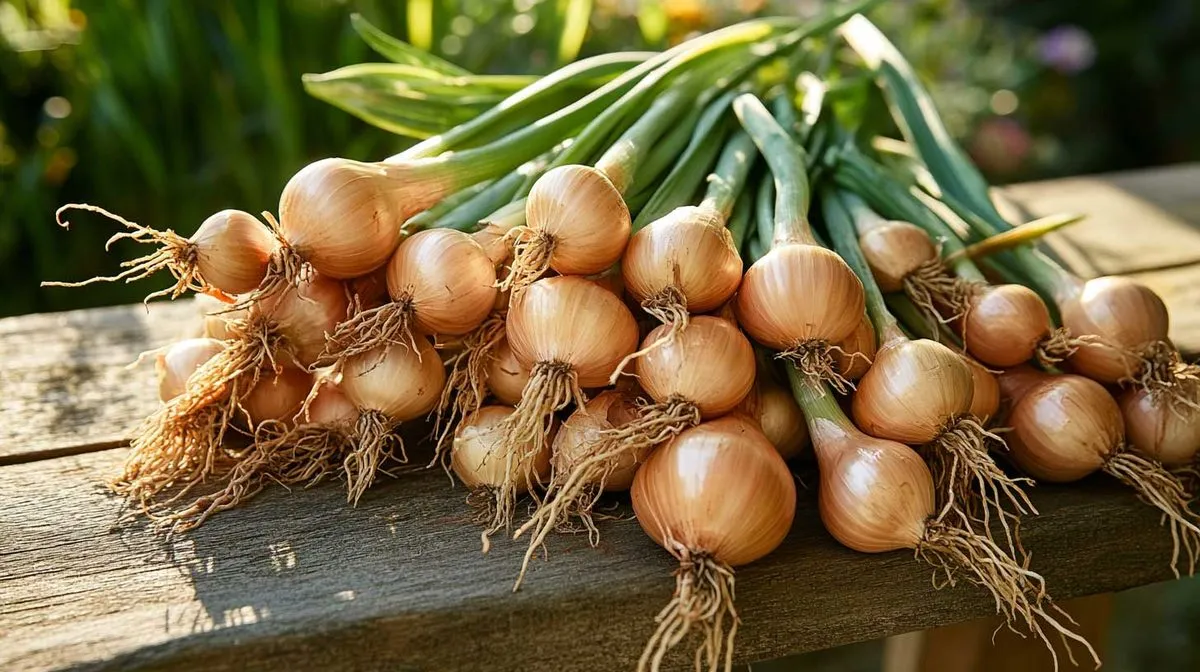
- The neck (where the leaves meet the bulb) feels soft and thin rather than thick and fleshy
- The bulb has reached the expected size for its variety
How to Lift Onions
Use a garden fork to loosen the soil around the bulbs. Slide the fork in about 10 cm from the bulb and lever gently upwards. Do not pull onions out by their tops. The neck can tear, which opens the bulb to rot during storage.
Once loosened, lift each bulb by hand and shake off excess soil. Do not wash them. Any moisture on the surface will slow the curing process and can introduce rot. If the soil is caked on, brush it off gently once it dries.
Harvest on a dry day if possible. If rain is forecast and your onions are ready, lift them anyway and move them under cover immediately.
Curing Onions
Curing is the most important step between harvesting and storing onions. It dries the outer skins and seals the neck, creating a natural barrier against moisture and bacteria. Skipping this step or cutting it short is the main reason stored onions go soft or rot.
The curing process
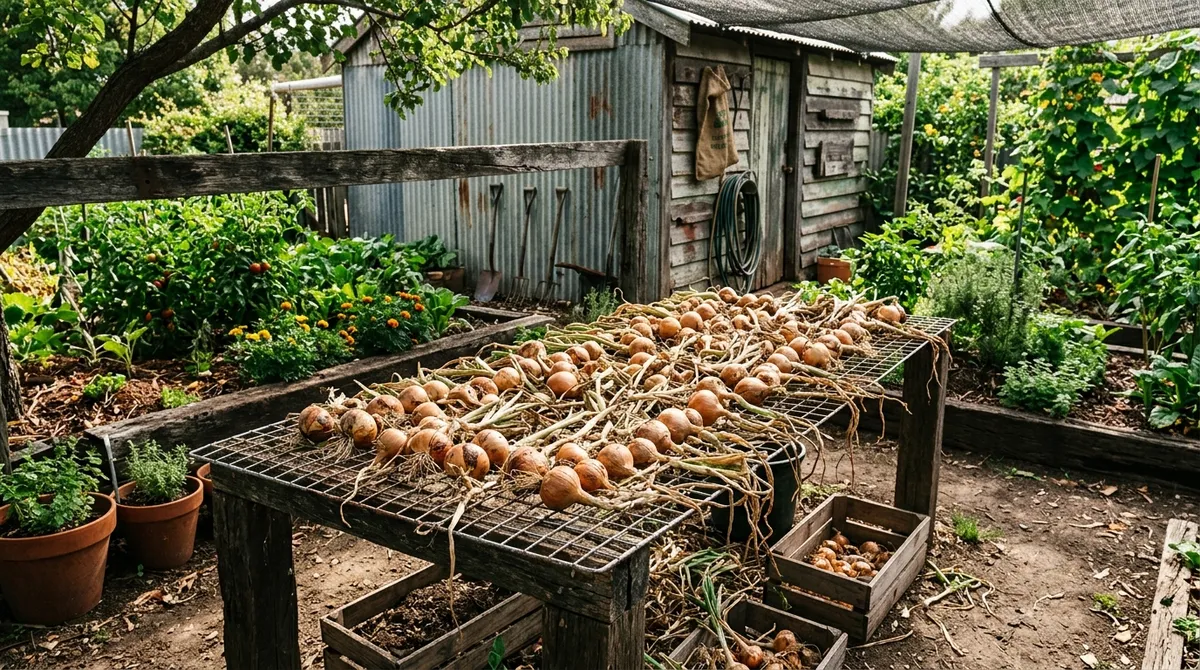
- Lay onions in a single layer on a wire rack, mesh screen, or slatted shelf. Airflow around the entire bulb is key. Avoid laying them on solid surfaces where moisture can pool underneath.
- Place them in a warm, dry, well-ventilated spot out of direct sun. A covered verandah, garden shed with open doors, or a carport works well. Direct sun can scald the bulbs and cause green patches.
- Leave them for 2 to 3 weeks. In humid regions (coastal Queensland, Top End), curing may take closer to 3 to 4 weeks. In dry inland areas, 2 weeks is often enough.
- The onions are properly cured when the outer skins rustle like paper, the necks are completely dry and tight, and the roots are wiry and brittle.
Trimming and Cleaning
Once cured, trim the roots to about 1 cm with secateurs or scissors. Cut the dried tops to about 3 cm above the bulb unless you plan to braid them (in which case, leave the tops long).
Brush off any remaining dry soil. Remove any loose, flaky outer skins that are torn or damaged, but leave the tight papery layers intact. These layers protect the bulb during storage.
At this stage, sort your onions into three groups:
- Damaged or soft-necked onions: Use these first within 1 to 2 weeks. Any bulb with a thick, damp neck, cuts from the fork, or soft spots will not store well.
- Medium-sized onions with tight necks: These go into your main storage supply.
- Largest, hardest onions with thin, dry necks: These will store the longest. Keep them for later in the season.
Storage Methods
The best storage method depends on how many onions you have and the space available. All methods share the same principle: keep onions cool, dry, dark, and with plenty of airflow.
Mesh bags
The simplest option. Place cured onions in net or mesh bags (the kind citrus fruit comes in works perfectly). Hang the bags from a hook in a shed, pantry, or garage. Each bag should hold no more than 3 to 4 kg so the bottom onions are not crushed.
Pantyhose trick
This old method works brilliantly and keeps each onion separate. Drop one onion into the toe of a pair of pantyhose, tie a knot above it, drop in another onion, tie another knot, and repeat until the leg is full. Hang the whole thing from a hook. When you need an onion, cut below the lowest knot. Each onion gets its own pocket of airflow.
Braiding
Braiding works best with softneck onion varieties that have flexible, pliable tops. Leave the cured tops long (at least 20 cm) and braid three onions together at a time, working your way up and adding new bulbs as you go. Hang the finished braid in a cool spot. Braids look great in a kitchen but only if the room stays cool and dry.
Wooden crates or slatted shelves
Lay onions in a single layer on wooden crates or slatted shelves in a shed or cellar. Do not stack them more than two layers deep. Check them every few weeks and remove any that are softening.
Storage Conditions
Onions store best at 4 to 10 degrees Celsius with low humidity and no light. The ideal spot is a cool, dark shed, garage, or cellar with some air movement. Avoid storing onions in the fridge. The humidity inside a refrigerator is too high and onions absorb odours from other food.
Keep onions away from direct sunlight. Light triggers sprouting, and sprouted onions lose their firmness quickly.
What NOT to store near onions
Keep onions well away from potatoes. Potatoes release moisture and ethylene gas as they age, and this causes onions to soften and rot faster. The effect works both ways: onions can also speed up sprouting in potatoes. Store them in separate rooms or at least on opposite sides of the shed.
Also avoid storing onions near apples, pears, or bananas, which release ethylene too.
Which Varieties Store Longest
Not all onions are built for long storage. As a general rule, pungent onions store longer than mild ones, and brown onions outlast reds and whites.
Brown Spanish
The classic brown storage onion. Firm flesh, strong flavour, thick papery skin. Stores 6 to 8 months in good conditions. The best all-rounder for long keeping.
Creamgold
An Australian-bred brown onion with excellent storage life. Medium size, golden skin, mild-to-medium flavour. Stores 5 to 7 months. Widely available as seedlings.
Hunter River Brown
Heritage variety, slightly flattened shape, keeps very well. Good for cooler regions. Stores 5 to 7 months with proper curing.
Red Onions (general)
Red varieties like Red Creole and Redwing store for 3 to 4 months. They have thinner skins and milder flavour, so they do not keep as long as browns. Use these within the first few months.
White Onions
White onions have the shortest storage life at 1 to 3 months. Their skins are thin and do not provide much protection. Best eaten fresh or stored for short periods only.
How Long Different Types Last
Storage times assume properly cured onions kept in ideal conditions (cool, dry, dark, good airflow).
- Brown onions: 6 to 8 months
- Yellow onions: 4 to 6 months
- Red onions: 3 to 4 months
- White onions: 1 to 3 months
- Sweet onions: 1 to 2 months (high sugar and water content means they spoil quickly)
- Shallots: 4 to 6 months
- Spring onions: Not suitable for long storage. Use within 1 to 2 weeks fresh.
Using Damaged Onions First
Any onion that has a nick from the garden fork, a soft spot, a thick neck that did not dry properly, or split outer skin should go into your kitchen first. These will not store well and should be used within a week or two of harvest.
If you have more damaged onions than you can eat quickly, try these options:
- Chop and freeze: Dice the onions, spread on a baking tray lined with baking paper, freeze until solid, then transfer to freezer bags. Frozen diced onion keeps for 6 to 8 months and goes straight into the pan from the freezer.
- Caramelise in bulk: Slowly cook sliced onions in butter or olive oil until deep golden brown. Freeze in portions for pizza, pasta, sandwiches, and soups.
- Pickle: Quick-pickled red onion in vinegar keeps in the fridge for weeks and goes with everything.
Frequently Asked Questions
How do I know when onions are ready to harvest?
Onions are ready when the tops begin to yellow, flop over, and collapse at the neck. This usually happens in late spring to early summer in Australia. Wait until about half the tops have fallen before lifting.
How long do you need to cure onions before storing?
Cure onions for 2 to 3 weeks in a warm, dry, well-ventilated spot out of direct sun. They are ready when the outer skins are papery, the necks are completely dry, and the roots are wiry and brittle.
What is the best way to store onions at home?
Store cured onions in mesh bags, old pantyhose with knots between each bulb, or braided on a string. Keep them in a cool, dry, dark place with good airflow. Ideal temperature is 4 to 10 degrees Celsius with low humidity.
Can you store onions and potatoes together?
No. Potatoes release moisture and ethylene gas that cause onions to spoil faster. Keep onions and potatoes in separate locations for the longest storage life.
See also: Onion in the Plant Library
Plant profile
The onion profile has sowing times for your region, companion plants and common pests.