Flying foxes: identify, prevent, control
Updated October 2026
Worst when native blossom is scarce and fruit ripens, often late spring to autumn, along the east coast and across the north.
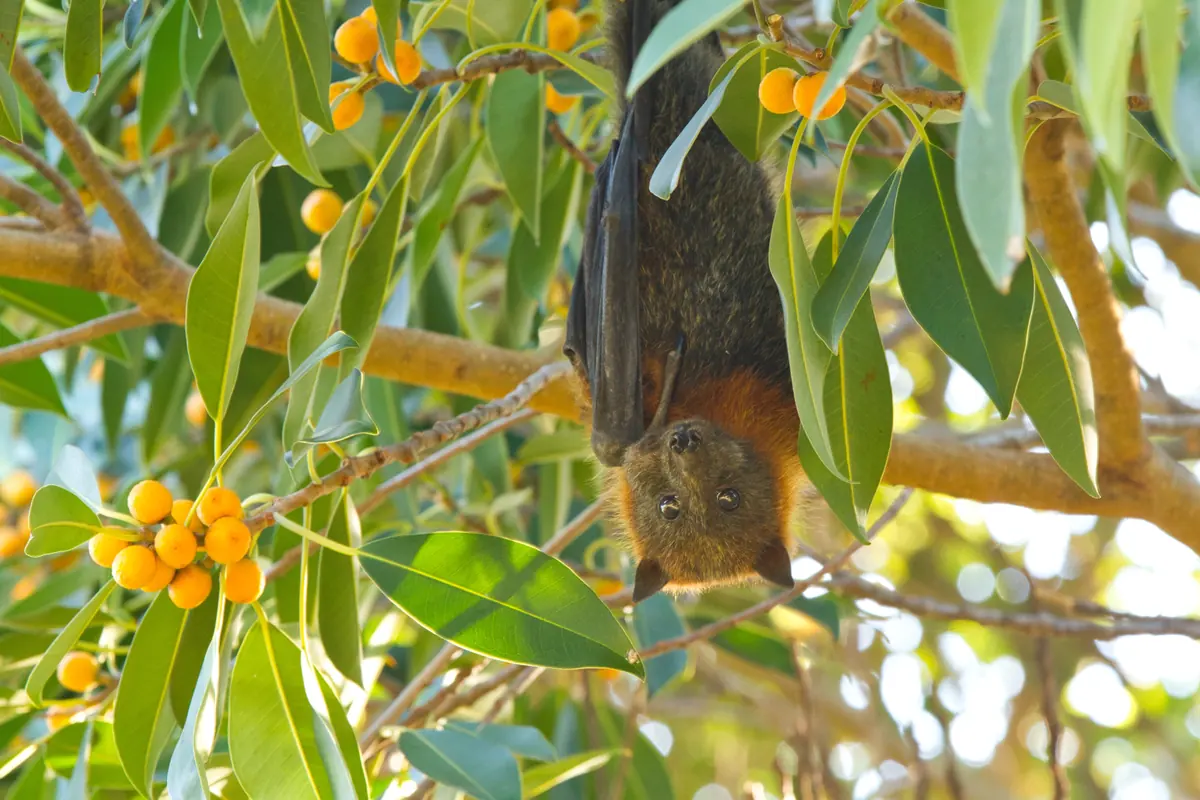
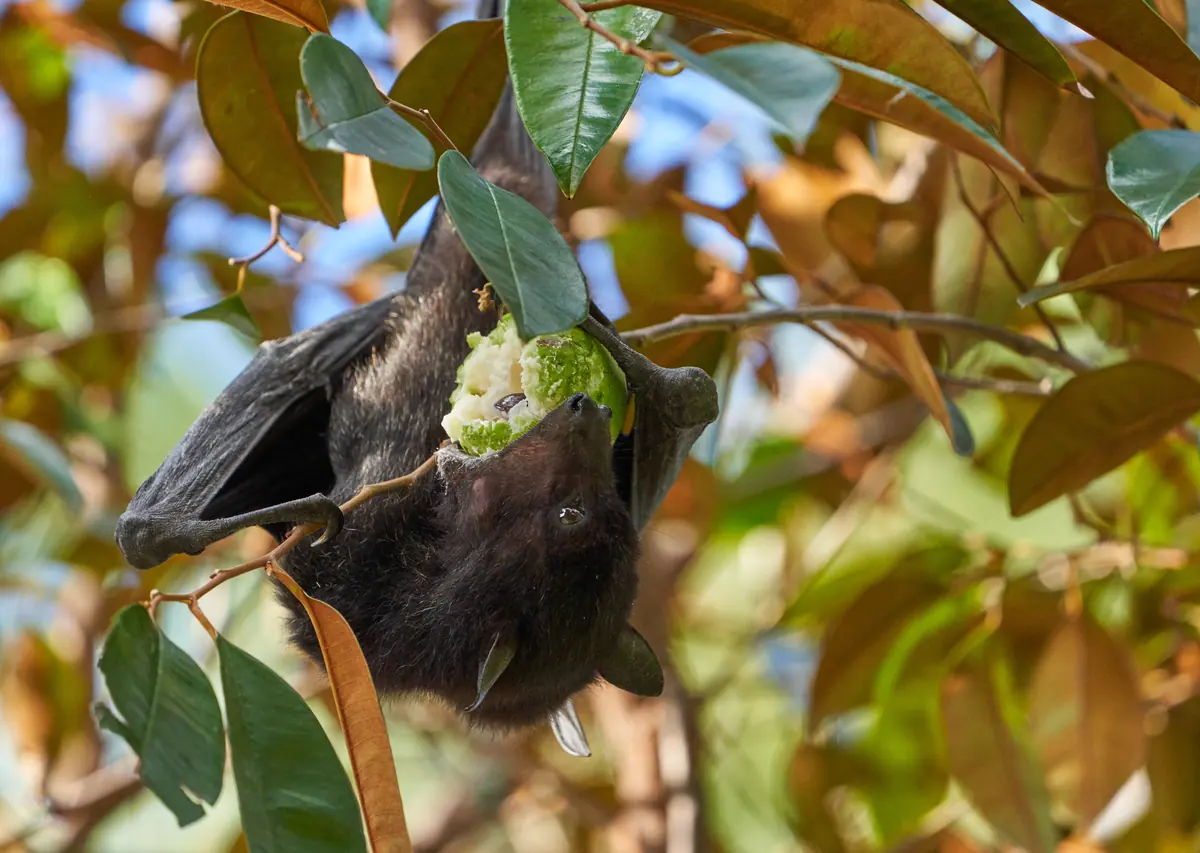
Flying foxes, also called fruit bats, are large native bats that feed on nectar, blossom and fruit at night. They are protected native animals and important pollinators, and the grey-headed flying-fox is listed as vulnerable. You cannot harm them, but you can protect your fruit with the right netting and bags, and you must never handle one because of the risk of Australian bat lyssavirus.
Pteropus spp.

How to identify it
- The damage happens at night, so the first sign is often half-eaten ripe fruit in the morning that was fine the evening before.
- Under the tree you find chewed, spat-out pellets of fruit fibre, called spats, left after the bats squeeze out the juice.
- There are splashes of runny droppings on the ground, paths and cars under the tree.
- Bitten fruit shows scrape marks from small front teeth and larger canine marks, and dropped fruit may be found away from the tree.
- At dusk or by torchlight you may see large bats with a wingspan of up to a metre feeding or squabbling noisily in the tree.

What it is often confused with
Possums
Possums leave scraped fruit and firm pellet droppings 10 to 15 mm long, and may carry fruit away. Flying foxes leave spat-out fibre pellets and runny droppings.
Rats
Rats leave small, neat tooth marks and tiny droppings under 1 cm long, and often hollow out fruit. Flying foxes leave larger, messier damage and spats.
Birds
Bird damage happens in daylight and shows as pecks and holes. Flying fox damage appears overnight.
When and where it is worst
Flying foxes live along the east coast from Cape York to Victoria and Adelaide, and across northern Australia. The grey-headed flying-fox ranges from Queensland to Victoria and South Australia, the black flying-fox through northern and eastern Australia, the little red flying-fox inland and across the north, and the endangered spectacled flying-fox in Far North Queensland. Bananas, figs, mangoes, lychees, stone fruit and many other fruits are eaten, and banana bunches ripening on the plant are a favourite.
Raids are worst when native trees are not flowering, which can happen in any season but often hits backyard fruit from late spring through autumn. Bats can travel tens of kilometres from their camp in a night, so you may have them in the garden even if there is no camp nearby.
Plants it attacks
These plants in our library list it as a problem to watch for.
How to prevent it
- Net fruit trees only with wildlife-safe netting, a knitted mesh with holes 5 mm by 5 mm or smaller at full stretch that you cannot poke your finger through; in Victoria this is the law for backyard fruit tree netting, and the Queensland, NSW and SA governments recommend the same standard.
- Choose white netting so bats and birds can see it at night, and stretch it taut over a frame rather than throwing it loosely over the tree.
- Gather and secure the bottom of the net around the trunk or frame so animals cannot crawl underneath and become trapped.
- Cover banana bunches with a bunch bag and pick when the fingers are full and plump but still green, then ripen them indoors.
- Use fruit bags, exclusion sleeves or small netted cages over individual branches as an alternative to netting the whole tree.
- Check any netting every morning so you can call a wildlife rescuer quickly if something gets caught.
Organic control, step by step
- Harvest fruit a little early and ripen it indoors so there is less ripe fruit on the tree at night.
- Pick up fallen and damaged fruit each morning so it does not attract bats back.
- Keep fruit trees pruned low and compact so they are easier to net or bag fully.
- Accept a small share of fruit losses in years when native blossom fails, as flying foxes are under real pressure for food at those times.
Conventional control
- There is no spray or chemical control for flying foxes, and it is illegal to harm, kill or trap them in any state, so netting and bagging are the only legal tools for gardeners.
- Never touch a flying fox, alive or dead, because Australian bat lyssavirus is spread through a bite or scratch; if a bat is caught in netting or injured, call your local wildlife rescue group, such as WIRES in NSW or Wildlife Victoria, and keep people and pets away.
- If you are bitten or scratched, wash the wound well with soap and water for 15 minutes, apply an antiseptic and see a doctor straight away.
Frequently asked questions
What size netting is legal for fruit trees?
In Victoria it is illegal to use or sell household fruit tree netting with a mesh larger than 5 mm by 5 mm. Queensland, NSW and South Australian government guidance recommends the same 5 mm standard, white colour and taut installation everywhere.
Can I catch lyssavirus from flying foxes feeding in my garden?
No, as long as you do not touch them. Lyssavirus is only spread through a bite or scratch, not through droppings, urine or bats flying overhead. That is why you should never handle a bat.
A flying fox is tangled in my net. What do I do?
Do not try to free it yourself. Call a local wildlife rescue group straight away, keep pets and children away and, if you can, cover the bat loosely with a towel to calm it without touching it.
Are flying foxes eating my bananas?
If ripe banana fingers are chewed overnight and you find spat-out fibre and runny droppings below, flying foxes are the likely cause. Bagging bunches and picking them at the mature green stage solves most of the problem.
Related problems
Sources: Queensland Government, Netting fruit trees; NSW Environment and Heritage, Living with grey-headed flying-foxes; City of Whitehorse (Victoria), Fruit tree netting; Department for Environment and Water SA, Wildlife friendly netting. Identification and control follow these sources. Always read the product label before use.