How to Grow Daikon in Australia
Updated June 2026
Deep roots, fast harvests: grow Japanese white radish in your backyard
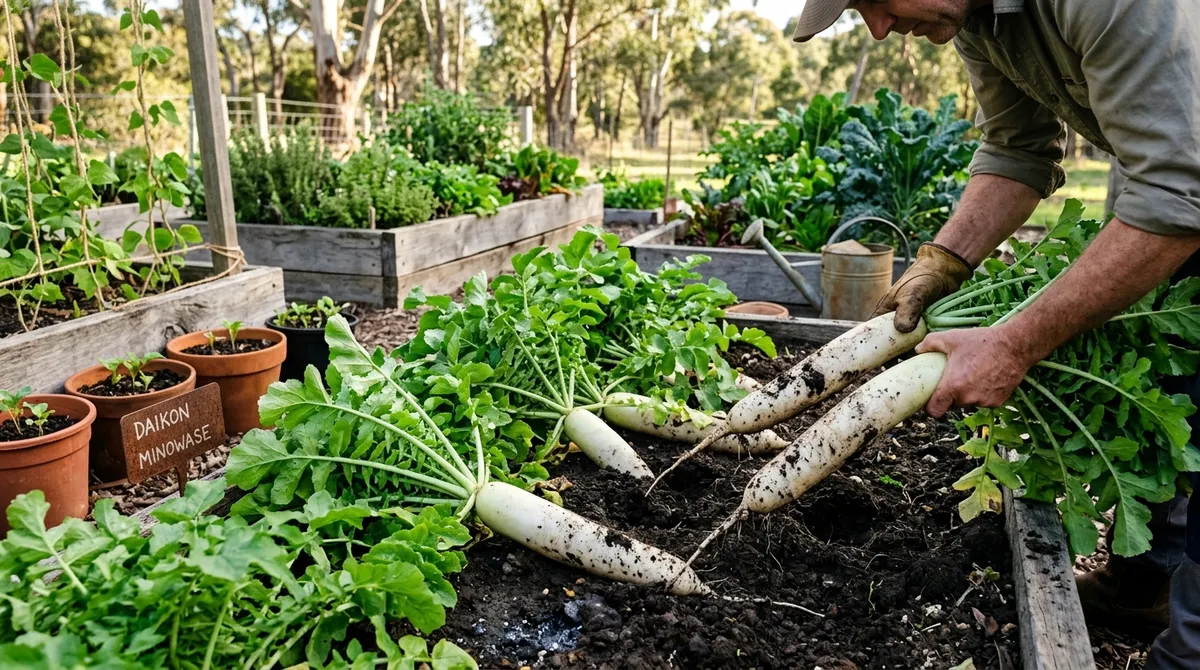
Daikon is the giant of the radish family. The roots grow 30 to 60 cm long, pure white, mild, and crisp. Japanese, Korean, Chinese, and Indian cuisines all use daikon in different ways. Grated fresh over noodles, pickled as takuan, simmered in soups, braised with pork belly, or shredded into salads. It is one of the most versatile vegetables in Asian cooking.
Daikon also works as a cover crop. The deep taproot punches through compacted soil and breaks up hard clay, earning it the nickname "tillage radish" among farmers. You can grow it to eat, grow it to improve your soil, or both.
The crop is fast, direct-sown, and straightforward. Give it loose, deep soil and cool weather, and you will have enormous radishes in 8 to 10 weeks.
What it looks like as it grows


🌱 Plant profile: Daikon, with sowing times for your region, companion plants and common pests.
When to Plant Daikon in Your Region
Daikon grows best in cool weather. Soil temperatures between 10 and 25 degrees Celsius are suitable, with 15 to 20 degrees being ideal. Hot weather causes bolting (the plant sends up a flower stalk instead of fattening the root). Autumn and winter are the main seasons in subtropical and tropical regions. Temperate gardeners can sow from late summer through autumn and again in early spring.
Daikon Varieties for Australia
Minowase
The standard long white daikon. Grows 35 to 45 cm long with a mild, juicy flavour. The variety you will find at most Asian grocery stores. Reliable, fast-growing, and versatile in the kitchen. The best starting point for first-time growers.
Watermelon Radish
Green skin with stunning pink-to-magenta flesh inside. Slightly smaller and rounder than Minowase. Adds brilliant colour to salads and pickle plates. Mild, sweet flavour with a subtle peppery finish. A showstopper at the table.
Korean Mu
Shorter and rounder than Japanese types, typically 15 to 20 cm long. Dense, crunchy texture with a slightly sharper flavour. The variety used in Korean kimchi, kkakdugi (cubed radish kimchi), and dongchimi (radish water kimchi). Holds up well in cooking and fermenting.
Sakurajima
A giant variety from southern Japan. Individual roots can reach 15 to 30 kg under good conditions. Needs a long growing season (12 to 14 weeks) and very deep, fertile soil. More of a novelty than an everyday crop, but impressive to grow. Mild flavour, firm texture.
Soil Preparation
Soil is everything with daikon. The root grows straight down, and any obstacle causes forking, splitting, or stunted growth. You need loose, well-drained soil to a minimum depth of 40 cm. For long varieties like Minowase, 50 to 60 cm of loose soil is better.
Raised beds are the easiest option. Fill a deep raised bed (40 cm or taller) with a mix of quality potting soil and compost. The root will grow straight and true without hitting any obstructions.
In-ground beds need thorough preparation. Double-dig the soil, remove every stone and root fragment, and work in aged compost. Avoid fresh manure, which causes forking and off-flavours. Sandy loam is ideal. Heavy clay soils should be amended heavily or, better still, avoided in favour of a raised bed.
Sowing and Growing
Daikon must be direct-sown. The long taproot does not survive transplanting. Seedlings moved from pots will fork, stunt, or bolt.
- Sow seeds 1 cm deep in rows 30 cm apart. Place 2 to 3 seeds per position, spaced 15 cm apart along the row.
- Thin to one seedling per position once they reach 5 cm tall. Keep the strongest seedling and snip the others at soil level. Final spacing should be 15 cm between plants.
- Water consistently. Daikon needs steady moisture throughout the growing period. Irregular watering causes the roots to crack or develop a woody texture. Water deeply 2 to 3 times per week.
- Mulch between rows to retain moisture and suppress weeds. Straw or sugar cane mulch works well. Keep mulch a few centimetres away from the base of each plant.
- Feed lightly at the 4-week mark with a balanced organic fertiliser. Avoid high-nitrogen feeds, which encourage leafy top growth at the expense of the root.
Harvesting and Storage
Most daikon varieties are ready 8 to 10 weeks after sowing. The top of the root will push above the soil surface as it matures. Harvest by loosening the soil alongside the root with a garden fork, then pulling gently. Pulling without loosening the soil first will snap the root.
Store unwashed daikon in the fridge wrapped loosely in a damp cloth or plastic bag. Roots keep for 2 to 3 weeks. Remove the leafy tops immediately after harvest, as they draw moisture from the root. Daikon can also be pickled, fermented, dried, or grated and frozen for longer storage.
Common Problems
Forked or twisted roots
Caused by stones, compacted soil, or heavy clay. Prevention is the only fix. Prepare deep, loose soil before sowing. Raised beds eliminate most forking problems.
Bolting
Daikon bolts (sends up a flower stalk) in hot weather or in response to long days. Sow in autumn for the most reliable results. Spring sowings can bolt early in warm regions. Choose a bolt-resistant variety for spring planting.
Root maggots
Cabbage root fly larvae tunnel into developing roots. Cover crops with fine insect mesh immediately after sowing. Rotating where you grow brassicas and radishes each year also helps reduce maggot pressure.
Cracking
Caused by irregular watering or leaving roots in the ground too long after maturity. Harvest on time and maintain consistent soil moisture throughout the growing period.
Frequently Asked Questions
When should I plant daikon in Australia?
In subtropical regions, sow daikon from March to August. In temperate regions, sow from September to April. In tropical regions, the dry season (April to July) works best. Use the region picker above for your exact timing.
How long does daikon take to grow?
Most daikon varieties are ready to harvest in 8 to 10 weeks from sowing. Sakurajima and other giant varieties can take 12 to 14 weeks. Germination is fast, usually within 4 to 7 days.
Why is my daikon forked or twisted?
Forking happens when roots hit stones, compacted soil, or heavy clay. Daikon needs deep, loose soil to at least 40 cm. Raised beds filled with quality soil mix are the easiest solution.
Can you eat daikon leaves?
Yes. Daikon leaves are edible and nutritious. They have a mild, peppery flavour similar to turnip greens. Stir-fry them, add them to soups, or use young leaves in salads.
See also: Daikon in the Plant Library
Plant profile
The daikon profile has sowing times for your region, companion plants and common pests.