
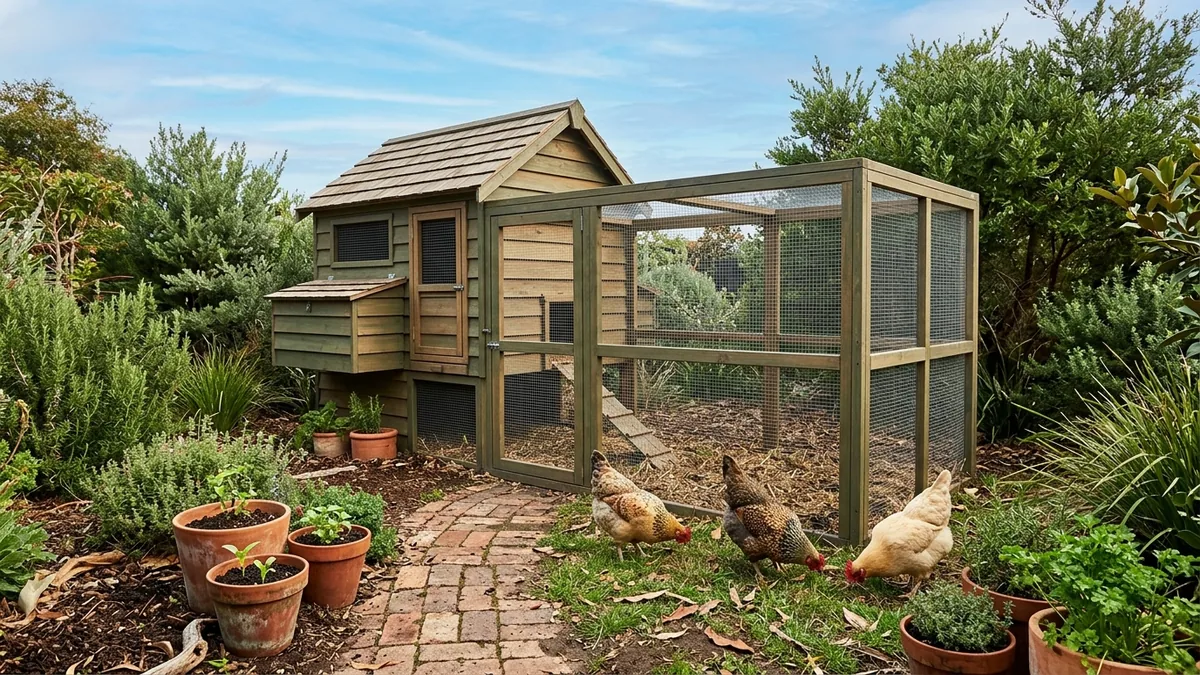
What makes a coop work, the main coop types compared, region-tuned predator notes, and a calculator that sizes the coop and run for your flock.
A coop is two spaces: the enclosed roost where birds sleep and lay, and the run where they spend the day. Get a handful of basics right and almost any design works.
About 0.3 to 0.4 square metres of indoor floor per standard hen, plus at least 1 square metre each in the run. More is always better.
Vents high, above roost height, year round. Damp ammonia air causes illness faster than cold. Avoid draughts blowing on roosting birds.
One box per three to four hens, about 30 cm cubed, set lower than the roosts and kept dark and private.
About 20 to 25 cm of roost per bird, higher than the nest boxes, with rounded edges so feet grip comfortably.
Welded steel mesh, a buried or skirted base, a covered run, and latches a clever paw cannot flick open.
A door or hinged roof you can reach into, a droppings tray or deep litter, and surfaces that hose down.
Morning sun to warm and dry the coop, afternoon shade against Australian heat, and rain kept off the roost area.
Three shapes cover most backyards. Pick the one that matches your flock size and whether you want to move it around the yard.
Best for flocks of 4 to 12 or more, on a permanent spot
Best for small flocks of 2 to 5 on lawn or garden beds
Best for medium to large flocks and easy daily care
Enter your flock and the calculator works out indoor floor area, run area, number of nesting boxes and roost length. Figures are in metric. Nothing is saved, and it works offline.
The threats here are different from elsewhere, and most losses happen at night or to chicks. Plan for these.
Once the coop is up, the free Planting Season app and its Poultry module track each bird, eggs, feed and health, and remind you of jobs like cleaning and worming. The Smart Yard map even links the coop to the rest of your homestead.
Allow about 0.3 to 0.4 square metres of indoor floor per standard hen, plus at least 1 square metre each in the run. Crowding causes pecking, disease and stress, so err on the generous side, especially if the birds are shut in during bad weather.
One nesting box for every three to four hens is plenty. Hens share boxes and often queue for a favourite, so more boxes than that usually sit empty or get used for sleeping, which makes them messy.
Allow about 20 to 25 centimetres of roost length per standard hen so they can all perch at night without squabbling. Place roosts higher than the nesting boxes so birds do not sleep and foul the nests.
Yes. Ventilation matters year round. Damp, ammonia-laden air causes respiratory illness and frostbite faster than cold does. Put vents high, above roost height, so stale air escapes without a draught blowing directly on the birds.
Use welded steel mesh, not flimsy chicken wire, bury or skirt it to stop foxes digging in, and lock birds in solidly at dusk. Cover the run against hawks and pythons, and use predator-proof latches that a clever paw cannot flick open.
More run space is rarely a problem, but a large, draughty roost area is harder for a small flock to keep warm and harder to keep clean. Match the enclosed roost space to the flock and give the extra room in the run instead.
Log eggs, feed, health and coop jobs in the free Poultry module, tuned to your region.