
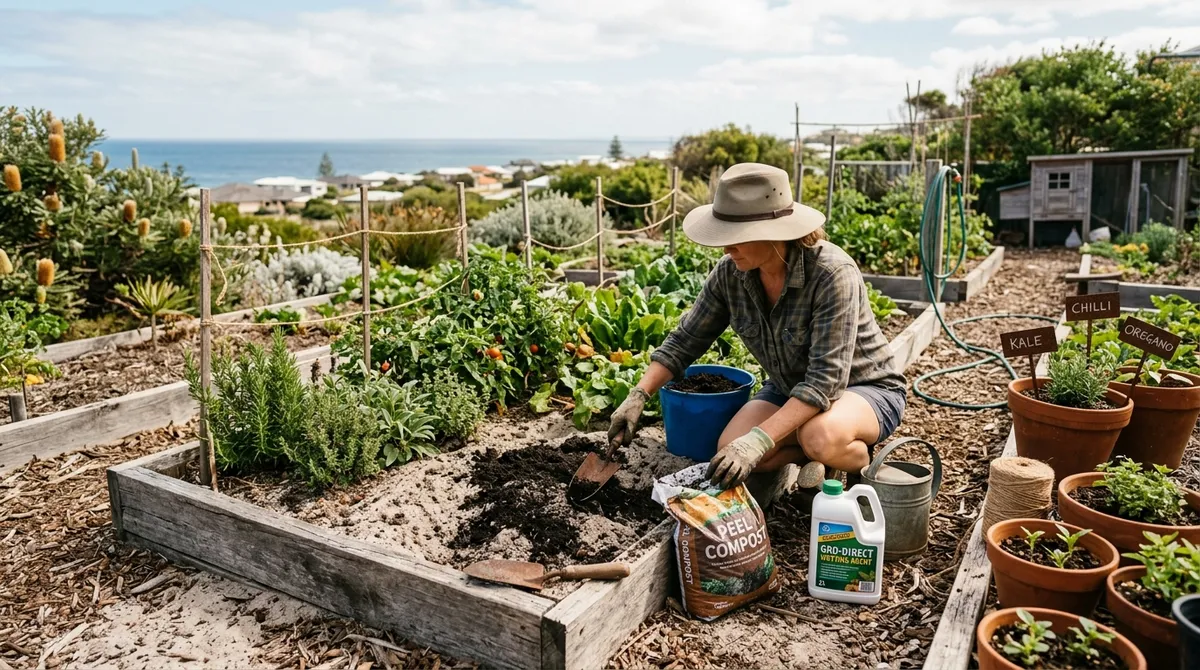
Gardening in Perth's Sandy Soil
Soil amendments, water retention, wetting agents, and raised bed strategies for WA's sandy soils
Almost every Perth gardener deals with sand. The metropolitan area sits on ancient coastal dune systems, primarily Bassendean sand (pale grey, extremely low in nutrients) in the northern and eastern suburbs, and Spearwood sand (slightly more fertile, yellow-brown) in the western and southern suburbs. Both types drain water rapidly, hold minimal nutrients, and become hydrophobic in summer.
The good news: sandy soil can be improved, and some crops actually prefer it. With the right amendments and ongoing management, you can grow productive vegetables and fruit trees in Perth's sand.
Understanding Perth's Sand Types
Knowing which sand you have helps you plan your approach.
- Bassendean sand (Joondalup, Wanneroo, Midland, Ellenbrook, Baldivis): Pale grey to white, very coarse, extremely low in organic matter and nutrients. This is Perth's most challenging garden soil. Water passes through it like a sieve. It needs the most amendment work.
- Spearwood sand (Fremantle, Rockingham, Jandakot, parts of Stirling): Yellow-brown, finer texture, slightly better nutrient retention. Still sandy, but more workable than Bassendean sand. Responds well to compost addition.
- Pinjarra clay-loam (Serpentine, Mundijong, parts of Armadale): The exception. These eastern and southern fringe suburbs have heavier soil with better water retention. If you have clay-loam, your soil challenges are different to typical Perth sand.
The Four Key Amendments
1. Compost
Compost is the foundation of any sandy soil improvement program. It adds organic matter that holds water, feeds soil microbes, and provides slow-release nutrients. Add 5-10 centimetres of quality compost and dig it through the top 20-30 centimetres before each planting season.
Perth produces excellent municipal compost. The City of Wanneroo, City of Joondalup, and City of Stirling all sell or distribute composted green waste at competitive prices. Commercial options include the C3 range from Richgro (made in WA) and bulk compost from Soils Ain't Soils or Nuway Landscape Supplies.
Expect to use 1-2 cubic metres of compost per 10 square metres of garden bed. This sounds like a lot because it is. Sandy soil breaks down organic matter faster than clay or loam, so you need to replenish it at least twice a year (March and September).
2. Bentonite Clay
Bentonite is a natural clay mineral that swells when wet, binding with sand particles to create a soil structure that holds water and nutrients. Apply at 1-2 kilograms per square metre and dig it through the top 20-30 centimetres. This is a one-off treatment that permanently improves soil structure.
Bentonite is available at Bunnings, rural supply stores (Elders, Landmark), and specialist garden suppliers across Perth. Buy it in bulk bags (25 kilograms) for better value if you have a large garden area to treat.
3. Wetting Agents
Perth's sand becomes hydrophobic in summer. Water beads on the surface and runs off without penetrating the root zone. This happens because organic coatings on sand grains repel water, a common problem in WA's sandy soils.
Apply a granular wetting agent (Saturaid, Hydrawise, or Scotts Lawn Builder with wetting agent) in September before summer and again in December. Liquid soil wetters applied through a hose-end sprayer also work well. For vegetable gardens, choose wetting agents labelled as safe for edible plants.
4. Mulch
Mulch slows evaporation, moderates soil temperature, and gradually adds organic matter as it breaks down. Apply 8-10 centimetres of pea straw, sugar cane mulch, or lupin mulch (a WA favourite, made from local lupin stubble). Pull mulch back 5 centimetres from plant stems to prevent collar rot.
Avoid pine bark mulch in vegetable gardens. It can temporarily draw nitrogen from the soil as it breaks down, competing with your crops. Save pine bark for ornamental beds and paths.
Raised Beds: The Fast Track
If your native sand is extremely poor (grey Bassendean sand is the worst), raised beds filled with quality soil mix are the most practical option. You bypass years of soil building and start growing immediately.
- Depth: Build beds at least 30 centimetres deep. 40-50 centimetres is better for tomatoes, root vegetables, and fruit trees.
- Materials: Treated pine sleepers, galvanised steel garden beds, or recycled hardwood. Avoid CCA-treated timber (the old green-tinted type) near food crops. H3 or H4 treated pine is safe for garden use.
- Fill: Order a vegetable garden mix from a Perth soil supplier. A good mix contains composted soil, composted manure, sand, and organic matter. Soils Ain't Soils, Perth Soil Mixes, and Baileys offer suitable mixes with delivery across the metro area.
- Maintenance: Even quality fill settles and loses organic matter over time. Top up with 5 centimetres of compost each season.
Watering Strategies for Sandy Soil
Sandy soil drains in minutes. A sprinkler running for 10 minutes on sand delivers water past the root zone before most plants can absorb it. The solution is frequent, short watering cycles rather than long, infrequent ones.
- Drip irrigation: The best option for Perth vegetable gardens. Drip lines deliver water slowly at the root zone, minimising waste. Run drip for 20-30 minutes every second day during summer. Drip irrigation is exempt from Perth's sprinkler roster restrictions.
- Cycle and soak: If using sprinklers, run short cycles (5 minutes on, 10 minutes off, repeat 3 times) rather than one long run. This gives water time to soak in before the next cycle.
- Morning watering: Water before 9 am to reduce evaporation. Perth's summer afternoons routinely exceed 35 degrees, and water applied in the heat evaporates rapidly.
Feeding in Sandy Soil
Nutrients leach through sand quickly. A single heavy dose of fertiliser washes below the root zone within days. Smaller, more frequent applications work far better.
- Slow-release fertiliser: Apply a complete organic fertiliser (like Richgro Mega Booster or Charlie Carp pellets) every 4-6 weeks through the growing season.
- Liquid feeding: Supplement with liquid seaweed and fish emulsion every 2 weeks. These are quickly absorbed and boost growth between solid fertiliser applications.
- Side-dressing: Scatter a handful of blood and bone or pelletised chicken manure around each plant every 3-4 weeks during active growth.
Avoid high-analysis synthetic fertilisers on sandy soil. They deliver a short, intense nutrient spike that leaches away within a few waterings. Organic and slow-release options are more cost-effective because they stay in the root zone longer.
Crops That Love Perth's Sand
Some vegetables prefer sandy, well-drained soil. These crops need less amendment and often produce better results in sand than in heavier soils.
- Carrots: Grow straight and fork-free in sand. Minimal soil prep needed.
- Radishes: Fast, easy, and perfect in sandy beds.
- Sweet potatoes: Love Perth's hot summers and sandy soil. Excellent drainage prevents tuber rot.
- Watermelon and rockmelon: Thrive in Perth's heat with sandy, well-drained roots.
- Herbs (rosemary, thyme, oregano): Mediterranean herbs are perfectly adapted to Perth's sandy, dry conditions.
Get Soil Tips for Your Suburb
The Planting Season app includes soil type data and amendment recommendations for Perth suburbs.
Open the Planting Season AppFrequently Asked Questions
Why is Perth's sandy soil so hard to garden in?
Perth sits on ancient coastal sand dunes. This sand drains water in minutes, holds almost no nutrients, and becomes hydrophobic in summer. Nutrients leach through the root zone before plants can absorb them. Without amendment, most vegetables struggle to grow.
What is the best soil amendment for Perth sand?
Compost is the single most effective amendment. Add 5-10 centimetres and dig it through the top 20-30 centimetres. Bentonite clay at 1-2 kilograms per square metre permanently improves water and nutrient retention. Wetting agents help water penetrate hydrophobic sand during summer.
Should I use raised beds in Perth?
Raised beds filled with a quality vegetable mix are the fastest way to a productive garden in Perth. You bypass the sandy soil entirely. Use beds at least 30 centimetres deep. Fill with a composted soil mix from a local supplier.
How often should I add compost to Perth sand?
Add compost at least twice a year: before the winter planting season (March) and before the summer season (September). Sandy soil breaks down organic matter faster than clay or loam, so regular topping up is essential.
Free Monthly Planting Calendar
Get a personalised email each month with what to plant, seasonal tips, and harvest reminders for your region.
We send one email per month. Unsubscribe any time.