
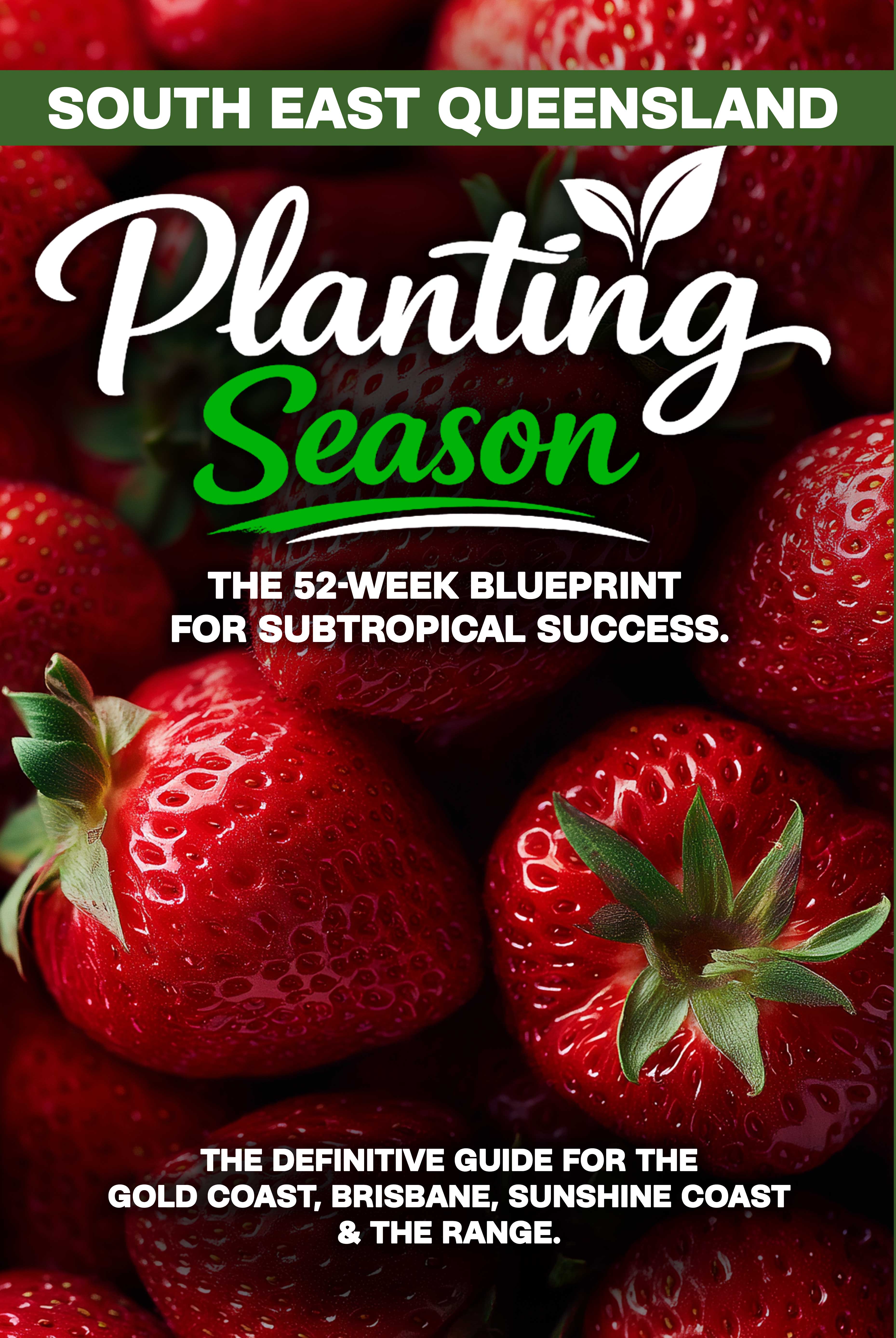
Why SEQ Needs Its Own Gardening Book
Most gardening books are written for temperate climates: four clean seasons, a frost-defined winter, a dry summer. South East Queensland doesn't work that way. We have two real seasons (a cool dry and a warm wet), humidity that breeds fungal disease, a fruit fly window that kills every spring tomato, storm weeks that can flatten a bed overnight, and frost pockets that only appear on the Darling Downs and in the Hinterland.
Follow a generic seed packet in SEQ and you plant at the wrong time, fight the wrong pests, and lose crops to problems no one warned you about.
Planting Season SEQ fixes that. It gives you the calendar, the plant library, and the playbook calibrated to this exact climate.
What You Get Inside
The Full Chapter List
Seventeen main chapters plus a nine-part plant library. Every chapter is written for SEQ. Every chapter assumes you want to eat what you grow.
The Plant Library (parts 1 through 9)
- Part 1: Leafy greens and brassicas (lettuce, silverbeet, kale, cabbage, broccoli, cauliflower, bok choy, rocket, spinach and more)
- Part 2: Fruiting vegetables (tomatoes, capsicum, eggplant, zucchini, cucumber, beans)
- Part 3: Root vegetables (carrots, beetroot, radish, onion, garlic, ginger, turmeric)
- Part 4: Warm-season greens
- Part 5: Legumes (bush and climbing beans, peas, snow peas)
- Part 6: Herbs (basil, parsley, coriander, mint, thyme, rosemary, oregano, sage and more)
- Part 7: Tropical and subtropical fruit trees
- Part 8: Australian native and indigenous edibles
- Part 9: Companion plants and flowers
Each plant entry includes sowing windows, spacing, sun, water needs, companions to plant with, common pests, common diseases, a kitchen use note, and a realistic SEQ tip.
A Sample from the Book
SEQ isn't one climate. It's several, stacked next to each other across a relatively small area. A gardener in Redcliffe has a fundamentally different growing environment from a gardener in Toowoomba, even though they're barely an hour apart by car. Understanding your specific microclimate is the difference between a garden that struggles and one that thrives.
At around 600 metres elevation, Toowoomba has a fundamentally different climate from coastal SEQ. Real frosts, sometimes hard frosts, from May through August. Cooler nights year-round. Lower humidity than the coast. Summer days can still hit 35°C+ but nights cool dramatically. For the garden, that means you can grow temperate-zone crops that will not work on the coast, and you need cold protection that coastal gardeners never think about.
Who It's For
You've just moved in. The backyard is bare. You want food growing by next season and you don't know where to start. The book walks you through your first year.
You've followed the seed packets and watched half your crops fail to fruit fly, humidity, or bolting. This book tells you why, and what to do instead.
You gardened in Melbourne or Sydney. Everything you knew is wrong up here. The book recalibrates your timing to subtropical reality.
You rent, or you live in a unit. The small spaces chapter and container-friendly plant entries are built for you.
You want real food, lower bills, and a backyard that feeds the household year-round. The book is the 12-month plan for that.
You know your way around a garden already. The plant library, pest field guide, and SEQ-tuned calendar are the book you keep open on the bench.
Pair the book with the free Planting Season app
The book is the reference. The app is the day-to-day: month-by-month alerts, watering reminders, and a mobile plant library you can search from the garden.
Open the Planting Season app →Why This Book, Not Another
Planting Season SEQ was written in the subtropics, tested in the subtropics, and structured around the real microclimates that sit inside SEQ. A Toowoomba reader and a Redcliffe reader get different advice for the same month, because their weather is different in the same month.
The voice is plain and direct. Real Talk, not marketing fluff. The book will tell you when to skip a crop, when to rest the gardener, and when a glossy catalogue is selling you something that will not grow here. Every chapter was drafted, reviewed, and rewritten with local gardening knowledge in mind.
It is also built to last. At around 430 pages it is a reference book, not a skinny intro. You will come back to it every season for years.
Early Reader Reactions
More reviews incoming as the first Amazon readers weigh in.
Frequently Asked Questions
Is this book only for South East Queensland?
Yes. Planting Season SEQ is written specifically for the subtropical climate between Caloundra and Coolangatta, including Brisbane, the Gold Coast, the Sunshine Coast, Ipswich, the Scenic Rim and Toowoomba. Gardeners in similar subtropical climates (northern NSW, central Queensland coast) will find most of it useful, but timing is calibrated for SEQ.
I'm a total beginner. Is this book for me?
Yes. The book starts with the SEQ climate, the seven biggest mistakes new gardeners make here, soil basics, water, and planning. It builds from first garden bed through to seed saving and crop rotation. No prior experience needed.
What about paperback?
The Kindle edition is available now on Amazon. The paperback edition is going through Amazon's print review process. Once approved, the paperback link will go live at the same Amazon listing.
Does it include fruit trees and natives?
Yes. The plant library has sections on tropical and subtropical fruit trees, Australian native and indigenous edibles, companion flowers, herbs, leafy greens, brassicas, fruiting vegetables, root crops, warm-season greens, and legumes.
How long is the book?
Around 430 pages in the paperback edition, printed at 6 by 9 inches. It's a genuine reference you keep on the shelf, not a skinny intro.
Does it work with the Planting Season app?
Yes. The book is the full reference. The free Planting Season app is the day-to-day companion, with month-by-month alerts, watering reminders, a mobile plant library, and a pest-solver index. Visit plantingseason.com.au/app to try it.
Grow food every month of the year. Start this weekend.
Planting Season SEQ is on Amazon now. Kindle edition live, paperback coming as Amazon completes its review.
Buy on Amazon→ASIN: B0GX2YFZMB · Planting Season · English · ~430 pages