
Planting Passionfruit in Australia: Growing Passion Fruit
Updated October 2026
More fruit growing help: Backyard Fruit Trees in Australia, with the best fruit for each region and when to plant it.
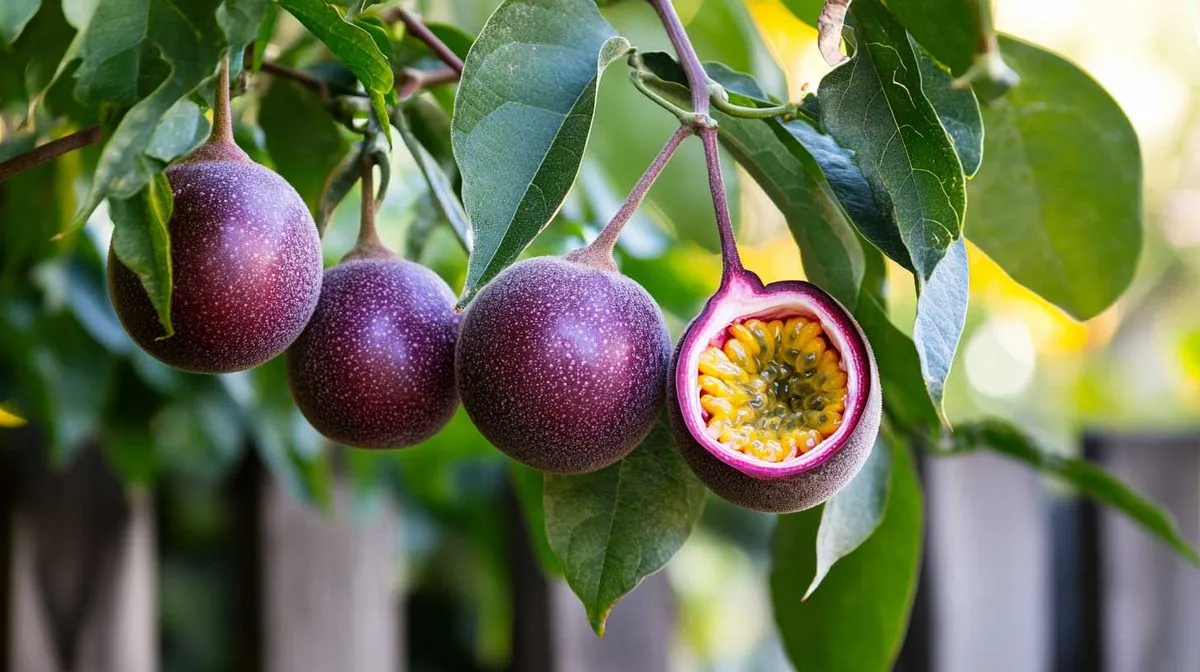
Pick your climate, then get it growing: varieties, trellis, feeding, pollination and pruning
What it looks like as it grows


Passionfruit is one of the great backyard rewards. A single vine can cover a fence in a season and hang dozens of fruit, it grows fast and fruits young, and a sun-ripened passionfruit straight off your own vine tastes nothing like the cold-store fruit at the shops.
The catch is climate. Passionfruit is a frost-tender, warm-climate vine that thrives in the subtropics and warm temperate zones, struggles in genuine cold, and grows happily in a pot where the ground is too cold or the space is too small. This guide starts by matching passionfruit to your climate, then takes you through varieties, support, feeding, pollination, pruning, harvest and the common problems.
🌱 Plant profile: Passionfruit, with sowing times for your region, companion plants and common pests.
Climate and Position: Will It Suit Where You Are?
Passionfruit needs warmth, a long growing season and full sun. Pick your climate below to see whether to plant it in the ground, grow it in a pot, or give it winter protection, plus the variety types that suit you best.
Wherever you grow it, give passionfruit the warmest, sunniest, most sheltered spot you have, ideally a north or north-east facing wall or fence that soaks up sun and radiates warmth at night. It wants free-draining soil rich in organic matter and hates wet feet, so improve heavy clay with compost and plant on a slight mound if drainage is poor.
When to Plant Passionfruit in Your Region
Passionfruit is planted as a young vine, usually grafted, in the warm months so it establishes before winter. These are the planting months for each region from our planting data. Each region links to its full vegetable planting calendar, and the Passionfruit plant page has spacing, companions and care notes for your region.
| Region | Plant vines | Local note |
|---|---|---|
| South East Queensland | September to April | Plant Sep to Apr. Prime passionfruit country, where most named varieties crop well. |
| Northern Rivers NSW | September to April | Plant Sep to Apr, as in South East Queensland. |
| Sydney & Coastal NSW | September to March | Plant Sep to Mar so the vine is established before winter. Grafted black passionfruit handles cool Sydney winters best; in the west plant after the last frost. |
| Melbourne & Victoria | October to December | Plant Oct to Dec. Mulched vines survive light frosts, and frost may kill new growth, but the plant regrows. |
| Adelaide & SA | September to November | Plant vines Sep to Nov against a warm wall. Protect from frost for the first two winters. Water deeply through summer. |
| Perth & WA | September to November | Plant vines Sep to Nov on a sunny fence or trellis. Feed and water well on sandy soil, and shade the roots with mulch through summer. |
| Tasmania | Not recommended outdoors | Unsuitable for reliable cropping. Vines survive in rare frost-free coastal corners but fruit rarely ripens well. |
| Canberra & ACT | November | Marginal. Plant in November after the last frost against a warm north wall. Vines are often killed in hard winters. |
| North Queensland | September to April | Spring/early wet season Sep to Apr. Passionfruit is a tropical staple; vines thrive with monsoonal wet. |
| Darwin & Top End | September to April | Spring/early wet season Sep to Apr. Passionfruit is a tropical staple; vines thrive with monsoonal wet. |
Best Varieties for Australia
Most home gardeners are choosing between black (purple) passionfruit, which is the classic tart-sweet fruit, and the golden Panama types, which are larger, milder and need more warmth. Grafted vines are the most reliable choice because the rootstock adds vigour and disease tolerance.
| Variety | Type | Best climate | Notes |
|---|---|---|---|
| Nellie Kelly | Black, grafted | Temperate to subtropical | The most widely planted passionfruit in Australia. Grafted onto a hardy rootstock for extra cold and disease tolerance, so it is the safest pick for cooler and marginal gardens. Reliable, heavy cropper. |
| Panama Gold | Golden, seedling | Subtropical to tropical | Large golden fruit with sweeter, less acidic pulp. Vigorous and needs real warmth, so best in frost-free subtropical and tropical gardens. Often planted with Panama Red for cross-pollination. |
| Panama Red | Reddish-purple, seedling | Subtropical to tropical | Sweet, large fruit similar to Panama Gold. Warm-climate vine that fruits well alongside Panama Gold, as the Panama types crop better with a second vine nearby. |
| Misty Gem | Purple hybrid | Warm temperate to subtropical | Round purple fruit, heavy yields and good aromatic flavour with useful disease resistance. A popular modern alternative to Nellie Kelly in warmer gardens. |
| Sweetheart | Purple, self-fertile | Warm temperate to subtropical | Compact, self-fertile purple variety that suits smaller gardens and pots. Sets fruit reliably without a second vine. |
A note on banana passionfruit
Banana passionfruit (the elongated yellow fruit, Passiflora tarminiana and relatives) is very vigorous and copes with cool conditions, but it is a declared or environmental weed in parts of Australia because birds spread its seed into bushland. Check your local council or state weed list before planting it, and for most gardens choose a named purple variety such as Nellie Kelly instead.
Planting Passionfruit Step by Step
Plant in spring once the soil has warmed and frost has passed. In the subtropics and tropics the window runs right through the warm season, from September to April, while Sydney plants from September to March, Adelaide and Perth from September to November, Melbourne from October to December and Canberra only in November. Dig in plenty of compost and well-rotted manure before planting, and add a handful of dolomite if your soil is acidic, as passionfruit likes a near-neutral pH around 6.5.
- Space vines about 2 metres apart along a fence or trellis.
- Plant at the same depth the vine sat in its pot, and keep the graft union (the swollen joint low on the stem) well above the soil so it cannot send out rootstock suckers.
- Water in well, mulch thickly to keep the roots cool and moist, and keep the mulch clear of the stem.
- Tie the leading shoots onto the support to start them climbing.
Planting passionfruit in a pot
Our plant data calls for a pot at least 60 cm across with a trellis, which is a large container of 50 litres or more. Use a free-draining potting mix, set the trellis in place at planting time, and stand the pot in the warmest, sunniest spot you have. In Tasmania and other cold gardens, a pot you can move under cover for winter is the realistic way to grow passionfruit.
Watering and Feeding
Passionfruit is shallow-rooted and thirsty, especially while flowering and fruiting. Water deeply and regularly through the warm months and never let a fruiting vine dry out, or it will drop flowers and fruit. Mulch heavily to hold moisture and feed the soil life.
This is a hungry vine, but feeding it the wrong way is the most common reason for a wall of leaves and no fruit. Too much high-nitrogen fertiliser drives leafy growth at the expense of flowers and fruit. Use a fertiliser made for fruiting plants or citrus, which is lower in nitrogen and includes potassium, and feed little and often through spring and summer. Chicken manure and compost are fine in moderation, but go easy. If your vine is all leaf and no flower, ease off the nitrogen and add some potassium (sulphate of potash).
Support and Pruning
Passionfruit climbs by tendrils and is far heavier than it looks once laden, so build a solid structure before you plant.
- Fence trellis: sturdy wire run along the top of a fence is the classic backyard setup. The vine runs along the wire and hangs fruit down.
- Free-standing trellis: two strong posts about 3 metres apart with three horizontal wires at roughly 60 cm, 120 cm and 180 cm.
- Pergola: a vine will cover a pergola fast for shade and fruit, provided the frame can carry the weight.
Prune in early spring as growth restarts, never in the cold of winter. Cut back about a third of the growth to a healthy bud, remove dead and tangled wood to let light and air into the centre, and shorten stems that have outrun their support. Fruit forms on the new season's growth, so a light annual prune keeps a vine vigorous and productive rather than a bird's nest of old wood.
Pollination
Passionfruit flowers must be pollinated to set fruit. Most purple varieties are largely self-fertile, while the Panama golden types set far better with a second vine nearby for cross-pollination. Large carpenter bees and honey bees are the main pollinators, so a garden busy with bees fruits better.
If you are getting flowers but no fruit, hand-pollinate around midday when flowers are fully open: brush pollen from the stamens onto the central stigmas with a small soft brush. Cold, wet or windy weather during flowering knocks pollination, so in cooler gardens the main set happens in the warmest part of the season.
How Long Does Passionfruit Take to Fruit?
Our plant data allows about 400 days, a little over a year, from planting a young vine to its first good crop, so a vine planted in spring usually starts cropping in its second summer. The main picking season runs from December to August, and the heaviest crops come in years two to four. Vines decline after about 5 to 7 years, so plant a replacement when the old vine is around three years old.
Harvest and Storage
Passionfruit tells you when it is ready by falling to the ground, fully coloured and ripe. You can also pick fruit once it is richly coloured and let it finish on the bench. The skin wrinkles as it ripens further, which concentrates the flavour, so do not be put off by a crinkly skin.
Ripe fruit keeps about a week in the fridge. For a glut, scoop the pulp and freeze it in ice-cube trays, then tip the frozen cubes into a bag for smoothies, desserts, dressings and sauces all year. Whole fruit also freezes well.
Common Problems
All leaf, no fruit
Usually too much nitrogen, or a young vine still building up. Switch to a low-nitrogen fruiting fertiliser, add potassium, and be patient with a first-year vine. Also check it is not a rootstock sucker that has taken over.
Rootstock suckers
Grafted vines can throw suckers from below the graft. These are the rootstock, not the fruiting variety, and they usually look different (lighter, differently shaped leaves). Cut them off cleanly at the base as soon as you see them, or they will overrun the good variety and you will get a vigorous vine with little fruit.
Passionfruit woodiness virus
Causes hard, woody, pulp-poor fruit, distorted leaves and weak growth. There is no cure. Remove and destroy affected vines, buy certified clean plants, and control aphids, which spread it.
Fusarium wilt
A soil fungus that wilts and kills vines. Grafted rootstocks give some resistance. Do not replant passionfruit in a spot where a vine died of wilt.
Frequently Asked Questions
When should I plant passionfruit in Australia?
Plant in spring once the soil has warmed and frost risk has passed. South East Queensland, the Northern Rivers, North Queensland and Darwin can plant from September to April, Sydney from September to March, Adelaide and Perth from September to November and Melbourne from October to December. Canberra is marginal, with a November planting against a warm north wall, and Tasmania is not suited to reliable cropping. Avoid planting in winter, as cold soil stunts young vines and frost can kill them outright.
How long do passionfruit take to produce fruit?
Our plant data allows about 400 days, a little over a year, from planting to the first good crop, so a vine planted in spring usually starts cropping in its second summer. The heaviest crops come in years two to four.
Why is my passionfruit flowering but not setting fruit?
The usual causes are too much high-nitrogen fertiliser, poor pollination, cold or wet weather during flowering, or a rootstock sucker taking over. Switch to a low-nitrogen fruiting fertiliser, hand-pollinate at midday with a soft brush, and remove any rootstock suckers.
Can I grow passionfruit in a pot?
Yes. Use a large pot of at least 50 litres with a trellis behind it. Pots are the best option for cool-temperate gardeners who can move the vine to shelter over winter, and for renters and balconies. Pots dry out and run short of food faster than the ground, so water consistently and feed little and often.
Is banana passionfruit a weed?
Banana passionfruit is a declared or environmental weed in several parts of Australia because birds spread its seed into bushland. Check your local council or state weed list before planting it, and prefer a named purple variety such as Nellie Kelly for most home gardens.
How do I prune a passionfruit vine?
Prune in early spring as growth starts, never in the cold of winter. Cut back about a third of the growth to a healthy bud, thin out tangled and dead wood, and shorten stems that have outgrown their support. Fruit forms on new growth, so a light annual prune keeps the vine productive.
How long do passionfruit vines last?
Most vines live about 5 to 7 years, peaking in years two to four and then declining. Plant a replacement when the existing vine is around three years old so you always have a productive vine coming on.
How do I store and ripen passionfruit?
Let fruit fall or pick it fully coloured, then ripen at room temperature until the skin wrinkles, which deepens the flavour. Ripe fruit keeps about a week in the fridge, or scoop the pulp and freeze it in ice-cube trays for use all year.
How do you plant a passionfruit vine?
Plant a grafted vine in full sun against a strong trellis or fence, in free-draining soil with compost dug through it. Set it at the same depth it sat in the pot with the graft union well above the soil, water it in well and mulch, keeping the mulch clear of the stem. Space vines about 2 metres apart.
Where is the best place to plant passionfruit?
The warmest, sunniest, most sheltered spot you have, ideally a north or north-east facing wall or fence that soaks up the sun. The soil must drain freely, so plant on a slight mound if drainage is poor, and make sure the support can carry a heavy, fruiting vine.
Can you grow passionfruit in Melbourne?
Yes, with shelter. Our Melbourne calendar plants passionfruit from October to December. Mulched vines survive light frosts, and frost may kill new growth, but the plant regrows. A grafted purple variety such as Nellie Kelly against a warm north-facing wall gives the best chance.
See also: Passionfruit in the Plant Library and our guide to preserving a garden glut.
Plant profile
The passionfruit profile has sowing times for your region, companion plants and common pests.