
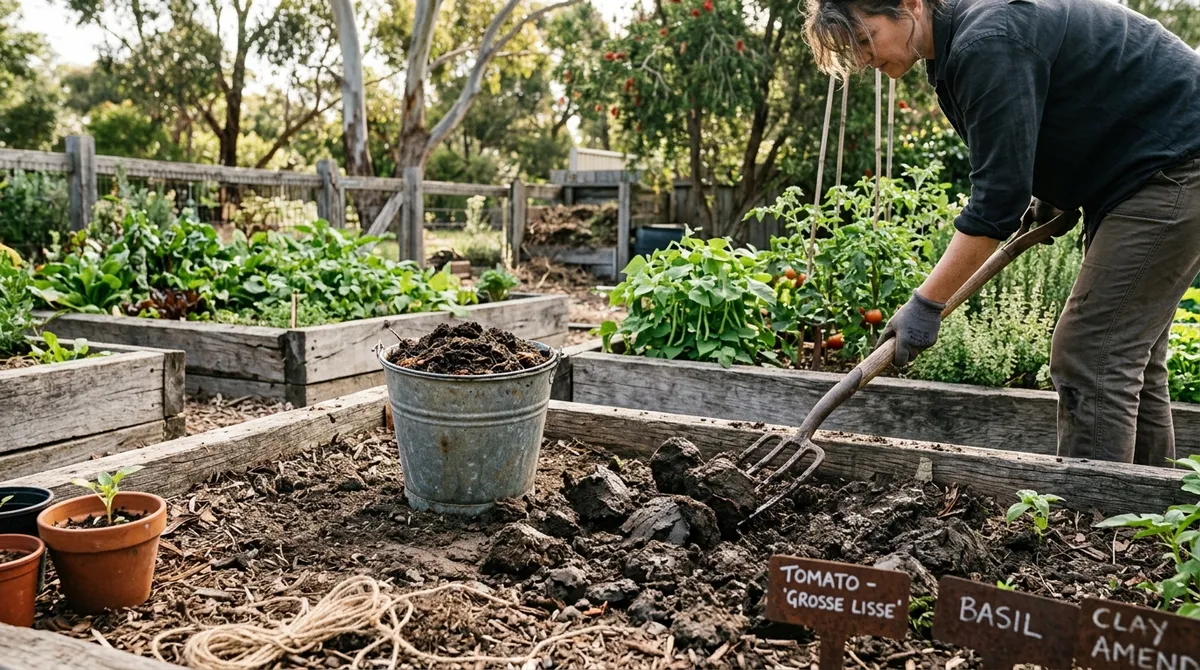
Gardening in Melbourne's Heavy Clay Soil
Your clay is a challenge, but it's also mineral-rich and fertile
Almost every Melbourne gardener deals with clay. The western suburbs (Werribee, Altona, Sunshine, Melton) sit on some of the heaviest basalt clay in Australia. The northern suburbs (Northcote, Preston, Reservoir, Fawkner) have a mix of basalt clay and alluvial clay. The eastern suburbs and hills vary from sandy loam to deep clay depending on elevation. Even the relatively sandy Mornington Peninsula has clay subsoil in many areas. Understanding your clay, and working with it rather than against it, is the foundation of productive gardening in Melbourne.
Why Clay is Both a Problem and an Asset
Clay particles are extremely fine, much smaller than sand or silt particles. When wet, they pack together tightly, squeezing out air spaces. This creates soil that is sticky, poorly drained, and low in oxygen. Roots need oxygen to grow. When clay stays waterlogged for days after rain (common in Melbourne winter), roots suffocate and rot.
When clay dries out in Melbourne's hot summers, it shrinks and cracks. The cracks rip through root systems and the surface becomes rock-hard. Trying to dig dry clay is punishing work.
The advantage is that those tiny clay particles hold minerals and nutrients far better than sandy soil. Melbourne's basalt clay is rich in calcium, magnesium, iron, and trace minerals. Once you fix the structure, the fertility is already there. Sandy soils drain well but lose nutrients rapidly. Clay holds onto them.
The Gypsum Step
Gypsum (calcium sulfate) is the first step for most Melbourne clay. It works by displacing sodium ions in sodic clay, allowing the clay particles to group into larger aggregates. These aggregates create air pockets and drainage channels. Spread gypsum at 1 kilogram per square metre over the bed and dig it into the top 15 centimetres. Water it in well.
Gypsum is most effective on sodic clay (clay that is high in sodium). You can test for sodicity with a simple home test: drop a lump of dry clay into a glass of clean water. If the water turns cloudy and the clay disperses rather than staying as a lump, your clay is likely sodic and gypsum will help. If the lump stays intact and the water stays clear, your clay may be non-sodic and gypsum will have less effect.
Even on non-sodic clay, gypsum adds calcium, which is beneficial. It does no harm and is worth applying as a starting point.
Compost: The Long-Term Fix
Organic matter is the real solution for Melbourne clay. Compost, aged manure, leaf mould, and mulch improve clay structure permanently when applied consistently. The organic matter creates binding agents (humus) that hold clay particles in aggregates, maintaining air spaces even when wet. It feeds soil organisms (worms, fungi, bacteria) that physically break up clay through their movement and chemical activity.
Spread 5 to 10 centimetres of compost or aged manure over your beds and fork it into the top 20 centimetres. Repeat every season. After two to three years of consistent compost addition, the clay transforms from a sticky, heavy mass into dark, crumbly, workable soil.
Mushroom compost, cow manure compost, and homemade compost all work well. Avoid uncomposted sawdust or woodchip dug into the soil, as it draws nitrogen from the soil during decomposition. Woodchip is excellent as a surface mulch but should sit on top of the soil, not mixed in.
Raised Beds: The Fast Track
If you want to start growing immediately on heavy Melbourne clay, raised beds are the answer. Build or buy beds at least 30 centimetres deep. Place them directly on the clay surface without any barrier or liner at the bottom. Fill with a quality garden soil mix (available from landscape suppliers by the cubic metre).
A good fill mix is 50 percent topsoil, 30 percent compost, and 20 percent coarse organic matter (composted bark, aged manure). Avoid 100 percent compost fills, which compact over time and drain poorly once the initial structure breaks down.
Over the years, worms move between the raised bed soil and the clay beneath, gradually improving the clay layer. The raised bed acts as a composting system that progressively upgrades the underlying clay.
Common raised bed materials for Melbourne include treated pine sleepers, galvanised steel, hardwood timber, and recycled plastic lumber. Steel is long-lasting, relatively affordable, and does not rot. Timber is more expensive but looks better. Corrugated iron surrounds are a classic Australian look.
Mulching on Clay
Mulch is especially important on Melbourne clay. In summer, it prevents the surface from baking hard and cracking. In winter, it stops the surface from becoming compacted by heavy rain. Year-round, it feeds soil organisms that improve clay structure from the top down.
Apply 5 to 10 centimetres of straw, sugar cane mulch, or pea straw around plants. Keep mulch away from the stems of plants to prevent collar rot. On bare beds between crops, spread a thick layer of mulch or sow a green manure crop (broad beans, clover, or oats) to protect the clay surface and add organic matter.
What Grows Well in Unimproved Clay
Some crops tolerate heavy clay better than others. If you're starting with raw Melbourne clay and want to grow food while you improve the soil, these are your best options:
- Brassicas: Broccoli, cabbage, kale, and cauliflower all handle heavy clay reasonably well. Their roots are strong enough to push through dense soil.
- Silverbeet: Remarkably clay-tolerant. It handles poor drainage and heavy soil without complaint.
- Broad beans: Grow well in clay and fix nitrogen, improving the soil for following crops.
- Pumpkin and zucchini: Their vigorous root systems push through clay. Mound the soil into hills 30 centimetres high to improve drainage around the root zone.
- Potatoes: Grow in clay if you hill them up well. The mounding creates better drainage around the developing tubers.
Root vegetables (carrots, beetroot, parsnips) struggle in unimproved clay. The dense soil causes roots to fork, stunt, or develop poor shape. Grow these in raised beds or well-improved clay.
A Three-Year Clay Improvement Plan
Year 1
Apply gypsum. Build one or two raised beds for immediate production. Start composting. Mulch all bare soil. Grow clay-tolerant crops (brassicas, silverbeet, broad beans) directly in the ground.
Year 2
Add 10 centimetres of compost to the clay beds and fork it in. The soil should be noticeably easier to work. Expand to more crops. Plant root vegetables in beds that received compost in year one. Continue mulching.
Year 3
The clay beds that received two years of compost should now be dark, crumbly, and well-draining. You can grow anything in them. Continue adding compost each season to maintain the improvement. The raised beds will also be well-established and highly productive.
Plan Your Melbourne Garden
Get planting advice tailored to Melbourne's soil and climate conditions.
Open the Planting Season AppFrequently Asked Questions
Why is Melbourne clay soil so difficult?
Melbourne's clay soil is derived from ancient basalt lava flows. The fine particles pack tightly, creating soil that is waterlogged when wet and rock-hard when dry. The good news is that basalt clay is naturally high in minerals and very fertile once the structure is improved.
Does gypsum fix Melbourne clay?
Gypsum helps break up clay structure by encouraging particles to clump together into larger aggregates. Apply 1 kilogram per square metre. It works best on sodic clay. Gypsum is a helpful first step, but consistent compost addition is needed for lasting improvement.
Should I build raised beds on Melbourne clay?
Raised beds are the fastest way to productive gardening on Melbourne clay. A bed 30 centimetres deep gives you instant good soil. Place beds directly on the clay surface without a liner. Worms will gradually improve the clay beneath.
What vegetables grow well in Melbourne clay soil?
Brassicas (broccoli, cabbage, kale), silverbeet, broad beans, pumpkin, and zucchini all tolerate heavy clay. Root vegetables need improved clay or raised beds because dense soil causes forking and stunting.
Free Monthly Planting Calendar
Get a personalised email each month with what to plant, seasonal tips, and harvest reminders for your region.
We send one email per month. Unsubscribe any time.