How to Grow Potatoes in Australia
Updated June 2026
Region-by-region planting times, variety picks, and harvest tips for every climate
Potatoes are one of the most satisfying crops you can grow at home. They're generous with yields, forgiving of beginners, and produce something genuinely useful in the kitchen. But getting the timing right matters, and Australia's climates are so varied that a planting date that works in Melbourne will fail completely in Darwin.
This guide covers when to plant potatoes in every major Australian region, which varieties suit which climates, and how to get the best harvest from your space.
What it looks like as it grows


🌱 Plant profile: Potato, with sowing times for your region, companion plants and common pests.
When to Plant Potatoes in Your Region
Potatoes need cool-to-mild soil temperatures (around 15 to 20 degrees Celsius) for tuber formation. In warm and tropical regions, this limits you to autumn and winter planting. In cool-temperate regions, spring through early summer is the main window.
Potato planting months in every region
The same calendar as the region picker above, for every region at once, with the local note from our data.
| Region | Plant seed potatoes | Local note |
|---|---|---|
| South East Queensland | March to August | |
| Northern Rivers NSW | March to August | |
| Sydney & Coastal NSW | March to May and August | Plant an autumn crop from March to May and a late winter crop in August. Avoid frost and the summer heat. |
| Melbourne & Victoria | August to November | Plant certified seed potatoes Aug to Nov (spring). Autumn planting fails in Melbourne: winter frost kills the tops. Protect shoots that emerge before the last frost. |
| Adelaide & SA | August to November | Plant certified seed potatoes Aug to Nov; watch late frosts in Aug, especially in the Hills. Autumn planting risks frosted tops in winter. |
| Perth & WA | March to May and August to September | Two windows: autumn Mar to May on the frost light plain and coast, late winter to spring Aug to Sep everywhere. Frosty Swan Valley floor and Hills plant spring only. Certified WA seed. |
| Tasmania | September to December | Plant certified seed potatoes Sep to Dec. Pink Eye can go in from late Aug near the coast. Hill against late frost. Prime potato country. |
| Canberra & ACT | September to January | Plant Sep to Dec after soil warms; hill well as late frosts burn early shoots. Jan planting gives a quick autumn crop. Never plant into frozen winter soil. |
| North Queensland | May to August | Dry season May to Aug. Potato needs cool temps; plant in dry season only. |
| Darwin & Top End | May to August | Dry season May to Aug. Potato needs cool temps; plant in dry season only. |
When to plant potatoes in Melbourne
Our Melbourne vegetable planting calendar has seed potatoes going in from August to November. Plant certified seed potatoes Aug to Nov (spring). Autumn planting fails in Melbourne: winter frost kills the tops. Protect shoots that emerge before the last frost. Across Melbourne and Victoria the average last spring frost is around 10 September and the first autumn frost around 15 May, so a spring planting has the whole warm season to grow.
Our plant data gives potatoes about 90 days from planting to harvest, so an August planting is ready from around November and a November planting from around February. Frost dates vary a lot across the region, which decides how early you can plant without protecting the shoots: Melbourne CBD (3000) frost in 4 of 10 winters, safe from about 17 August; Mornington (3931) frost in 3 of 10 winters, safe from about 20 August; Geelong (3220) typical last frost 16 July, safe 9 years in 10 from 13 August; Healesville (3777) typical last frost 7 August, safe 9 years in 10 from 1 September; Ballarat (3350) typical last frost 27 September, safe 9 years in 10 from 19 October; Bendigo (3550) typical last frost 17 September, safe 9 years in 10 from 28 September. Check your own postcode in the Frost Lookup, and see August, September, October and November in Melbourne for everything else to plant alongside them. Postcode figures: SILO (Queensland Government), daily minimum temperatures 2011 to 2020, CC BY 4.0.
When to plant potatoes in Canberra
Our Canberra vegetable planting calendar has seed potatoes going in from September to January. Plant from September once the soil warms and hill well, because late frosts burn early shoots. A January planting gives a quick autumn crop. Never plant into frozen winter soil. Across Canberra and the ACT the average last spring frost is around 1 November and the first autumn frost around 10 April, so September plantings need their shoots covered or hilled until November.
Our plant data gives potatoes about 90 days from planting to harvest, so a September planting is ready from around December and a January planting from around April, before the first frosts. Postcode records show how frosty the region is: Canberra City (2601) and Queanbeyan (2620) both had frost in 10 of the last 10 winters, with the typical last frost on 7 October and frost-tender crops safe 9 years in 10 from 1 November; Goulburn (2580) has a typical last frost on 1 October and is safe from 21 October. Check your own postcode in the Frost Lookup, and see September, October, November and January in Canberra for everything else to plant alongside them. Postcode figures: SILO (Queensland Government), daily minimum temperatures 2011 to 2020, CC BY 4.0.
Best Potato Varieties for Australia
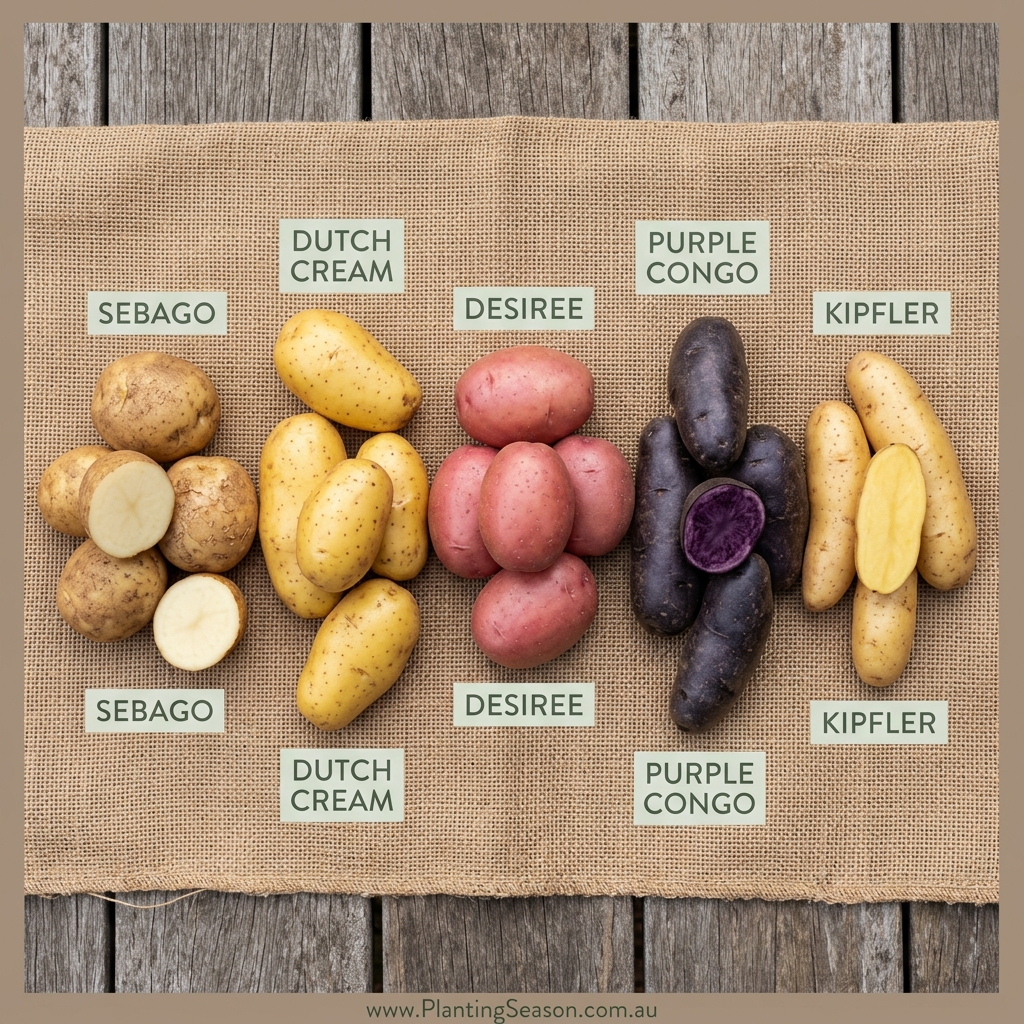
Australian gardeners have access to excellent seed potato varieties bred for local conditions. Here are the proven performers across different climates.
Sebago
The classic all-rounder. White-fleshed, reliable yields, stores well. Suits every Australian region. Good for mashing, roasting, and chips. Available from most nurseries and seed suppliers.
Kipfler
Waxy, fingerling-style potato with yellow flesh and nutty flavour. Excellent roasted or in salads. Performs best in cooler regions (Melbourne, Hobart, Canberra, Adelaide) where the longer growing season develops its flavour.
Dutch Cream
Buttery yellow flesh, creamy texture. A favourite for roasting. Moderate disease resistance. Does well in most temperate and subtropical regions. Takes 16 to 18 weeks to maturity.
Nicola
Waxy, smooth-skinned variety ideal for salads and boiling. High yields and good disease resistance. Performs well in Perth's Mediterranean climate and Adelaide's dry summers.
Ruby Lou
Red-skinned Australian-bred variety. Compact habit suits containers and small beds. Early maturing (12 to 14 weeks). Good choice for subtropical and warm-temperate regions where you want a quick crop before heat arrives.
Planting Method: Step by Step
- Source certified seed potatoes. Don't plant supermarket potatoes. They may carry diseases and are often treated to prevent sprouting. Buy certified seed potatoes from a nursery or online supplier.
- Chit your seed potatoes. Place them in a cool, light spot for 2 to 3 weeks until short green sprouts appear. This gives them a head start once planted.
- Prepare the soil. Potatoes need loose, well-drained soil with plenty of organic matter. Heavy clay soils cause misshapen tubers. Dig through compost and aged manure at least 2 weeks before planting.
- Plant 10 to 15 cm deep, 30 cm apart. Place each seed potato with sprouts facing up in a trench or hole. Space rows 60 to 75 cm apart to allow for hilling.
- Hill up as they grow. When shoots reach 15 to 20 cm tall, mound soil around the stems, leaving just the top leaves exposed. Repeat 2 to 3 times during the season. This protects developing tubers from sunlight (which turns them green and toxic).
- Water consistently but don't waterlog. Potatoes need even moisture, especially during flowering when tubers are forming. Overwatering causes rot. Underwatering causes small, cracked tubers.
Growing in Containers
Potatoes grow surprisingly well in large pots, grow bags, or even hessian sacks. Use at least a 40-litre container with drainage holes. Fill the bottom third with potting mix, place 3 to 4 seed potatoes on top, then cover with 10 cm of mix. Add more mix as the plants grow (the same hilling principle).
Container growing works especially well in warmer regions where in-ground soil temperatures get too hot. Move pots to shadier spots during heat waves. Ruby Lou and other early-maturing varieties are the best picks for containers.
Common Problems
Green tubers
Caused by exposure to sunlight. Hill up regularly and mulch well. Green potatoes contain solanine and should not be eaten.
Potato scab
Rough, corky patches on the skin. More common in alkaline soils. Keep soil pH between 5.0 and 6.0 and avoid adding lime near your potato patch. The tubers are still edible underneath the scab.
Late blight
Dark patches on leaves that spread quickly in wet, humid weather. Remove affected foliage immediately. Avoid overhead watering. In humid regions (SEQ, Northern Rivers, Darwin, North QLD), choose disease-resistant varieties and time planting to avoid the wettest months.
28-spotted ladybird
This is not the beneficial ladybird. The 28-spotted variety eats potato leaves, creating a lace-like pattern. Handpick adults and crush orange egg clusters on leaf undersides. Neem oil spray helps control heavy infestations.
Harvesting and Storage
Potatoes are ready when the foliage yellows and dies back, usually 14 to 20 weeks after planting depending on variety. For new potatoes (small, thin-skinned), dig a few out when the plants are still flowering.
For storage potatoes, wait until all foliage has died, then leave tubers in the ground for another 2 weeks. This lets the skins toughen up for longer storage. Dig carefully with a fork (not a spade) to avoid cutting tubers.
Cure harvested potatoes in a cool, dark, dry spot for a week before storing. Store in hessian or paper bags in a dark cupboard. Never refrigerate or store with onions. Well-cured potatoes store for 2 to 4 months.
Frequently Asked Questions
When should I plant potatoes in Melbourne?
Plant certified seed potatoes in Melbourne from August to November. Autumn planting fails in Melbourne because winter frost kills the tops, and shoots that come up before the last frost (around 10 September on average, later in colder inland spots such as Ballarat and Bendigo) need protecting. See when to plant potatoes in Melbourne for frost dates by postcode.
Can I grow potatoes all year round in Australia?
Not in one location. In subtropical and tropical regions, potatoes grow best in the cooler months (March to August). In cool-temperate regions, they grow in spring and summer (September to February). By choosing the right region and timing, Australian gardeners can grow potatoes for most of the year.
What are the best potato varieties in Australia?
The most reliable varieties across Australian climates are Sebago (all-rounder), Kipfler (waxy, for salads), Dutch Cream (creamy, for roasting), Nicola (smooth, boiling), and Ruby Lou (early, red-skinned). Sebago suits the widest range of conditions.
How long do potatoes take to grow?
Most potato varieties take 14 to 20 weeks from planting to harvest. Early varieties like Ruby Lou mature in 12 to 14 weeks. Kipfler and Dutch Cream take 16 to 18 weeks. You can harvest "new potatoes" earlier by digging a few out while the plant is still flowering.
See also: Potato in the Plant Library
Plant profile
The potato profile has sowing times for your region, companion plants and common pests.