
Succession Planting in SEQ: Never Run Out of Vegetables
Sow lettuce every 2 weeks, beans every 4 weeks, radish every 2 weeks. Follow a month-by-month schedule and harvest something fresh every week of the year.
Succession planting means sowing the same crop on regular intervals, so harvests flow continuously instead of arriving in bursts. You plant lettuce once and get a mega-harvest in one week, then nothing for two months. You plant lettuce every two weeks and harvest tender leaves every week for six months straight. Succession planting keeps the kitchen supplied with fresh vegetables all year, eliminates feast-or-famine cycles, and uses small spaces efficiently.
SEQ's mild winters and long warm seasons make succession planting easier than cooler states. You can grow something green nearly every month, and fast-growing crops like lettuce, radish, and beans cycle continuously.
Which Crops Benefit Most From Succession Planting
Not all crops suit succession planting. Long-season crops like tomatoes or brassicas take too much space and time. Fast, shorter-season crops produce multiple harvests per year and are perfect for staggered sowing.
Lettuce: The absolute best crop for succession. Sow every 2 to 3 weeks for continuous harvest. Maturity: 35 to 45 days in warm months (November to February), 60 to 70 days in cool months (May to August). A single row of lettuce sown every 2 weeks guarantees salad greens year-round.
Radish: Ultra-fast. Sow every 2 weeks. Maturity: 25-30 days. Radishes mature so quickly you can fit 6-8 crops per year in one small bed.
Beans: Sow every 4 weeks for steady pod production. Maturity: 50-60 days. Each planting produces for 4-6 weeks, so overlapping plantings give continuous production.
Carrot: Sow every 3 weeks for continuous harvests. Maturity: 60-80 days. Slower than lettuce but still fast enough for multiple successions. Harvest at thumbnail size or wait for full size.
Rocket: Sow every 2-3 weeks. Maturity: 30-40 days. Even faster and peppier than lettuce. Perfect for succession in small spaces.
Spinach: Sow every 3 weeks. Maturity: 40-50 days. More heat-sensitive than lettuce but reliable in autumn and spring.
Peas: Sow every 4 weeks March to August. Maturity: 50 to 70 days. Excellent for autumn and spring overlapping harvests.
How to Stagger Plantings in Small Spaces
Succession planting works in gardens of any size. Small space gardeners use it more efficiently because every square metre matters.
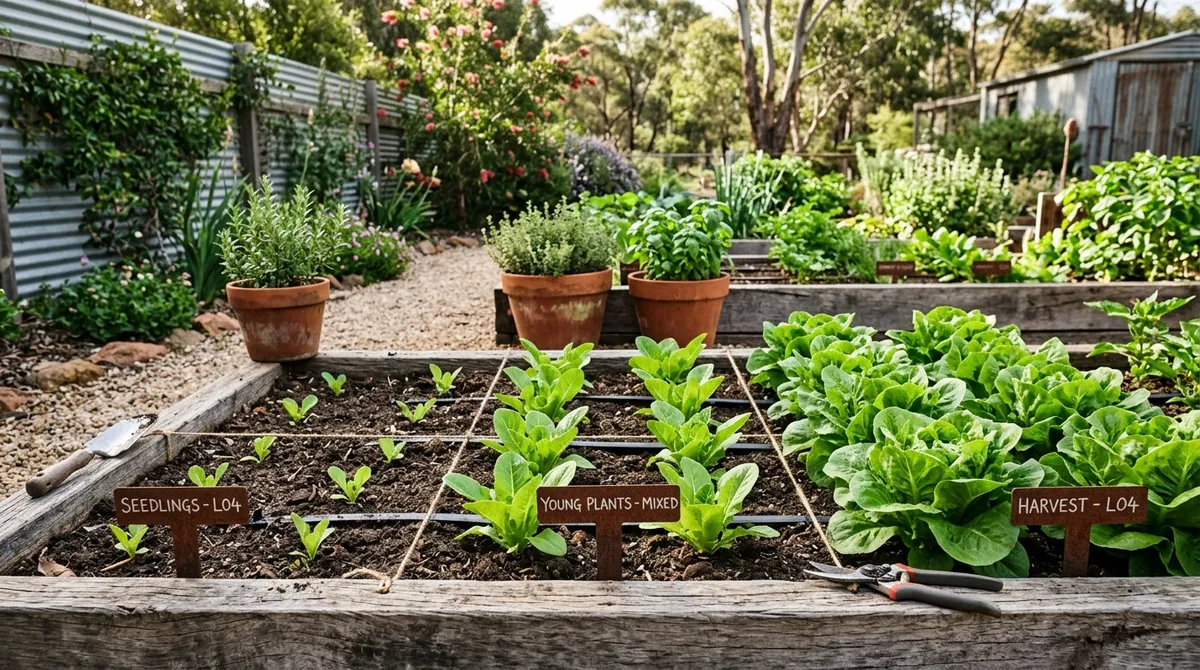
Method 1: Single row or bed, rolling harvest. Plant one 5-metre row of lettuce. Mark four sections (1.2m each). Sow section 1 on day 1. Sow section 2 on day 14. Sow section 3 on day 28. Sow section 4 on day 42. By day 45, section 1 is harvestable. You harvest continuously for the next 120 days.
Method 2: Relay planting into the same space. When lettuce finishes (80 days), pull it out immediately and sow beans in the same bed. Beans finish (55 days), pull them out and plant spinach (45 days). Three crops in one bed in 180 days. This requires tight timing but maximizes productivity.
Method 3: Staggered pots or containers. Sow lettuce in a container. Every 2 weeks, sow another pot. By week 6, you have three productive pots harvesting at different stages. Perfect for balconies and small courtyards.
A Practical Month-by-Month Succession Schedule for SEQ
This schedule assumes you want continuous lettuce and fast crops. Adjust based on what you like eating and available space.
January: Sow lettuce (mid-month). Sow radish (beginning and mid-month). Plant established bean seedlings from nursery for quick summer pods. Air temperature 25-30°C, soil warm. Fast growth.
February: Sow next lettuce round (mid-month). Sow carrot. Sow chillies and capsicums for autumn production. January lettuce harvests throughout month.
March: Sow lettuce (mid-month). Sow radish. Plant beans (they like cooling temperatures coming). February lettuce finishes. Carrot is growing (still too young to harvest).
April: Sow lettuce (mid-month). Sow spinach and rocket (they prefer cooling). March lettuce is harvesting. Beans flower. Carrot still growing. Best succession window opens now.
May: Sow lettuce (mid-month). Sow peas (critical window). Sow rocket and spinach. April lettuce is harvestable. Winter is starting, growth slows.
June: Sow lettuce (early month, winter slows germination). Sow spinach and rocket. Hold off beans (too cold). Peas sown in May are flowering. May lettuce is harvestable but slower than summer.
July: Sow lettuce (early month). Sow peas (last window). Sow spinach. Growth is slowest now (5-10°C nights). Expect 70-80 day maturity for lettuce.
August: Sow lettuce (early-mid month). Sow radish (beginning). Sow beans (season starting to warm). Peas planted in July are harvesting. Prepare ground for hot season ahead.
September: Sow lettuce (only early month, heat returning). Sow carrot. Sow chillies and capsicums (critical window). Beans are productive. Radish planted in August is harvesting. Stop succession lettuce now (too hot).
October: Stop succession planting lettuce (heat kills it by November). Sow carrot (mid-month). Beans continue. Prepare for November planting of warm-season crops.
November: Plant established seedlings (tomatoes, capsicum, basil). Resume lettuce succession (early month, soil warming). Beans finish. Ground is warming toward summer.
December: Sow lettuce (early month only). Sow radish (early month). Warm season crops (tomato, capsicum, chilli, basil) are growing. Succession window for cool-season crops is closing. January begins the cycle again.
Relay Planting: The Advanced Technique
Relay planting sows a second crop into the same bed while the first crop is still finishing. This maximizes bed productivity in limited space.
Example: Plant beans in spring (September). By early December (90 days later), beans are declining in heat and flowering slows. Plant lettuce seedlings between the remaining bean plants 4 weeks before bean harvest. When beans finish completely, lettuce is established and taking over. This uses the same bed three times per year (peas-beans-lettuce, for example) instead of once.
Timing is critical: Sow the relay crop 2-3 weeks before the main crop finishes, so the relay is established when you rip out the main crop. If you're a week late, the relay crop gets shaded and grows slow.
Relay planting vs succession: Succession means sowing the same crop multiple times in different areas or containers. Relay means sowing different crops into the same bed on a tightly planned schedule. Most home gardeners use succession (easier to manage). Market gardeners use relay (space-efficient).
Tracking Plantings for Success
Success requires tracking. Without records, you'll forget when you last planted lettuce and suddenly have all lettuce ripening simultaneously again.
Simple tracking: Mark planting dates on a calendar. Write the crop, planting date, and expected harvest date. Keep a garden notebook beside the bed. Take photos of new plantings so you remember what's where.
Better tracking: Use the Planting Season app. It logs planting dates, tracks days to harvest, and sends reminders when the next planting is due. After one year, you'll see patterns in your garden and predict harvests accurately.
Temperature Effects on Growth Rate
Growth speed varies dramatically by season. Lettuce sown in January grows in 35 days. The same variety sown in June takes 70 days due to cold, short days, and slow soil. Adjust succession intervals based on temperature.
Summer (November to February): Lettuce every 2 weeks, radish every 2 weeks, beans every 4 weeks.
Shoulder (March to April, August to October): Lettuce every 2 to 3 weeks (growth slowing), beans every 4 to 5 weeks.
Winter (May to July): Lettuce every 3 to 4 weeks (cold slows germination and growth), radish every 3 weeks, peas every 4 weeks.
Dealing With Pest and Disease Cycles
Succession plantings of the same crop can concentrate pests and diseases. If lettuce suddenly gets aphids, all lettuce plantings are at risk.
Prevention: Rotate crop families when possible. If lettuce finishes, plant beans (different family) in the same bed rather than more lettuce. This breaks pest cycles.
Isolation: Plant different crop families in different areas. Lettuce in one bed, beans in another. If lettuce gets disease, beans are unaffected.
Timing management: If a succession planting looks diseased, remove it immediately and rip out the previous planting's residue. Skip that crop for two months before replanting.
Frequently Asked Questions
What's the difference between relay planting and succession planting?
Succession planting means sowing the same crop multiple times on the same date interval (e.g., lettuce every 2 weeks). Relay planting means sowing a second crop into the same bed while the first crop is still finishing (e.g., lettuce finishing, then beans planted in the same spot). Both stagger harvests. Succession keeps the same crop flowing. Relay extends productivity of the bed itself by using the space efficiently. Most home gardens use succession (multiple sowings of lettuce) rather than relay (complex to time correctly), but relay is valuable for small spaces.
How do I know when to sow the next round if my lettuce is slow to grow?
Temperature controls growth speed. Lettuce sown in warm months (November to February) grows fast (35 to 40 days). The same variety sown in cool months (May to August) grows slow (60 to 75 days). Follow the calendar guide in this article, but adjust for your microclimate. If lettuce is slow, delay your next sowing 1 to 2 weeks until temperatures warm. Track planting and harvest dates in a garden journal. After one cycle, you'll know your exact intervals. The Planting Season app logs dates automatically and learns your garden patterns.
Can I succession plant in the same bed if pests or disease hit one crop?
Yes, but carefully. If brassicas (cabbage, broccoli) get clubroot, avoid planting more brassicas in that bed for 2-3 years. If beans get root rot from wet soil, improve drainage before replanting beans. If lettuce bolts in heat, skip planting more lettuce in hot months. Use succession planting to rotate different crop families. For example, plant brassicas for winter, then beans for spring, then lettuce for autumn. This breaks pest and disease cycles while keeping beds productive year-round.
Free Monthly Planting Calendar
Get a personalised email each month with what to plant, seasonal tips, and harvest reminders for your region.
We send one email per month. Unsubscribe any time.