
What's Wrong With My Plant?
Diagnose common plant problems in South East Queensland. Identify yellow leaves, wilting, holes, spots, and other symptoms with this visual troubleshooting guide.
Start with what you can see. Do not guess. Push your finger into the soil. Check leaf undersides for insects. Look for patterns. Yellow leaves that start at the bottom are different from yellow leaves everywhere. Wilting plants that have wet soil are different from wilting plants in dry soil. Work from symptom to diagnosis, and the fix will become obvious.
| Symptom | Likely Cause | What To Do |
|---|---|---|
| YELLOW LEAVES | ||
| Lower and older leaves yellow first, new growth normal | Nitrogen deficiency or natural ageing | Feed with liquid fertiliser (seaweed or fish emulsion) weekly for 3 weeks. Remove old yellow leaves. If plant is 3+ months old, yellowing of oldest leaves is normal as it redirects nitrogen to new growth. |
| All leaves yellowing at once | Overwatering or poor drainage | Check soil moisture. Push your finger 5 cm deep. If wet, stop watering. Improve drainage by adding mulch and organic matter. In clay soil, consider raised beds. Root rot may be fatal if roots are black and mushy. |
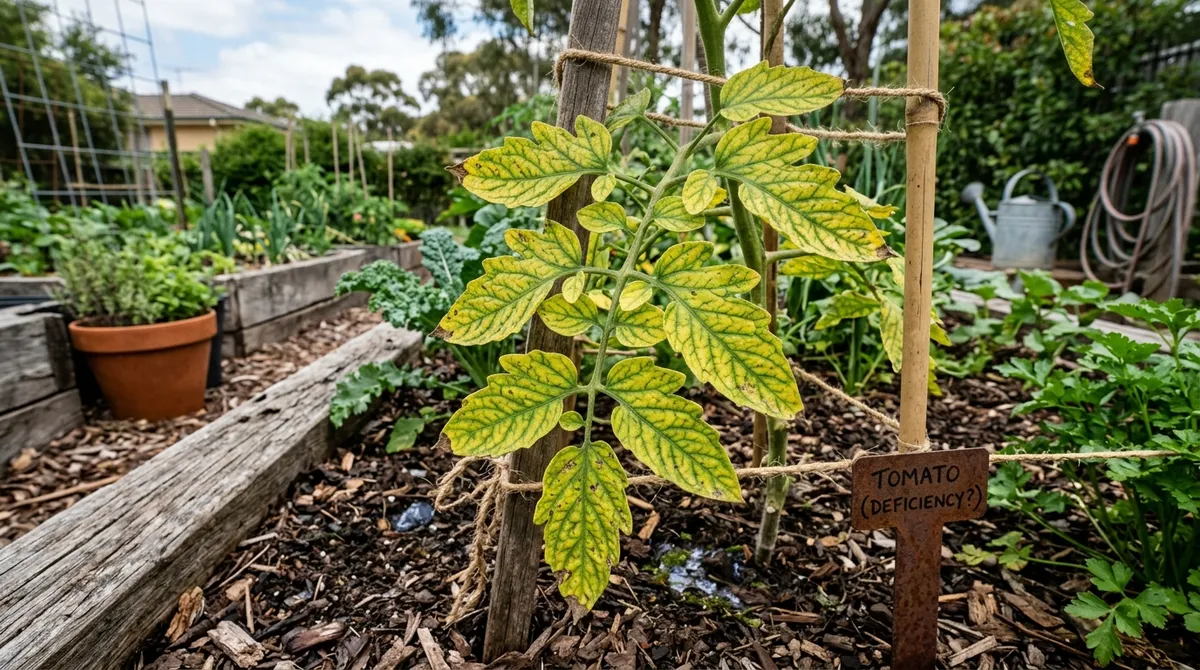
| Yellow between leaf veins, veins stay green | Iron or magnesium deficiency | Apply trace elements or Epsom salts (magnesium). Mix 1 tablespoon Epsom salts per litre of water and spray foliage weekly for 3 weeks. More common in alkaline or very wet soils. |
| New growth yellow, older leaves normal | Iron deficiency (common in alkaline soil) | Apply chelated iron. Check soil pH if possible. Iron becomes locked in alkaline soil. Add sulphur to acidify soil slightly over time, or use iron chelate spray. |
| WILTING | ||
| Wilting in afternoon, recovers by evening or overnight | Heat stress (normal in SEQ summer) | Mulch heavily (7 cm). Water in morning. Shade cloth helps if wilting persists. This is common and not serious if plant recovers. Wilt on hot days does not mean the plant is dying. |
| Wilting despite wet soil | Root rot from overwatering | Stop watering immediately. Improve drainage. If in a pot, repot into fresh soil. If in ground, may not recover. Healthy roots are white and firm. Black, mushy roots are dead. |
| Wilting with dark, mushy stem base | Fungal wilt disease | Pull and destroy plant immediately. Do not compost as fungus survives in soil. Rotate crops. Common in tomato after wet seasons. No cure once infected. |
| Sudden wilt, one side of plant only | Bacterial wilt | Pull and destroy plant. Do not compost. Rotate crops next season. Common in tomatoes after heavy rain. Spread by insects. No chemical treatment works. |
| HOLES IN LEAVES | ||
| Large irregular holes, chewed leaf edges | Caterpillars (cabbage moth, armyworm) | Hand-pick caterpillars and remove affected leaves. Dipel (Bt spray) works on young caterpillars on brassicas. Check leaf undersides. Use row covers to prevent moths from laying eggs. |
| Small round holes in leaves, no pest visible | Flea beetles | Usually cosmetic. Healthy plants outgrow damage. Remove affected leaves. Blast foliage with water to dislodge. Row covers prevent egg-laying. |
| Holes with obvious slime trails on plant | Slugs or snails | Beer traps work well. Iron-based pellets safe for edibles. Water in morning, not evening, to reduce slug activity. Hand-pick at night. Remove mulch piles where they hide. |
| Leaf appears lace-like or skeletonised | Leaf-eating beetles | Hand-pick beetles. Neem oil spray if severe. Encourage beetles' natural predators (spiders, ground beetles) by avoiding broad-spectrum pesticides. |
| SPOTS ON LEAVES | ||
| Brown or black spots with yellow halo | Fungal leaf spot | Remove affected leaves. Improve airflow between plants. Avoid overhead watering. Copper spray weekly. Do not compost diseased leaves. Common in humid SEQ conditions. |
| White powdery coating on leaves | Powdery mildew | Milk spray works well. Mix 1 part milk to 9 parts water and spray foliage weekly. Improve airflow. Reduce night humidity. In severe cases, use sulphur spray. |
| Rusty orange spots on leaf undersides | Rust fungus | Remove affected leaves. Do not wet foliage. Improve airflow. Copper spray weekly. Rust loves humidity and poor air movement. Thinning the plant helps. |
| Dark water-soaked spots, greasy appearance | Bacterial spot | Remove affected parts and dispose of them (do not compost). Copper spray works but will not cure the plant. Avoid overhead watering. No full cure exists. Often requires removing the plant. |
| NO FLOWERS OR FRUIT | ||
| Lots of leaves, lots of flowers, no fruit | Too much nitrogen | Stop feeding. Switch to potassium-rich fertiliser (tomato food or similar). Nitrogen promotes leaves at the expense of flowers. Reduce watering slightly to stress the plant a little. This takes 2 to 3 weeks to correct. |
| Flowers present but dropping without setting fruit | Poor pollination | Hand-pollinate with a small brush. Plant flowers to attract bees. Tomato flowers sometimes drop in heat or humidity stress. Wait for temperatures to stabilise. Lack of bees is the real problem, so grow bee flowers nearby. |
| Flowers dropping, no fruit set | Temperature stress or humidity | Wait for conditions to stabilise. In extreme heat above 35 degrees Celsius, shade cloth helps. In high humidity, improve airflow. Flower drop in these conditions is normal and not permanent. |
| Fruit dropping before ripe | Water stress or fruit fly damage | Check watering consistency. Inconsistent water causes fruit drop. If you see tiny holes in fruit, fruit fly is present. Use traps. May need to cull damaged fruit to prevent fly spreading. |
| STUNTED GROWTH | ||
| Slow growth, pale leaves, small plant overall | Nutrient deficiency (general) | Feed with complete organic fertiliser (NPK ratio). Check soil pH if possible. Compacted soil reduces nutrient uptake. If soil is hard, loosen it and add organic matter. |
| Stunted growth, distorted leaves, tiny insects visible | Aphids or spider mites | Blast with strong water stream. Neem oil spray if persistent. Encourage ladybirds and predatory mites by avoiding pesticides. Yellow sticky traps help monitor populations. |
| Stunted growth, roots knotted and deformed | Root-knot nematode | Pull and destroy plant. Plant marigolds in the area next. Nematodes are killed by heat and sunlight. Solarising soil (covering with clear plastic for 6 weeks in summer) helps. Rotate crops. |
| Seedlings not growing, staying small and pale | Compacted soil or wrong planting season | Loosen soil and add organic matter if starting new bed. Check if you are planting outside the right season. Seedlings started in wrong season never catch up. Start fresh with correct timing. |
Before you treat an insect problem, make sure the insect is a pest. Ladybird larvae, hoverflies, lacewings, assassin bugs and predatory mites all eat pests, and some look like the pests they eat. Our Good Bugs vs Bad Bugs photo guide shows them side by side.
Frequently Asked Questions
How do I know what is wrong with my plant?
Start with what you can see. Yellow leaves? Check if it is older leaves (nitrogen deficiency) or all leaves (overwatering). Holes in leaves? Look for caterpillars on leaf undersides or small round holes from flea beetles. Wilting? Push your finger into the soil. If wet, root rot. If dry, underwatering. Spots? Check if they have a yellow halo (fungal) or are water-soaked (bacterial). Work from symptom to diagnosis.
Should I use chemical spray on all plant problems?
No. Many problems are cultural (overwatering, poor drainage, wrong planting time) and sprays will not fix them. Always address the root cause first. Overwatering causes more plant deaths than pests. Poor drainage causes root rot. Wrong season causes bolting. Only use spray after you have fixed the environment. Dipel (Bt spray) is safe for brassicas. Copper spray works for fungal diseases. Neem oil for mites and soft insects.
When should I remove a plant and give up on it?
Remove a plant if it has fungal wilt disease (dark, mushy stem base with sudden wilting), bacterial wilt (one side wilts suddenly), or severe root-knot nematode damage (stunted growth and knotted roots). Do not compost these plants as the disease survives in soil. Bury them or burn them. Rotate crops in that location next season. Pull and remove any plant that is more than 30 percent dead or diseased.
Free Monthly Planting Calendar
Get a personalised email each month with what to plant, seasonal tips, and harvest reminders for your region.
We send one email per month. Unsubscribe any time.