
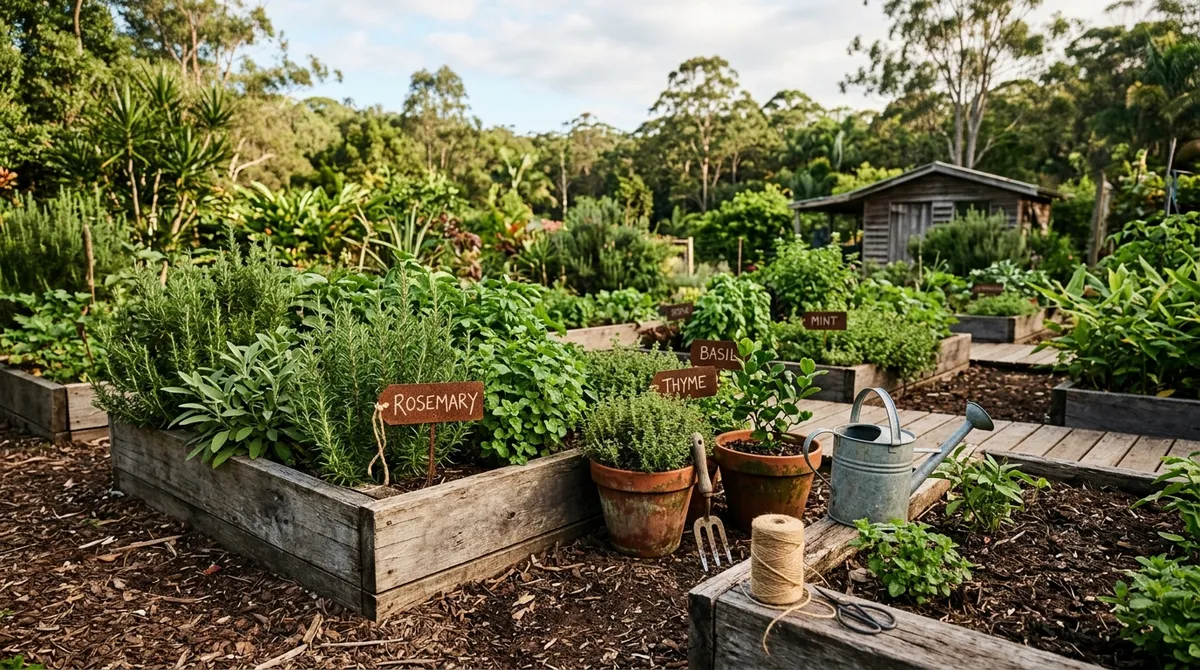
Growing Herbs in the Northern Rivers
Tropical basil, turmeric, ginger, lemongrass, and managing herbs in subtropical humidity
The Northern Rivers lets you grow tropical herbs that fail in most Australian gardens. Turmeric, ginger, galangal, lemongrass, and tropical basil varieties all thrive in the warm, humid conditions between Byron Bay and Casino. The region's long frost-free season (year-round on the coast, 9-10 months in the hinterland) gives these heat-loving crops the extended growing period they need.
The challenge is humidity. Mediterranean herbs like rosemary, thyme, and oregano can suffer root rot and fungal diseases in the wet season. The solution is separating your herb garden into two zones: tropical herbs in the ground, Mediterranean herbs in raised beds or pots with excellent drainage.
Tropical Herbs That Thrive
Turmeric (Curcuma longa)
Turmeric is perfectly suited to the Northern Rivers. The warm soil, regular rainfall, and long growing season produce large, intensely coloured rhizomes. Commercial turmeric farms operate around Nimbin, Lismore, and the Tweed Valley, taking advantage of the same conditions your backyard offers.
Plant rhizomes in September or October, 5-8 centimetres deep, with growing buds (eyes) facing upward. Space them 30 centimetres apart in rich, well-composted soil. Turmeric grows to 1 metre tall with attractive broad leaves and occasional white flowers. It handles full sun on the coast and benefits from afternoon shade in hotter hinterland areas. Water consistently through summer; turmeric is a tropical plant that dislikes dry conditions.
Harvest in May or June when the foliage yellows and dies back. Dig the entire clump with a fork. A single planted rhizome typically produces 1-2 kilograms of fresh turmeric. Store fresh rhizomes in the fridge for 2-3 weeks, freeze for longer storage, or dry and grind for powder. Save a few rhizomes for replanting the following spring.
Ginger (Zingiber officinale)
Ginger grows alongside turmeric with the same planting and harvesting schedule. Plant rhizomes in September or October in rich, moist soil. Each piece should have at least 2-3 growing buds. Space 30-40 centimetres apart. Ginger grows to 60-90 centimetres tall and prefers part shade, especially in summer.
The Buderim variety is the Australian standard, developed for subtropical conditions. It produces plump, pale-skinned rhizomes with strong flavour. Harvest young ginger from March (tender, mild flavour for pickles and stir-fries) or mature ginger in May to June (more fibrous, stronger flavour for cooking and tea). A single planted piece yields 500 grams to 1 kilogram.
Lemongrass (Cymbopogon citratus)
Lemongrass is one of the easiest tropical herbs for the Northern Rivers. It grows in dense clumps to 1.5 metres tall and produces an endless supply of fragrant stalks for Thai and Vietnamese cooking. Plant a division or a stalk from the supermarket (place in water until roots form, then plant out). Full sun, reasonable soil, and regular water are all it needs.
Harvest outer stalks by pulling them away from the base of the clump. The white, bulbous base of each stalk is the part used in cooking. Lemongrass is a perennial in the Northern Rivers and produces year-round, though growth slows in winter. Divide large clumps every 2-3 years. The foliage also makes excellent mulch material.
Tropical Basil Varieties
Standard sweet basil (Genovese) struggles in the Northern Rivers' wet season, succumbing to downy mildew and fusarium wilt. Tropical basil varieties are resistant to these problems and produce strongly flavoured leaves year-round.
- Thai basil (Ocimum basilicum var. thyrsiflora): Anise-flavoured, sturdy stems, purple flowers. Essential for Thai curries and stir-fries. Far more disease-resistant than sweet basil in humid conditions.
- Holy basil (Ocimum tenuiflorum): Peppery, clove-like flavour. Sacred in Thai cooking (pad kra pao). Extremely heat and humidity tolerant. Grows as a short-lived perennial in the Northern Rivers.
- African blue basil: A sterile hybrid that grows as a perennial shrub. Does not go to seed, so it produces leaves continuously. Strong camphor-basil flavour. Excellent bee plant.
- Cinnamon basil: Sweet, cinnamon-scented leaves. Good disease resistance. Use in desserts, teas, and Asian cooking.
Mediterranean Herbs: Managing Humidity
Rosemary, thyme, sage, and oregano are valuable kitchen herbs, but they evolved in dry, rocky Mediterranean conditions. The Northern Rivers' wet season (November to March, with 150-300 millimetres of rain per month) can kill them through root rot.
- Raised beds and containers: Grow Mediterranean herbs in raised beds filled with a fast-draining mix (50 percent potting mix, 25 percent coarse sand, 25 percent perlite). Containers work even better because you can move them under cover during prolonged wet weather.
- Position: Full sun, maximum airflow, and northern aspect. Avoid planting against walls or fences where air stagnates and humidity builds.
- Pruning: Keep plants compact and well-pruned to promote airflow through the canopy. Dense, bushy growth traps moisture and promotes fungal disease.
- Cover during heavy rain: A simple clear corrugated roof over a raised herb bed keeps rain off while allowing light through. This single step prevents most humidity-related problems.
Year-Round Herb Calendar
The Northern Rivers lets you grow fresh herbs 12 months of the year with the right species selection.
Spring (September to November): Plant turmeric, ginger, and galangal rhizomes. Sow basil seeds (tropical varieties). Divide lemongrass clumps. Plant Vietnamese mint divisions.
Summer (December to February): Harvest tropical herbs regularly. Basil, lemongrass, and Vietnamese mint are at peak production. Protect Mediterranean herbs from excessive rain. Sow perennial coriander (Eryngium foetidum) in a shaded position.
Autumn (March to May): Harvest turmeric and ginger rhizomes. Sow parsley, dill, and chervil for winter production. Mediterranean herbs recover as humidity drops. Curry leaf tree produces new growth.
Winter (June to August): Harvest rosemary, thyme, sage, and oregano (peak quality in drier months). Parsley and coriander thrive in cool weather. Lemongrass slows growth but remains harvestable. Plan next season's turmeric and ginger planting.
Other Tropical Herbs to Try
- Galangal (Alpinia galanga): A ginger relative with a sharper, more peppery flavour. Essential for Thai soups (tom kha gai). Grow exactly like ginger. Produces large clumps over several years.
- Vietnamese mint (Persicaria odorata): Peppery, coriander-like flavour. Grows in wet, partly shaded positions. Spreads vigorously; contain in a pot or bounded bed. Harvested year-round.
- Curry leaf tree (Murraya koenigii): Fresh curry leaves are essential in South Indian cooking and impossible to replicate with dried leaves. The tree grows to 3-5 metres in the Northern Rivers and produces fragrant leaves year-round. Plant in a warm, sheltered position. Frost-sensitive in the hinterland.
- Perennial coriander (Eryngium foetidum): Looks different from annual coriander but delivers a similar flavour. Tolerates heat and humidity far better than standard coriander, which bolts rapidly in the Northern Rivers' warm conditions. Grows in part shade.
Track Your Herb Garden
Get seasonal reminders for planting and harvesting herbs in the Northern Rivers.
Open the Planting Season AppFrequently Asked Questions
What herbs grow best in the Northern Rivers?
The Northern Rivers excels at tropical and subtropical herbs. Turmeric, ginger, galangal, lemongrass, Vietnamese mint, tropical basil varieties (Thai basil, holy basil, cinnamon basil), perennial coriander (Eryngium foetidum), and curry leaf tree all thrive. Mediterranean herbs like rosemary, thyme, and oregano also grow well but need excellent drainage and full sun to prevent root rot in wet periods.
Can I grow turmeric and ginger in the Northern Rivers?
The Northern Rivers is one of the best places in Australia for turmeric and ginger. Both are tropical rhizomes that need warm soil, consistent moisture, and 8-10 months of frost-free growing. Plant rhizomes in September or October in rich, well-drained soil with plenty of compost. Harvest in May to June when the foliage dies back. A single turmeric rhizome can produce 1-2 kilograms of fresh root in a season.
Why does my basil get fungal disease in the Northern Rivers?
High humidity from November to March promotes downy mildew and fusarium wilt in basil. Sweet Genovese basil is the most susceptible variety. Switch to tropical basil types (Thai basil, holy basil, African blue basil) that have stronger resistance to humidity-related diseases. Space plants widely for airflow, water at the base, and avoid overhead watering. Growing basil under a covered area during the wet season helps significantly.
How do I manage herbs during the Northern Rivers wet season?
The wet season (November to March) challenges Mediterranean herbs and can cause root rot in poorly drained soil. Grow rosemary, thyme, sage, and oregano in raised beds or containers with free-draining potting mix. Position them under eaves or a covered growing area during heavy rain periods. Tropical herbs (turmeric, ginger, lemongrass, Vietnamese mint) handle the wet season without problems because they evolved in similar conditions.
Free Monthly Planting Calendar
Get a personalised email each month with what to plant, seasonal tips, and harvest reminders for your region.
We send one email per month. Unsubscribe any time.